



Here’s a harsh truth: the average dropshipper wastes $2,500 on failed products before finding their first winner.
That’s money spent on ads, product samples, and inventory that never converts into sales.
It’s a painful, and expensive, learning curve!
But what if there was a better way?
What if entrepreneurs could validate product demand before spending a dime?
The reality is, successful dropshippers don’t rely on gut feelings or chase shiny trends.
They use data.
They research.
And most importantly, they validate demand before investing.
In this comprehensive guide, you’ll discover five powerful tools that successful dropshippers use to research product demand, analyze competition, and identify winning products before making any financial commitment.
These aren’t just theoretical tools, these are battle-tested resources that have helped thousands of entrepreneurs build profitable dropshipping businesses.
Whether you’re a complete beginner or looking to launch your next product line, these free tools will give you the competitive edge needed to succeed.
Let’s dive in and discover how to make data-driven decisions that actually move the needle!
By the end of this article, you’ll have a complete framework for validating products with confidence, minimizing risk, and maximizing your chances of dropshipping success.
Let’s get started!
1. Why Product Demand Research Is Critical for Dropshipping Success
Here’s something most people don’t want to hear when they’re excited about starting a dropshipping store: the success rate hovers around 10-20%, which means about 80-90% of people who jump into this fail.
That’s brutal, right?
And honestly, the biggest reason stores tank isn’t bad luck or timing.
It’s picking the wrong products.
You can have the prettiest website and killer social media presence, but if nobody wants what you’re selling, you’re toast.
Think about your friend who spent two grand on Facebook ads promoting some random gadget they thought was “cool.”
Three months later, they had maybe five sales and were out thousands of dollars.
That’s not an isolated story, that’s the norm when people skip the research phase and just wing it.
The financial hit goes way beyond the ad money too.
There’s your time, which you’ll never get back.
There’s the opportunity cost of what else you could’ve been doing.
And if you’re pre-ordering inventory or paying for tools and apps, those costs pile up fast.
One study looking at 500 e-commerce startups found that businesses who spent their first $10,000 on advertising before validating their products had only a 23% success rate, while those who validated first had a 67% success rate.
Let me say that again, you can almost triple your odds of success just by doing basic demand research before you start throwing money at ads.
Demand research gives you something most beginners don’t have: actual data.
You’re not guessing whether people want your product.
You’re seeing real search volume, real competitor sales, real interest.
It’s the difference between gambling and making an educated bet.
Now here’s where it gets interesting, the whole trending versus evergreen debate.
Trending products are tempting as hell.
You see someone making $50k in a month selling the latest viral gadget and think “I want that.”
But trending products are like fireworks. Bright, exciting, then gone.
Remember when everyone and their grandma was selling fidget spinners?
For about three months in 2017, people were printing money.
Then the trend died, and thousands of sellers got stuck with inventory nobody wanted.
Trending products can work if you catch them early, but if you’re even a week late, you’re competing with hundreds of other stores selling the exact same thing.
Evergreen products are the opposite.
These are the boring items people need year-round. Phone chargers. Yoga mats. Pet supplies. Kitchen organizers.
According to industry data, these items rarely see big changes in demand and usually bring better profit margins because they stay relevant in the market.
Nobody’s gonna get rich quick selling reusable water bottles, but they’re also not gonna go out of business when the trend dies because there is no trend.
People always need water bottles.
Let’s talk real success stories, because this stuff actually works when done right.
Irwin Dominguez from San Diego hit $1,000,000 in sales within eight months of starting his dropshipping business.
What did he do differently?
He validated his products before scaling and mastered Facebook advertising to reach the right people. He didn’t just throw products at the wall hoping something would stick.
Or take the person who documented their journey and shared the brutal truth, they went from $643 in their first month to $25k a month with 40% profit margins after figuring out which products their audience actually wanted.
That transformation didn’t happen because they got lucky.
It happened because they stopped selling random stuff and started selling what people were actively searching for.
Here’s a myth that needs to die: “You need expensive tools to do product research.”
Nope.
Google Trends is free.
Amazon’s bestseller lists are free.
Reddit communities where your target customers hang out? Also free.
Sure, paid tools can speed things up, but you can validate a product idea without spending a dime if you know where to look and what questions to ask.
The other big myth? “Research takes too long.”
You know what takes longer?
Wasting three months and $5,000 on a product that never had a chance.
Proper research might take 10-20 hours for a solid product.
Compare that to the months you’ll waste failing with the wrong one, and suddenly those 20 hours seem like a bargain.
Here’s the ROI that should wake everyone up.
After auditing thousands of PPC accounts, one agency found that the average business is wasting 76% of its ad spend on clicks with no real chance of converting.
That’s not a typo.
Three-quarters of the money businesses spend on ads is going down the drain because they’re promoting the wrong products to the wrong people.
Think about that for a second.
If you’re spending $1,000 on ads, $760 of it is probably wasted if you haven’t validated your product first.
But if you spend 10-20 hours doing research upfront, you could cut that waste dramatically and put your money toward products people actually want.
The difference between dropshippers who make it and those who don’t usually comes down to one thing: patience.
The successful ones didn’t rush. They researched. They validated.
They tested small before going big.
The ones who failed? They jumped in headfirst, picked products based on gut feeling, and wondered why nobody was buying.
Product demand research isn’t sexy.
It’s not gonna give you that dopamine rush of launching your store or seeing your first ad go live.
But it’s literally the foundation everything else sits on.
Skip it, and you’re building your business on sand.
Do it right, and you’ve got concrete under your feet.
You’ve got two paths here.
Spend 10-20 hours researching and validating your product, or spend months and thousands of dollars learning the painful way that you picked wrong.
One of those paths is way smarter than the other.
Tool #1 – Google Trends: Uncovering Search Volume and Seasonal Patterns
Google Trends is basically your crystal ball for dropshipping, and here’s the kicker, it’s completely free.
While other sellers are guessing which products to sell based on gut feeling or what they saw on TikTok last week,
You can be looking at real data showing exactly what people are searching for right now.
Recent research analyzed nearly 200 publicly traded retailers and found something wild:
Google search trends can predict retail sales up to three quarters in advance.
That’s nine months of foresight sitting in a free tool that most people ignore.
When search volumes go up for a product, revenues follow, often way before Wall Street analysts or investors even notice.
So what exactly is Google Trends?
It’s a tool that shows you how often people search for specific terms over time.
Instead of giving you exact numbers like “47,293 searches,” it uses a scale from 0-100 to show relative interest.
A score of 100 means that term hit peak popularity during your selected timeframe.
A score of 50? Half as popular. Zero means there wasn’t enough data.
Let’s walk through how to actually use this thing step-by-step, because it’s not as complicated as people make it seem.
First, head to trends.google.com and type in your product idea.
Let’s say you’re thinking about selling “resistance bands.” Type that in.
Right away, you’ll see a graph showing interest over time. This is where things get interesting.
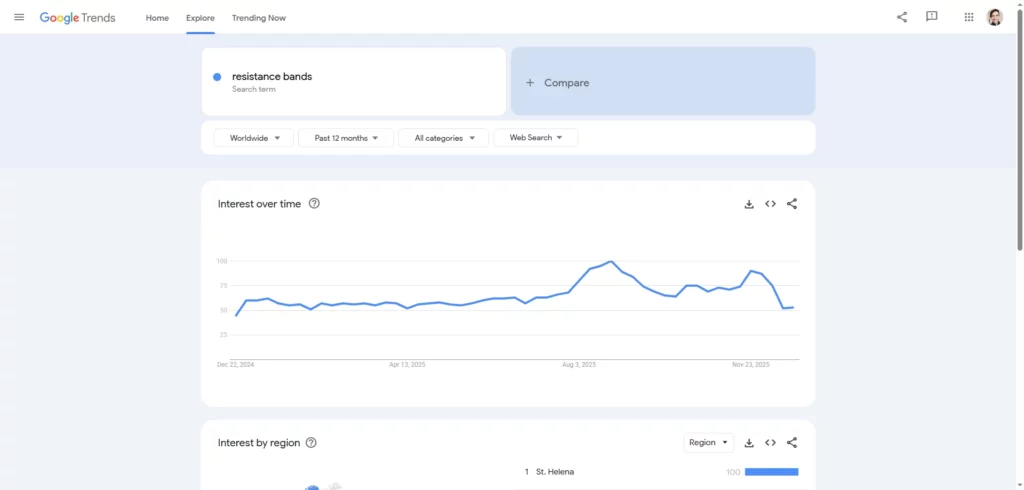
The “interest over time” graph is your roadmap. You’re looking for specific patterns here.
An upward trend, where the line keeps climbing over months or years, means demand is growing.
People want this product more now than they did before. That’s gold.
A flat, stable line? That’s an evergreen product.
Boring but reliable, kinda like a Toyota Camry. People consistently need it year-round.
But watch out for downward trends.
If that line’s been dropping for the past year, you’re looking at a dying product.
Don’t be the person who jumps into fidget spinners in 2018, two years after everyone moved on.
Here’s where it gets really useful, the geographic data. Scroll down and you’ll see a map showing which states or countries search for your product the most.
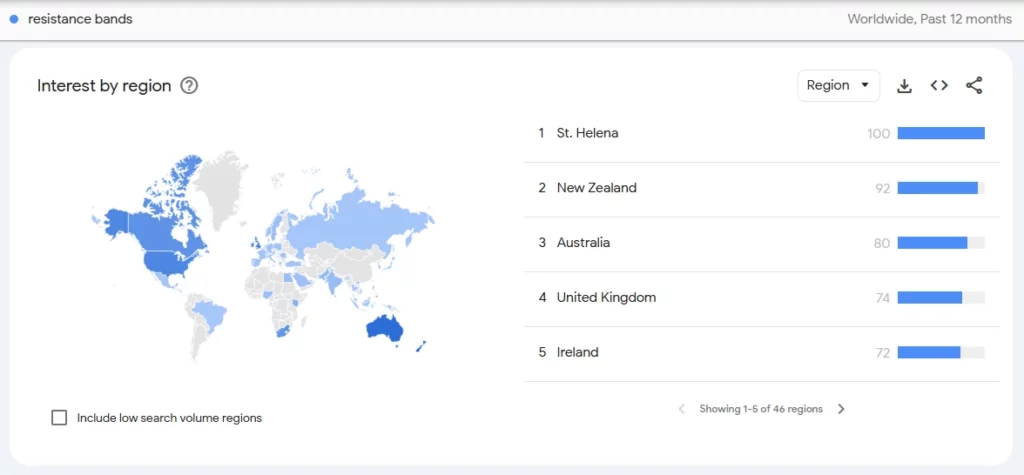
Let’s say you see that “resistance bands” are super popular in ST, Helena, New Zealand, and Australia.
Boom, now you know exactly where to target your Facebook ads.
Why waste money showing ads to people in states where nobody cares about your product?
Most retailers experience massive sales spikes in November, with orders running 29% higher than the annual average, driven by Black Friday and Cyber Monday.
But here’s what people miss, September is actually a top-3 volume month for many stores without requiring holiday-level discounting.
You can use Google Trends to spot these patterns and time your product launches perfectly.
One of the best features people sleep on is comparing multiple products at once.
You can add up to five search terms and see them stacked against each other.
This is huge when you’re trying to decide between product options.
For example, compare “yoga mat,” “resistance bands,” “dumbbells,” “kettlebell,” and “foam roller.” You’ll instantly see which one has the highest search interest.
You’re not guessing anymore, you’re looking at what thousands of people are actively searching for right now.
The “related queries” section at the bottom is pure gold for finding complementary products.
When you search “yoga mat,” you might see related searches like “yoga blocks,” “yoga strap,” or “yoga mat cleaner.” These are products your customers are already looking for.
You just discovered four more products to add to your store without doing any extra research.
Seasonality is another game-changer you need to understand.
Some products have clear seasonal patterns that repeat every year.
Search for “Christmas decorations” and you’ll see massive spikes in October through December, then it crashes in January.
E-commerce sales can drop up to 30% during summer months compared to December’s peak.
If you’re selling purely seasonal products, you better have a plan for those dead months.
Smart dropshippers mix seasonal products with evergreen ones so they’re not scrambling for cash in February and March when customers are recovering from holiday spending and focused on paying off debt.
Now let’s talk red flags, the warning signs that should make you run away from a product fast.
Red flag number one: declining trends.
If the graph shows consistent downward movement over six months to a year, that product’s dying. People are losing interest.
Yeah, you might catch a small bounce, but why fight an uphill battle?
Red flag number two: extreme volatility.
If you see a graph that looks like a heart rate monitor, spiking up and crashing down repeatedly, that’s usually a red flag.
Unless you’re specifically planning to catch a trend early, these rollercoaster products are risky.
You might launch right as the spike crashes.
Red flag number three: one-hit wonders.
These are products with one massive spike in the past, then nothing.
Remember Pokemon Go in summer 2016?
That spike on Google Trends was insane, then it fell off a cliff.
Products tied to specific events, viral moments, or trends often follow this pattern.
You want steady growth or at least stability, not one massive spike that’ll never repeat.
Let’s talk pro tips for getting the most out of Google Trends.
These are the things that separate beginners from people who actually know what they’re doing.
Use specific date ranges. Don’t just look at the default “past 12 months.” Toggle between different timeframes.
Check the past 5 years to see long-term trends, then zoom into the past 90 days to see what’s happening right now.
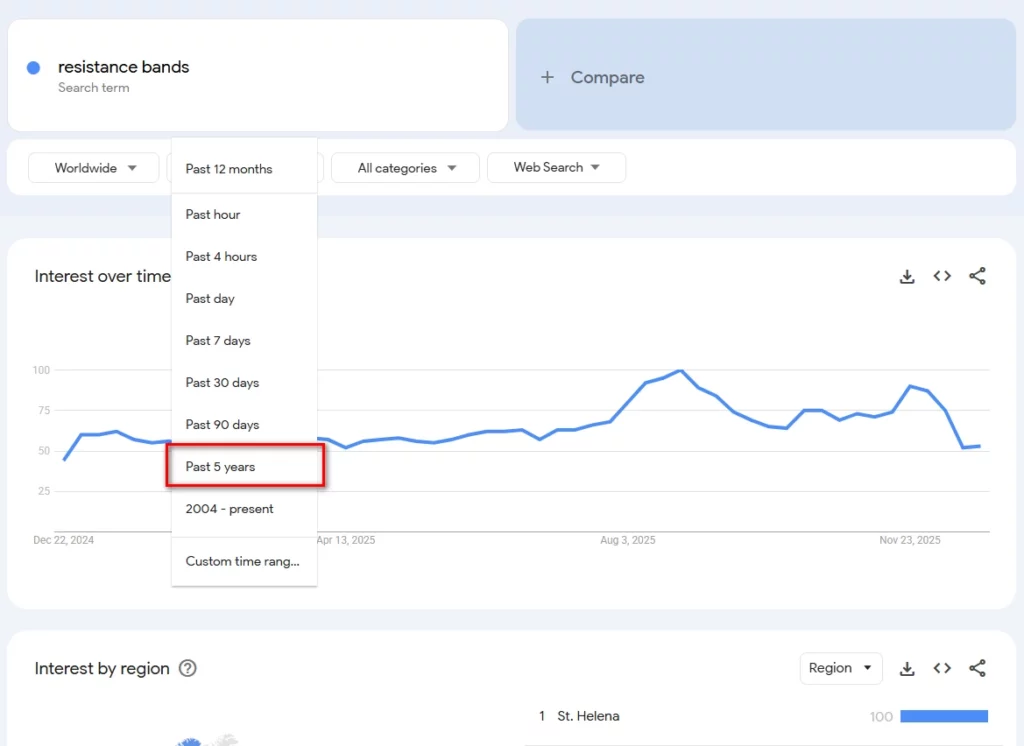
Sometimes a product looks dead on a 5-year view but has been quietly climbing the past few months.
Category filters are clutch too.
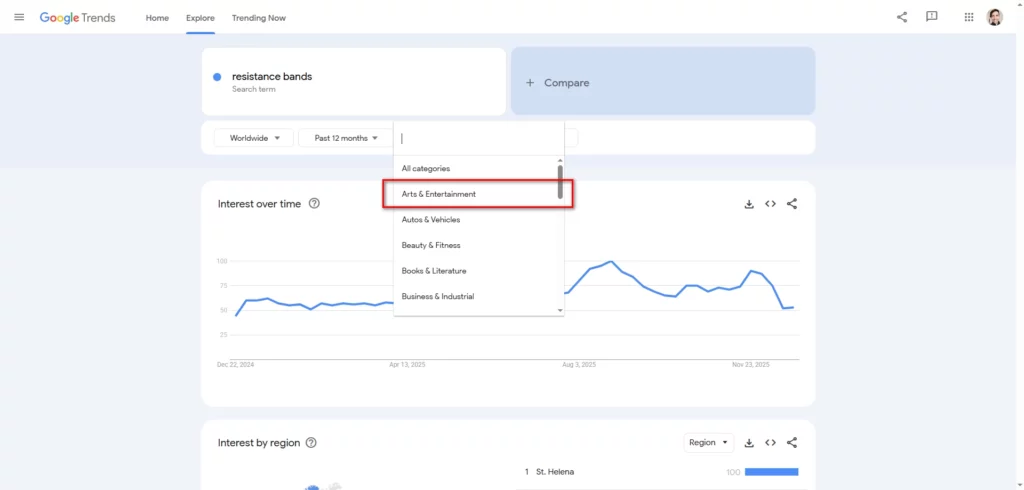
When you search a term, click the “All categories” dropdown and select the most relevant category.
Searching “apple” as a general term will mix Apple the tech company with apple the fruit.
But if you filter to “Computers & Electronics,” you’ll get clean data about Apple products specifically.
Here’s a real walkthrough so you can see how this works in practice.
Let’s say you’re researching “portable blenders” as a potential product.
Go to Google Trends and type in “portable blender.”
Immediately, you see the interest over time graph.
It’s been climbing steadily since 2020, with consistent growth, that’s a great sign.
No major crashes, just solid upward momentum.
Check the geographic data. California, Texas, Florida, New York all show strong interest.
Cool, now you know where your ads should focus. Big populations, high interest.
Scroll down to “related queries.” You see things like ninja blase, bledjet 2, blendjet 2 protable blender, etc…
These tell you two things: what features people want (USB charging, travel-friendly) and what content you should create (review blogs, comparison posts).
Compare it with similar products.
Add “mini blender,” “smoothie maker,” and “bullet blender” to the comparison.
You notice “portable blender” has been growing faster than the others recently.
That confirms it’s the term with momentum.
Check seasonality over 5 years.
You notice small spikes every January, New Year’s resolution time when people commit to health goals.
Plan your big marketing push for December and January to catch that wave.
All this took maybe ten minutes, and now you’ve got solid data telling you this product has real potential.
You know where to advertise, what features people care about, what related products to add, and when to push hardest.
That’s way better than just seeing a random dropshipper post about portable blenders on Reddit and hoping it works out.
Research showed that investment strategies using Google Trends data earned 2-3% higher returns than traditional models.
The data’s sitting there for free, most people just don’t bother to look at it properly.
The difference between successful dropshippers and failed ones often comes down to this: successful ones validate their ideas with data before spending money.
Failed ones pick products based on what “feels” right, then wonder why nobody’s buying.
Google Trends isn’t perfect, but it’s the closest thing to a free cheat code you’re gonna find. Use it.
H2: Tool #2 – Amazon Best Sellers: Validating Real Purchase Behavior
Google Trends shows you what people are searching for, which is helpful. But Amazon Best Sellers?
That’s showing you what people are actually pulling out their credit cards and buying. Big difference.
Here’s why that matters.
Someone might search “portable blender” on Google because they’re curious or doing research for a blog post or whatever.
But when someone buys a portable blender on Amazon, that’s real money changing hands.
That’s actual customer behavior you can bank on.
Amazon is where 79% of U.S. consumers go to inform their purchasing decisions.
Not to browse. Not to window shop. To actually decide what to buy.
So when you’re looking at the Best Sellers list, you’re seeing products that thousands of people have already validated with their wallets.
Let’s break down how to actually use this thing, because most dropshippers get it wrong.
They look at the top 10 products in a category, think “cool, I’ll sell that,” and completely miss the point.
First up, understanding BSR, or Best Sellers Rank. Every product on Amazon that’s made at least one sale gets a number. Lower is better.
A product ranked #1 is outselling everything else in that category right now.
A product ranked #50,000?
That’s selling maybe one unit every few days, if that.
The BSR updates hourly based on recent sales, so it’s constantly changing.
One thing to understand, BSR is relative to each category.
Being #500 in the massive “Home & Kitchen” category means way more sales than being #500 in something niche like “Camping Axes.”
Here’s how to navigate this properly.
Go to Amazon and click “Best Sellers” in the top menu.
You’ll see a list of broad categories. Don’t just look at “Home & Kitchen” and call it a day, that’s too broad. Drill down into subcategories.
For example, under “Home & Kitchen,” click into “Kitchen & Dining,” then “Coffee, Tea & Espresso,” then “Coffee Makers.”
Now you’re looking at specific products that are actually selling in a defined niche.
This is where you find opportunities, not in those massive top-level categories where competition is brutal.
Now, pay attention to the product reviews, and here’s why they matter so much.
Reviews tell you two critical things: what customers love about the product and what they hate.
A whopping 93% of consumers say online reviews impact their purchasing decisions, so if a product has hundreds of glowing reviews, that’s social proof on steroids.
But don’t just count the stars.
Read the actual reviews, especially the negative ones.
Let’s say you’re looking at a portable phone charger ranked #200 in Electronics.
Scroll through those 1-star and 2-star reviews. You might see complaints like “stopped working after a month” or “takes forever to charge” or “cable is too short.”
Those complaints?
That’s your roadmap to product improvements.
If twenty people complain about the cable being too short, you know exactly what to fix when sourcing your version.
You just got free market research from angry customers.
The “Movers & Shakers” section is straight fire for spotting products gaining momentum.
This shows you items whose BSR improved the most in the past 24 hours.
If a product jumped from #5,000 to #500 overnight, something’s happening.
Maybe it got featured on TikTok.
Maybe a big influencer mentioned it.
Maybe it’s just seasonal demand kicking in.
Catch these products early, and you can ride the wave before the market gets flooded.
But be careful, some movers spike fast and die just as quick.
Cross-reference with Google Trends to see if it’s a sustainable trend or a one-day flash.
Reverse-engineering successful products is where smart dropshippers separate themselves from the pack.
Find a product in the top 100 of its category. Study everything about it.
What keywords are in the title? How are they positioning the product in their description? What features do they emphasize? How many images do they have?
You’re not copying, you’re learning what works.
If the #3 best-selling yoga mat has “non-slip texture” and “eco-friendly material” front and center, those are features customers clearly care about.
Use that intel when sourcing your product.
Here’s something people miss, looking for gaps in the market through negative reviews.
Studies show that 78% of customers are less likely to buy a product if it has negative reviews, but those negative reviews are goldmines for identifying unmet needs.
Let’s say every top-selling camping hammock has reviews complaining about “complicated setup.”
Boom, you just found your angle.
Source a camping hammock with an easy setup, market that feature heavily, and you’ve differentiated yourself from products already selling thousands of units per month.
Now,
Here’s the reality check.
You need to cross-reference Amazon data with your dropshipping suppliers.
Just because something’s selling like crazy on Amazon doesn’t mean your supplier has it or can ship it fast enough.
Check AliExpress, Spocket, or whatever supplier platform you’re using.
Make sure the product exists, the quality matches what customers expect, and shipping times won’t kill your reviews.
Watch out for warning signs of saturated markets.
If you see hundreds of sellers offering the exact same product with nearly identical listings, that’s a red flag.
If prices are all within a dollar of each other and everyone’s fighting on razor-thin margins, you’re walking into a price war you probably can’t win.
Currently, 35% of Amazon sellers list in the Home & Kitchen category, that’s the highest concentration of sellers anywhere on the platform.
High competition means you better have something special to offer or move on to less crowded spaces.
Another saturation indicator?
If the top 10 products in a category all have 5,000+ reviews, you’re gonna struggle to compete as a new seller.
Customers trust products with thousands of reviews way more than your listing with zero reviews.
Only 45% of shoppers will buy a product with zero reviews, so you’d be fighting uphill from day one.
The “Customers who bought this also bought” section is pure gold for product bundling ideas.
Let’s say you’re selling a camping stove.
Amazon shows that customers who bought that stove also bought propane canisters, portable cookware, and camping utensils.
Now you’ve got four products you can either sell separately or bundle together for a higher profit margin.
Product bundling can seriously boost your average order value.
Instead of selling one item for $20, you sell a bundle of three related items for $50.
Customers love the convenience, and you make more per transaction. Win-win.
Turning Amazon insights into your dropshipping store’s winning products takes discipline.
You can’t just look at the Best Sellers page once and decide. Check it multiple times over a week or two.
See which products consistently rank high.
Those are your stable winners, not flash-in-the-pan trends.
Take notes. Build a spreadsheet. Track BSR changes, review counts, price fluctuations.
The more data you collect, the better your decisions become.
One seller documented going from $643 their first month to $25k monthly with 40% profit margins after figuring out which products their audience actually wanted, and Amazon Best Sellers was a huge part of their research process.
The difference between successful dropshippers and failed ones often comes down to validation.
Amazon Best Sellers gives you proof that real people with real money are buying specific products right now.
That’s not guesswork. That’s data you can act on. Use it.
Tool #3 – Facebook Audience Insights: Understanding Your Target Customer
Let’s get something straight right away, the original Facebook Audience Insights tool got shut down in July 2021.
Yeah, it’s gone.
If you’ve been looking for it and can’t find it, that’s why.
But before you panic, the data didn’t disappear.
Facebook just moved everything around and now calls it “Meta Business Suite Insights.”
It’s not quite as powerful as the old tool, but it’ll still give you the demographic and behavioral info you need to understand who’s actually interested in your products.
Here’s why this tool matters for dropshipping.
You can see how people are searching on Google or what’s selling on Amazon all day long, but Facebook tells you something different
What your actual target customers are into, what pages they follow, and how they behave on social media.
That’s crucial when you’re about to drop thousands on Facebook ads.
Let’s talk about what you can actually learn from this data, because most people just glance at it and move on without really digging in.
First up, demographics. Age, gender, location.
Basic stuff, but critical.
You might think your portable blender is perfect for college students, but then you check the data and realize women aged 30-45 are the ones actually buying fitness products on Facebook.
That’s a massive shift in how you’d write your ads and who you’d target.
Mobile devices account for 94.1% of all Facebook ad impressions, which means if your product page isn’t mobile-friendly, you’re basically throwing money away.
When you see that 94% of your potential customers are on their phones, you better believe your entire funnel needs to work flawlessly on a tiny screen.
Here’s how to actually access this thing now, since Facebook keeps moving stuff around.
Log into your Facebook account, head to business.facebook.com, and look for “Meta Business Suite” in the menu. From there, click “Insights” on the left sidebar. You’ll see tabs for your audience, content performance, and other metrics. The “Audience” tab is where you want to spend your time.
The data shows you who’s engaging with pages similar to yours or interested in topics related to your niche.
Let’s say you’re thinking about selling camping gear.
You can look at pages related to outdoor activities and see what demographics follow them.
If you notice most followers are men aged 25-54 living in states with national parks
Boom, you just identified your target market without guessing.
One thing people sleep on is the “page likes and affinity” data.
This shows you what other pages your target audience follows.
This is gold for two reasons.
First, you know where your customers are hanging out online, so you can study what content works in those spaces.
Second, you can use those pages for interest targeting when you set up your Facebook ads.
For example, if you’re selling yoga mats and you see that your target audience also follows pages about meditation, healthy cooking, and natural wellness,
You now know to target those interests when running ads.
You just discovered three additional audiences to test without doing any extra work.
Device usage data is another big one people ignore. Check whether your audience is mostly on mobile or desktop.
The average conversion rate for mobile-optimized ads is 9.3%, while desktop conversion sits at 6.7%.
That’s a significant gap.
If most of your audience is on mobile, your entire store needs to be built mobile-first, not as an afterthought.
Slow load times on mobile will absolutely kill you.
Mobile video ads have an average view-through rate of 32%, nearly double the 17% rate on desktop.
So if your audience is primarily mobile and you’re not using video ads optimized for small screens, you’re leaving money on the table.
Here’s where things get interesting, discovering complementary interests that reveal cross-selling opportunities.
Let’s say your data shows that people interested in “resistance bands” are also interested in “meal prep” and “fitness apps.”
Now you know these customers aren’t just buying one product and disappearing.
They’re invested in an entire lifestyle. You can bundle products, create email sequences around complete fitness solutions, and upsell related items.
Audience size is critical too, and Meta Business Suite will show you estimated reach.
If you’re targeting a niche that only has 5,000 people on Facebook, that’s not big enough to build a profitable dropshipping business around.
You want audiences in the hundreds of thousands at minimum, preferably millions. Too small and you’ll run out of people to advertise to within weeks.
Now,
Let’s talk validation before you spend money on ads. This is where beginners mess up constantly.
They see a product, think “that’s cool,” set up a store, and immediately start running $50/day in ads without any validation.
Smart dropshippers use Meta Business Suite to validate product-market fit first.
Here’s how: create a Facebook page related to your niche and start posting content about the problems your product solves.
Share educational posts, funny memes, whatever gets engagement.
Watch which posts perform best. After a few weeks, check your Insights to see who’s engaging.
If the demographics match your target customer and engagement is strong, you’ve got early validation that people care about this topic.
According to recent data, 54% of marketers say Facebook ads are “very effective” at driving sales, but that effectiveness depends entirely on targeting the right people.
You can have the best product in the world, but if you’re showing ads to the wrong audience, you’re toast.
Combining Facebook data with the other tools we’ve covered gives you a complete picture.
Google Trends shows you search interest over time. Amazon Best Sellers shows you what people are buying. Facebook Audience Insights shows you who those people are and what else they’re interested in.
Use all three together, and you’re making decisions based on data from multiple angles instead of guessing.
Here’s the reality about privacy updates and workarounds. Apple’s iOS 14 update significantly impacted Facebook’s tracking abilities, and Facebook itself warned that ad performance and Audience Network revenue could drop by more than 50% due to reduced data collection.
That’s huge.
With iOS 14, it was expected that IDFA sharing would drop from 70% to 10-15% as users had to explicitly opt-in to tracking.
Many people predicted disaster for Facebook advertisers.
And yeah, it made things harder, but it didn’t kill Facebook ads. It just meant advertisers had to adapt.
The workarounds?
First, focus on first-party data, email lists, phone numbers, customer data you collect directly.
Retargeting campaigns achieve conversion rates 367% higher than cold audience campaigns, so building your own customer lists became even more important after iOS 14.
Second, use Meta’s Conversions API in addition to the Facebook Pixel.
This sends data directly from your server to Facebook, bypassing some of the iOS 14 limitations.
Third, broaden your targeting.
With less granular data available, lookalike audiences based on your best customers became more valuable than hyper-specific interest targeting.
Starting January 15, 2024, Meta removed or consolidated some detailed targeting options, especially around sensitive topics.
Options that were rarely used or too specific got cut.
This simplified the ad creation process but meant advertisers needed to rely more on Facebook’s algorithm to find the right people.
The takeaway?
Meta Business Suite Insights isn’t as robust as the old Facebook Audience Insights tool, but it’s still useful when combined with smart targeting strategies and first-party data collection.
The days of hyper-specific targeting based on every page someone liked are mostly gone, thanks to privacy updates.
But Facebook ads still work, you just need to be smarter about how you use them.
Don’t sleep on this tool.
Spend an hour digging through your audience data before you launch any ads.
Check demographics, see what other interests your audience has, verify that the audience size is big enough,
And make sure your website works perfectly on mobile since that’s where nearly all your traffic will come from.
Those basics will save you from wasting thousands on ads that target the wrong people.
Tool #4 – AliExpress Dropshipping Center: Analyzing Supplier Data and Order Volume [Bonus]
Here’s something most new dropshippers don’t realize:
AliExpress isn’t just where you buy products from.
It’s actually one of the best free research tools sitting right in front of you, and most people completely ignore it.
AliExpress commands over 2 million merchants and more than 100 million products, with over 20 million visitors hitting the platform regularly.
That’s a massive amount of real buyer behavior and sales data you can tap into without spending a dime.
The AliExpress Dropshipping Center is where serious dropshippers go to dig through that data.
To access it, log into your AliExpress account and look for “Dropshipping Center” in the main menu, or just search for it in the help section.
Once you’re in, you’ll see a page where you select the prodcuts from and options Recommendations, Pricing and Sales.
The “Find Products to Sell” tool is your starting point.
This thing shows you products that are actively selling right now, complete with order counts and growth trends.
You’re not guessing, you’re looking at actual purchase data from thousands of transactions.
Order counts matter way more than most people think.
Here’s the reality: a product with 5,000 orders is way different from one with 50 orders.
But here’s the catch
You need to look at order velocity, not just total orders.
A product that jumped from 500 orders to 5,000 orders in two months?
That’s momentum.
A product sitting at 10,000 orders but hasn’t moved in six months?
That’s probably dead or dying.
What numbers indicate a winning product?
Generally, you’re looking for products with at least 1,000+ orders if you want proof of demand.
But pay attention to recent review dates.
Filter reviews by “Latest” to see if people are still buying.
Recent positive reviews indicate ongoing demand and reduce the risk of picking a fading trend.
Now let’s talk supplier evaluation, because this is where beginners mess up constantly.
They see a cheap price and jump without checking if the supplier is actually reliable.
Supplier ratings on AliExpress use a 1-5 star scale.
You want sellers close to 5 stars with ratings preferably 4.7 or higher.
But don’t just look at the star rating
Drill down into the individual metrics.
AliExpress breaks down ratings into three categories: fast delivery, satisfied, very fast delivery, good filament, fast shipping.
Check the supplier review and make sure is around 4.8 and make sure he has fast shipping speed.
Slow shipping kills customer satisfaction and tanks your review scores fast.
Research shows 70% of consumers are more likely to purchase from sellers with positive reviews, so if your supplier has shipping problems, those issues become your problems.
Check the store’s age too.
Sellers with several years of operation and at least two years on the platform are usually more dependable than brand new stores with zero track record.
A store that’s been around for three years and has tens of thousands of orders isn’t going to risk their reputation by sending garbage products.
Now here’s something people sleep on,
Filtering is crucial for narrowing down products fast.
Use category filters to focus on specific niches.
Filter by shipping from, products shipping from local warehouses (US) arrive way faster than items shipping from distant locations,
which keeps customers happy.
Filter by price point to make sure you’ve got room for decent profit margins.
Speaking of profit margins, let’s talk numbers.
The average dropshipping profit margin ranges from 15% to 30%, but you want to aim higher if possible.
Calculate your margins before committing to a product.
Here’s how it works:
Let’s say you find a product on AliExpress for $8 including shipping.
Check what similar products sell for on Amazon, eBay, or Shopify stores.
If they’re selling for $25-$30, you’ve got room to work with.
Price yours at $27, and after the $8 cost, you’ve got $19 gross profit per sale before ads and fees.
But watch out for oversaturated products.
If you see the exact same item being sold by 500 different suppliers at nearly identical prices, that’s a sign the market’s flooded.
High competition in oversaturated niches means lower margins and brutal price wars.
You’ll be fighting for scraps.
How do you spot saturation?
Look at the number of sellers offering identical products.
If there are 50+ suppliers selling the exact same thing with the same product photos and descriptions, move on.
You want products where maybe 5-10 quality suppliers exist, not hundreds.
Reading product reviews from actual buyers is where you find gold.
Don’t just skim the 5-star reviews, dig into the 3-star and 2-star reviews.
That’s where people tell the truth about quality issues, sizing problems, shipping delays, and misleading descriptions.
Let’s say you’re looking at a phone case.
You notice ten reviews complaining that “the buttons are hard to press” or “doesn’t fit iPhone 14 Pro Max even though it says it does.” That’s critical info.
Either find a different supplier or skip that product entirely.
Photo reviews are clutch too.
Buyers who upload pictures are showing you exactly what arrived at their door, not the polished marketing photos the supplier posted.
If you see photo reviews where the product looks way different or lower quality than advertised, that’s a massive red flag.
Assessing profit margins by comparing supplier prices with retail prices on other platforms is essential.
Check what the product sells for on Amazon, then check what it costs on AliExpress.
The gap between those numbers is your potential profit zone, but remember to account for advertising costs, platform fees, and shipping.
According to dropshipping experts, you should aim for profit margins of 40-70% when possible.
For products under $2 from suppliers, they recommend pricing around $9.95, giving you roughly $7.95 profit.
For products between $2-5, price them around $14.99-$19.99 depending on perceived value.
Here’s a pro tip people don’t talk about enough: use the AliExpress affiliate program data to see what other dropshippers are promoting.
AliExpress affiliate offers a minimum of 8.5% commission on sales, so products being heavily promoted by affiliates are products that convert well.
If affiliates are pushing a product hard, that’s usually because it’s making them money, which means it’ll probably make you money too.
You can find trending affiliate products by checking AliExpress’s the affiliate portal, or by using third-party tools that track what’s being promoted most heavily.
These products have already been validated by other marketers who’ve spent money testing them.
The AliExpress Dropshipping Center also provides a Sales Volume rating from 0 to 100, showing how much marketing momentum a product has.
Higher scores mean better performance. With raw data on sales volume, you can make data-based decisions instead of gambling on gut feelings.
Supplier logistical reliability is another huge factor.
You can use the Product Analysis tool to determine whether a supplier is reliable based on detailed ratings for consistency of delivering products as described, communication quality, and shipping speed.
A supplier might have cheap prices, but if they take 45 days to ship and ghost you when there’s a problem, you’ll lose customers fast.
The average delivery time from AliExpress ranges from 11 to 45 days depending on location.
If delivery time exceeds 20-25 days, treat that product as a test item only.
Once you validate demand, consider switching to a faster supplier or using warehouses closer to your target market.
One more thing
Watch for warning signs of saturation like too many sellers and razor-thin margins.
If every supplier is pricing the product within 50 cents of each other and margins are under 20%, you’re looking at a commodity product where nobody makes real money.
The race to the bottom kills profit.
The difference between successful dropshippers and failed ones often comes down to supplier research.
AliExpress Dropshipping Center gives you everything you need to evaluate products and suppliers properly
You just have to actually use it instead of picking random products based on what looks cool.
Spend an hour analyzing order volumes, supplier ratings, reviews, and profit margins before committing.
That hour could save you months of frustration and thousands of wasted dollars.
Conclusion
There you have it
Five completely free tools that can transform your dropshipping product research from guesswork into a data-driven science!
I cannot stress enough how important this research phase is.
Every successful dropshipper I know has one thing in common: they validate before they invest.
Remember, tools are only as good as the person using them.
Google Trends shows you the interest, Amazon confirms people are buying,
Facebook reveals your audience, AliExpress proves supplier viability, and Reddit uncovers the real human needs behind the numbers.
When you combine all five tools, you create a comprehensive picture that dramatically increases your chances of success.
Don’t let analysis paralysis hold you back, though!
Use these tools to research 5-10 product ideas, score them objectively, and then take action on your top 1-2 winners.
The market rewards those who move quickly on validated opportunities.
Start with Google Trends today, spend 30 minutes exploring a niche you’re interested in, and follow the framework I’ve outlined.
Your future self (and your bank account!) will thank you for doing the homework now rather than learning expensive lessons later.