



You’ve found the perfect product.
The supplier’s photos look amazing, the price point is right, and you’re ready to add it to your store.
But here’s the thing, those glossy product images might be hiding cheap materials, poor stitching, or colors that look nothing like the listing.
I’ve seen countless dropshippers skip the sampling phase only to face a nightmare of returns and angry customers three weeks later.
Requesting product samples isn’t just a “nice to have” step in dropshipping, it’s your insurance policy against disaster!
Whether you’re working with AliExpress vendors, private suppliers, or domestic wholesalers, getting your hands on physical products before you start selling is non-negotiable.
In this guide, you’ll learn exactly how to request samples professionally, what to look for when evaluating them, how to negotiate costs, and the red flags that signal you should walk away from a supplier entirely.
Why Product Samples Are Critical for Dropshipping Success
Jumping into an online business without testing items first is basically gambling with your reputation. Seventy-three percent of customers cite quality and delivery speed as the top factors influencing repeat purchases, according to research from Statista.
When you’re relying on suppliers thousands of miles away, that’s a huge deal.
Here’s what most new store owners don’t realize until it’s too late.
Those gorgeous stock photos from suppliers?
They’re often misleading or straight-up inaccurate.
One seller tested multiple products and discovered issues ranging from wrong colors to materials that felt cheaper than advertised.
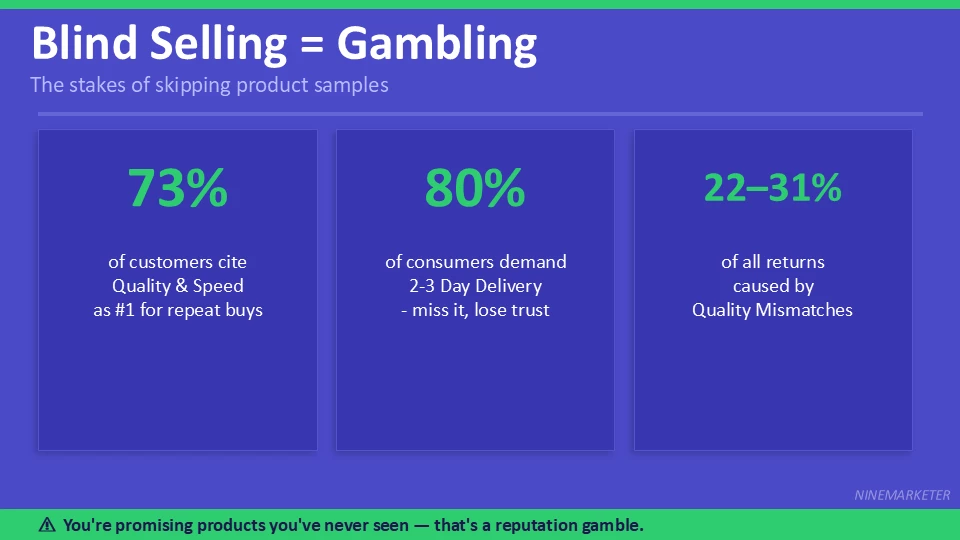
Without ordering samples, you’re essentially promising customers something you’ve never seen.
The shipping timeline thing is wild, too.
Your supplier might claim two to three-day delivery, but reality could be different.
And here’s the kicker, eighty percent of consumers prefer that delivery window specifically.
Miss it by a few days, and you’ll watch your trust score tank.
Testing packaging quality yourself reveals problems before customers do.
Maybe the box arrives crushed.
Perhaps items aren’t secured properly.
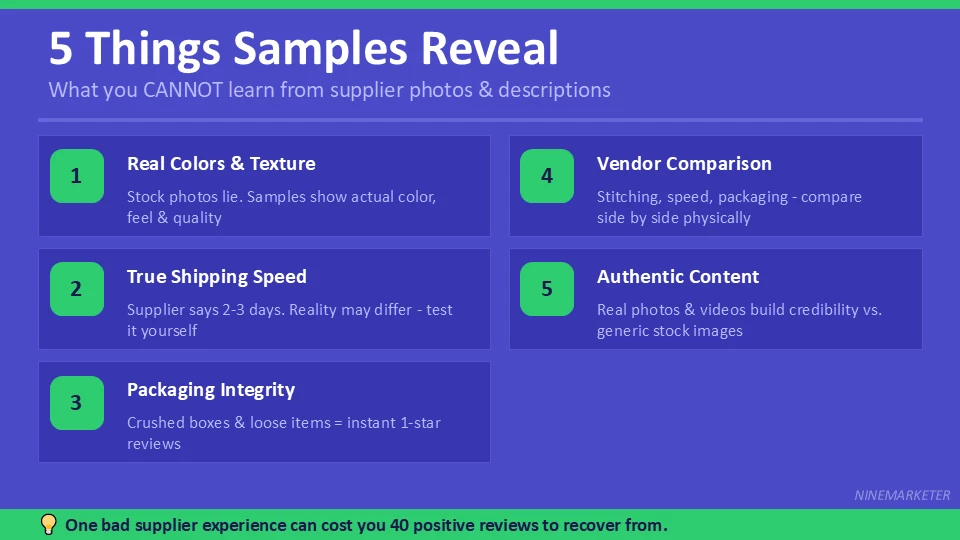
These aren’t theoretical concerns, they’re the difference between a five-star review and a one-star rant that costs you up to thirty customers.
Authenticity is another game-changer when ordering physical items.
Stock images scream “generic dropshipper” to savvy shoppers, but your own photos and videos?
That builds credibility fast.
You can show sizing, texture, actual colors, stuff that prevents returns and complaints.
Comparing multiple vendors becomes possible when you’ve got physical samples lined up on your desk.
Supplier A might have better stitching.
Supplier B ships faster but uses flimsy packaging.
You can’t make these calls from product descriptions alone.
And let’s talk money for a sec.
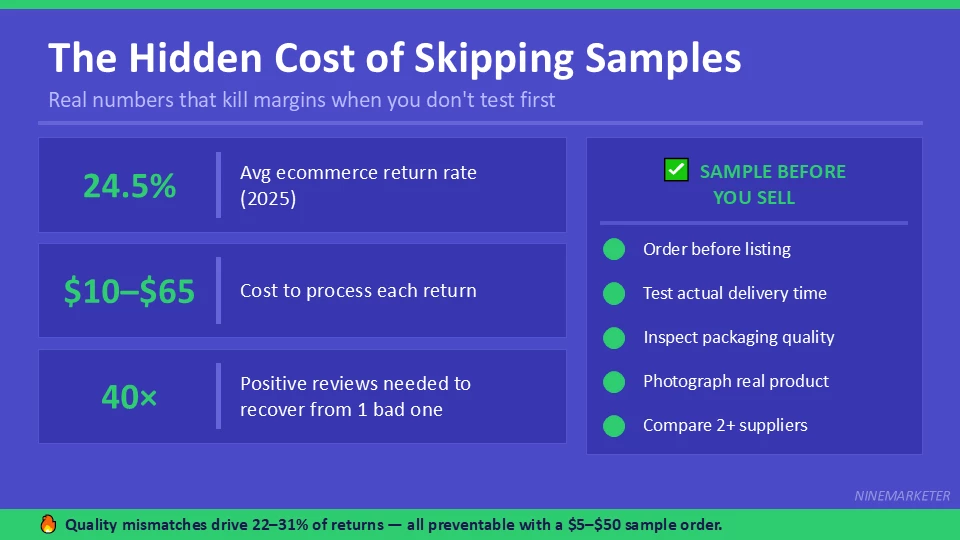
The average ecommerce return rate hit 24.5% in 2025, with each return costing retailers between $10 and $65 to process.
That’s brutal when margins are already tight.
Quality mismatches drive 22-31% of all returns, which is totally avoidable if you test items first.
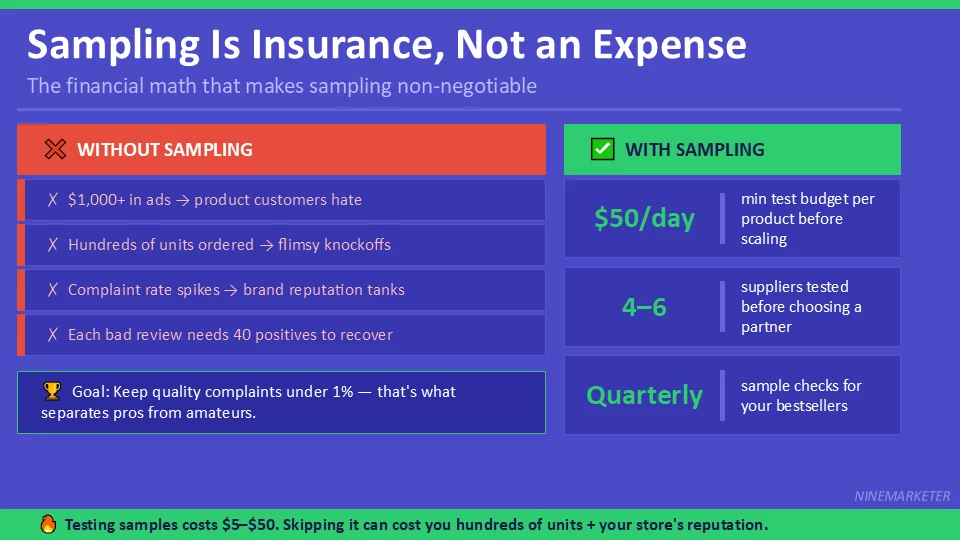
Smart operators know that one negative review requires around 40 positive ones to make up for it.
That’s an insane ratio.
Testing samples helps you avoid that nightmare scenario where angry customers trash your store publicly while you scramble to fix supplier issues.
When to Request Samples from Your Dropshipping Supplier
Before you commit to any partnership, ordering test items is non-negotiable.
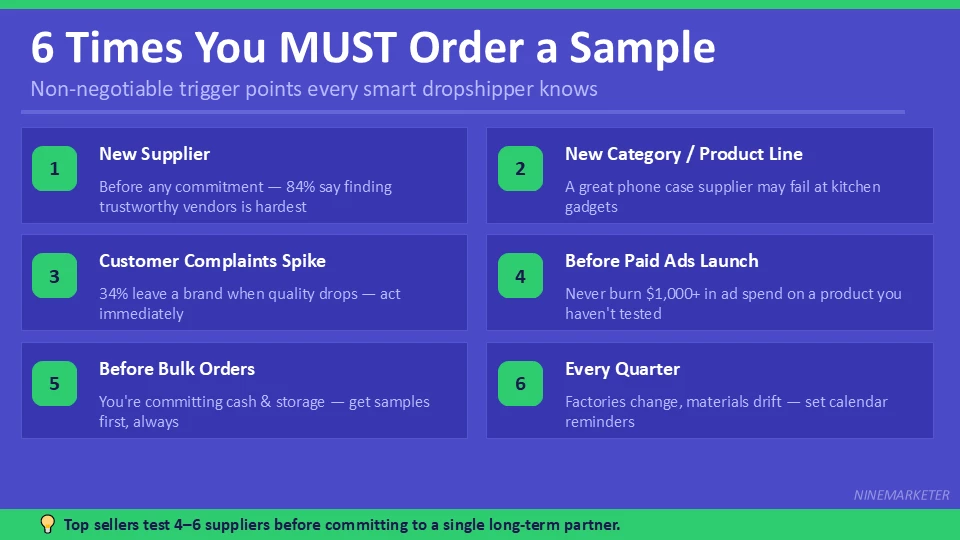
Eighty-four percent of retailers say finding trustworthy vendors is their biggest challenge, and you won’t know if yours is reliable without holding their merchandise in your hands.
Most successful sellers test four to six different suppliers before picking one long-term partner.
That’s not being picky, it’s being smart.
When you’re branching into new categories or lines, request samples again.
A vendor who crushes it with phone cases might totally bomb at selling kitchen gadgets.
The fulfillment process, packaging standards, and attention to detail can vary wildly between product types, even from the same company.
Customer complaints are your wake-up call.
If buyers start griping about quality issues that weren’t there before, something changed on the supplier’s end.
Research shows that thirty-four percent of customers will bail on a brand when product quality drops, so you can’t afford to ignore these red flags.
Order a fresh sample immediately to see what’s different.
Suppliers update specifications without warning sometimes.
Maybe they switched factories.
Perhaps they’re using cheaper materials to boost their margins.
You won’t know unless you’re testing periodically.
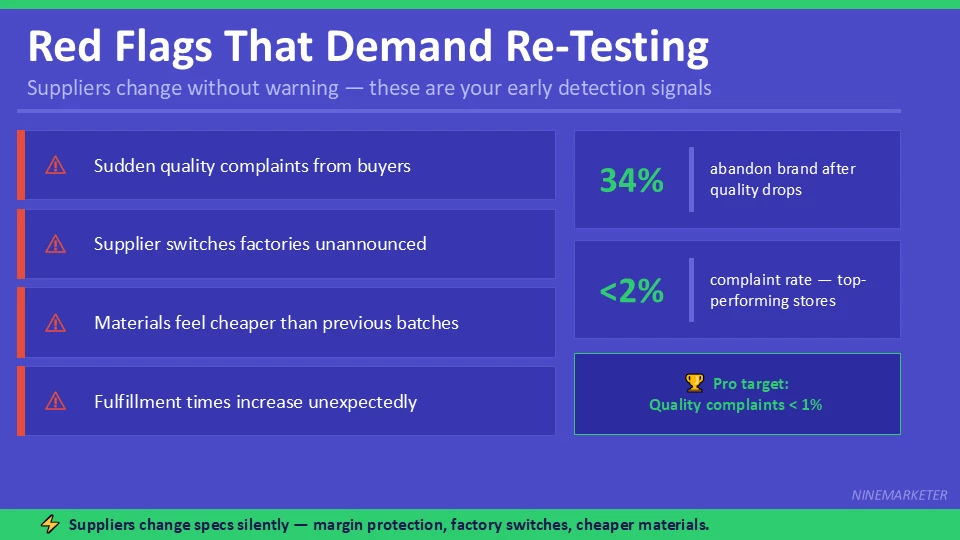
Top-performing stores maintain complaint rates under two percent, and staying there requires catching quality shifts early.
Before launching paid campaigns, always test first.
Imagine blowing a thousand bucks on ads and then discovering customers hate the actual item.
That’s money down the drain and a damaged reputation.
Smart operators know that spending at least fifty dollars daily per product test gives enough data to make informed decisions about scaling.
If you’re considering bulk inventory purchases, getting multiple samples becomes even more critical.
You’re about to drop serious cash and commit to storing physical goods.
One seller tested a “winning product” that looked great online but arrived with flimsy construction that screamed cheap knockoff.
Without sampling, they would’ve ordered hundreds of units destined for returns.
Seasonal testing matters too.
Summer batches might use different materials than winter runs.
Factories change production methods.
Quality can drift over time even with established relationships.
Set calendar reminders to order quarterly samples, especially for your bestsellers.
The goal is maintaining that less than one percent complaint rate for quality-related issues that separates pros from amateurs.
Testing isn’t an expense, it’s insurance against way bigger problems down the road.
How to Find Supplier Contact Information for Sample Requests
Tracking down the right person to contact at a vendor can feel like detective work sometimes.
Most platforms make it easier than you’d think though.
Start with the obvious, check official company sites for contact pages.
You’d be surprised how many sellers still list direct emails and phone numbers right there.
Platform messaging systems on marketplaces work too, but they’re not always the fastest route.
AliExpress stores typically include a “Contact Seller” button at the bottom of their pages, while other sites have similar features built in.
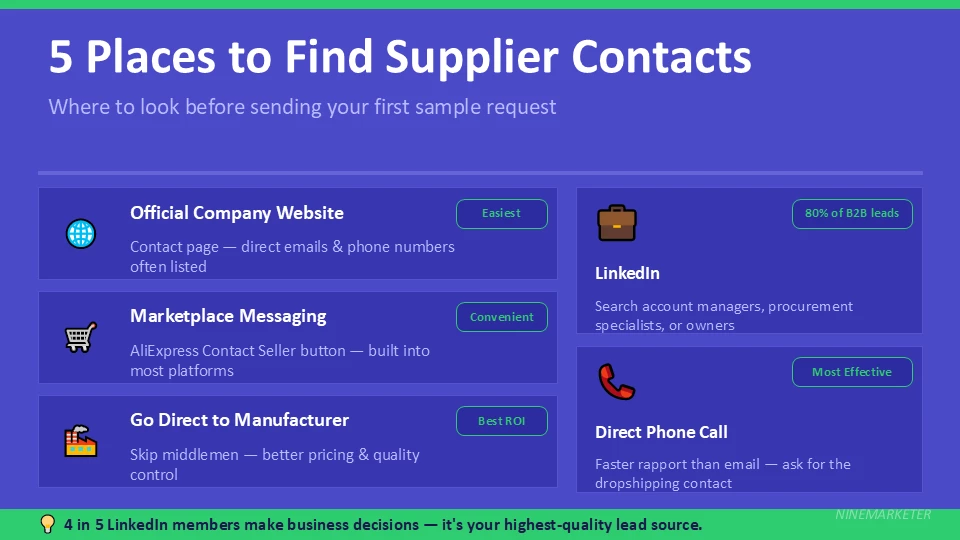
Here’s something most people skip: trying to reach manufacturers directly instead of going through middlemen.
Wholesalers and distributors mark up prices, so cutting out that layer saves money.
It takes more legwork to find factory contacts, but the payoff in pricing and quality control is worth it.
LinkedIn has become a goldmine for B2B connections lately.
Research shows that LinkedIn generates 80% of all B2B leads from social media, which crushes every other platform.
You can search for account managers, procurement specialists, or company owners directly.
Four out of five LinkedIn members drive business decisions, so you’re literally connecting with people who can approve partnerships.
The language barrier thing trips up a lot of folks.
Translation tools have gotten way better.
Spanish translations from modern AI hit ninety-four percent accuracy for business communications.
Tools like Google Translate or DeepL handle basic vendor conversations pretty well now.
Just remember that automated translation still struggles with complex terms and cultural nuances, so keep your initial messages simple and direct.
Finding the right department matters more than you think.
Sales reps handle initial inquiries, but account managers or distribution coordinators typically manage sample requests and partnership setups.
When you first reach out, ask who handles dropshipping relationships specifically.
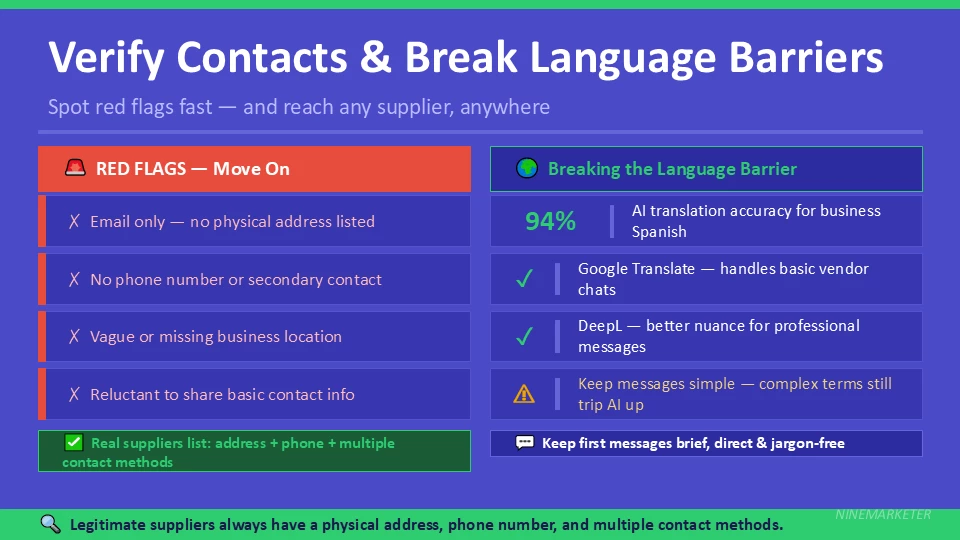
Pro tip: always verify you’re dealing with legit contacts.
Suppliers with only email addresses and no physical location are red flags.
Real businesses list street addresses, phone numbers, and usually have multiple contact methods available.
If a vendor seems sketchy about sharing basic contact info, that’s your cue to move on.
The initial message sets the tone for everything.
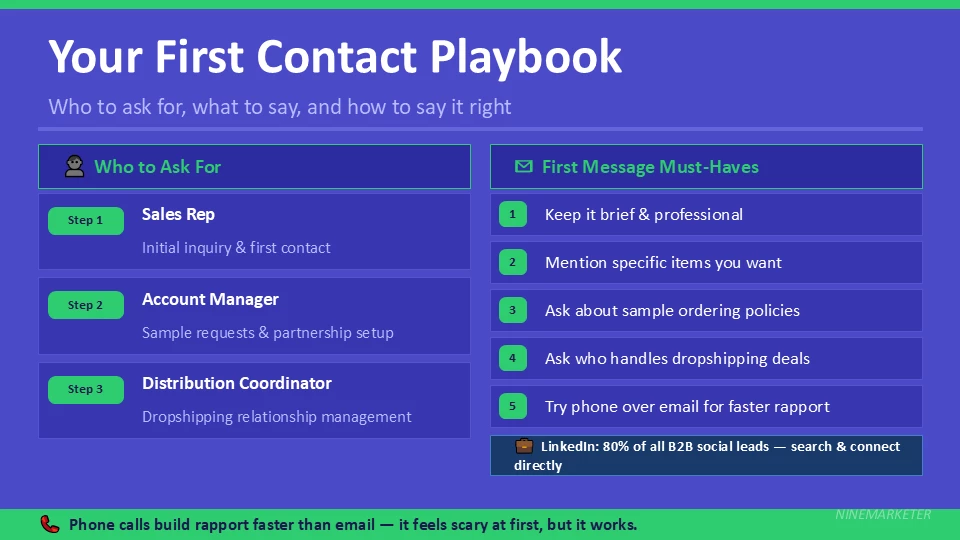
Keep it brief and professional but friendly when introducing yourself.
Mention specific items you’re interested in and ask about sample ordering policies upfront.
Experienced sellers know that direct phone calls often work better than emails for building that initial rapport, even though it feels nerve-wracking at first.
Crafting the Perfect Sample Request Email
Getting vendors to respond quickly starts with your subject line.
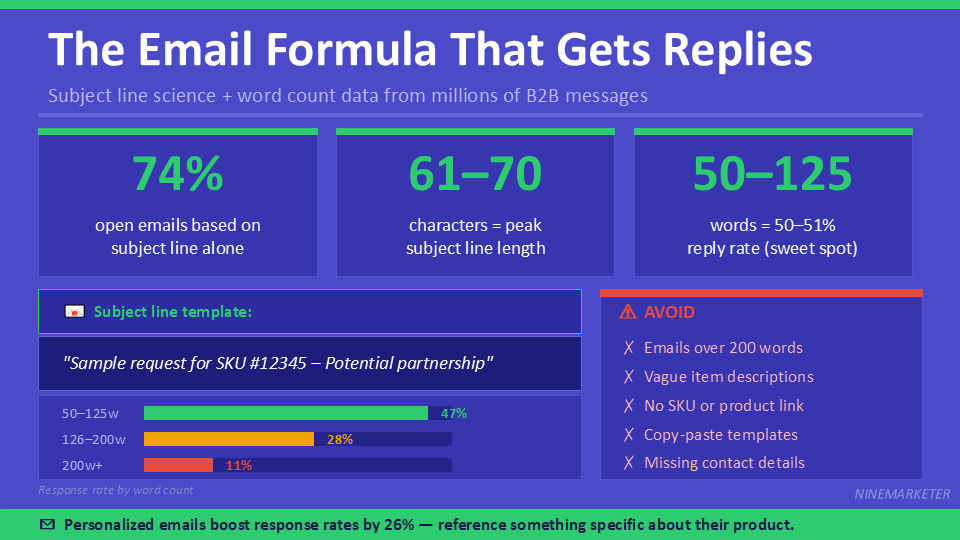
74% of recipients decide to open emails based purely on subject lines, so you can’t afford to wing it.
Keep yours between 61-70 characters for maximum impact, which works out to roughly eight words.
Something like “Sample request for SKU #12345 – Potential partnership” hits the sweet spot.
When you’re drafting the actual message, keep it tight.
Research analyzing millions of B2B messages shows emails between 50-125 words get a 50-51% response rate, while anything over 200 words tanks your chances.
That’s brutal but true.
Most supplier contacts are drowning in emails already, so respect their time.
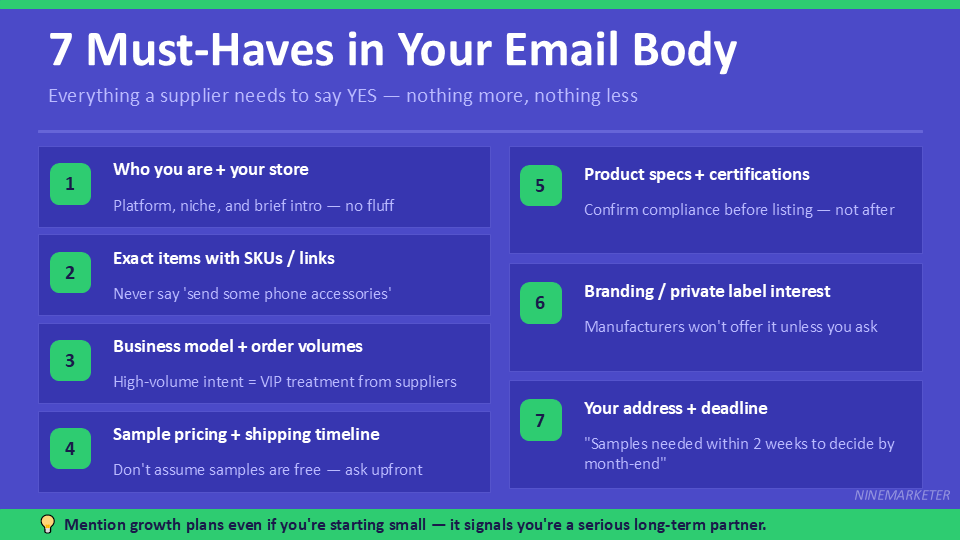
Start by introducing yourself and your store clearly, no fluff.
Mention which platform you’re selling on and what niche you’re in.
Then get specific about exactly which items you want to test.
Use SKU numbers or direct product links.
Vague requests like “send me some phone accessories” aren’t gonna cut it.
One seller learned this the hard way when their supplier shipped random items that had nothing to do with what they actually wanted.
Here’s something most folks skip: mention your business model upfront and realistic order volumes.
Suppliers treat potential high-volume partners way differently than one-off buyers.
If you’re planning to test products before scaling to hundreds of monthly orders, say so.
Even if you’re just starting out, being honest about growth plans shows you’re serious.
Ask directly about sample pricing, shipping costs, and timelines.
Don’t assume samples are free, many quality suppliers charge nominal fees that get credited back on bulk orders.
Also, request product specs, certifications, and any compliance documents upfront.
Better to know now if items don’t meet safety standards than after you’ve listed them.
If branding or customization matters for your store, bring it up early.
Some manufacturers offer private labeling but won’t mention it unless you ask.
Close with your complete shipping address and best contact method, phone number, WhatsApp, whatever works fastest.
Set clear expectations like “hoping to receive samples within two weeks to make a decision by month-end.”
This creates urgency without being pushy.
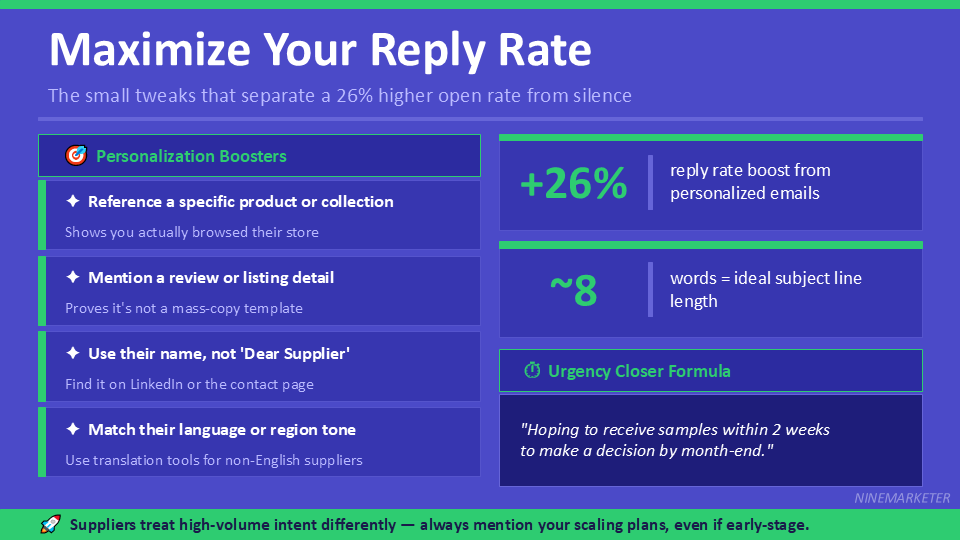
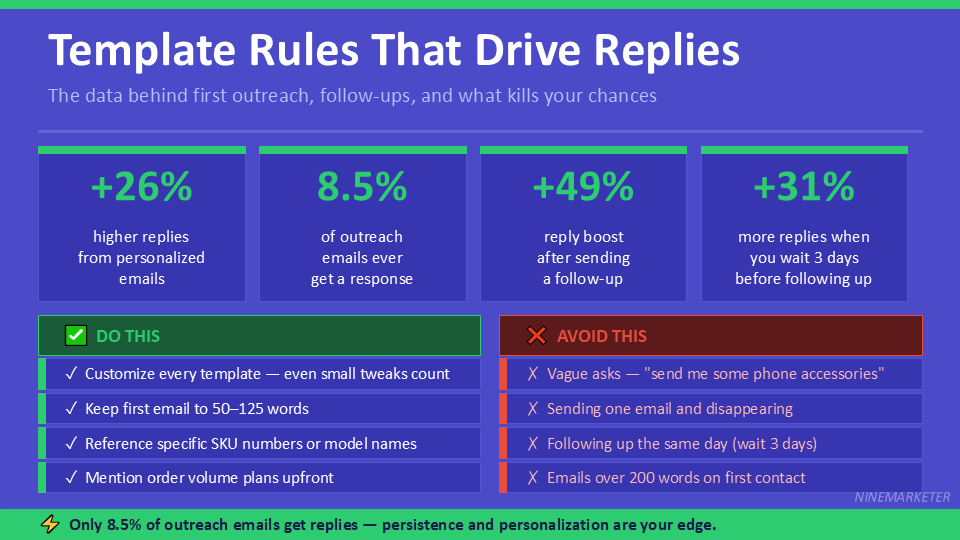
One last thing: personalized emails boost response rates by 26%.
If you can reference something specific about their company or products, do it.
Shows you did your homework instead of copy-pasting the same template to fifty suppliers.
Sample Request Email Templates That Get Results
Templates save time, but here’s the catch, you gotta customize them or vendors will smell that copy-paste vibe from a mile away.
Personalized emails get 26% higher response rates than generic ones, so even small tweaks make a difference.
For first-time outreach to a manufacturer or private label supplier, keep it between 50-125 words for the best shot at a reply.
Introduce your store, mention specific SKU numbers, and ask about sample pricing upfront.
Something like “interested in testing samples of your Model XYZ-500 phone cases before placing bulk orders” works way better than “send me phone case samples.”
When reaching out on marketplaces like those sites everybody uses, platform messaging works differently than email.
You can be slightly more casual there since vendors expect quick back-and-forth.
Still mention order volume plans though, suppliers treat potential high-volume buyers totally different.
Here’s where people mess up: they send one email and bounce.
But follow-ups boost response rates by 49% after the first attempt, and waiting three days before following up increases reply rates by 31%.
Your second message should reference the first one and maybe add a bit more context about your business.
For negotiating free or discounted samples, you need leverage.
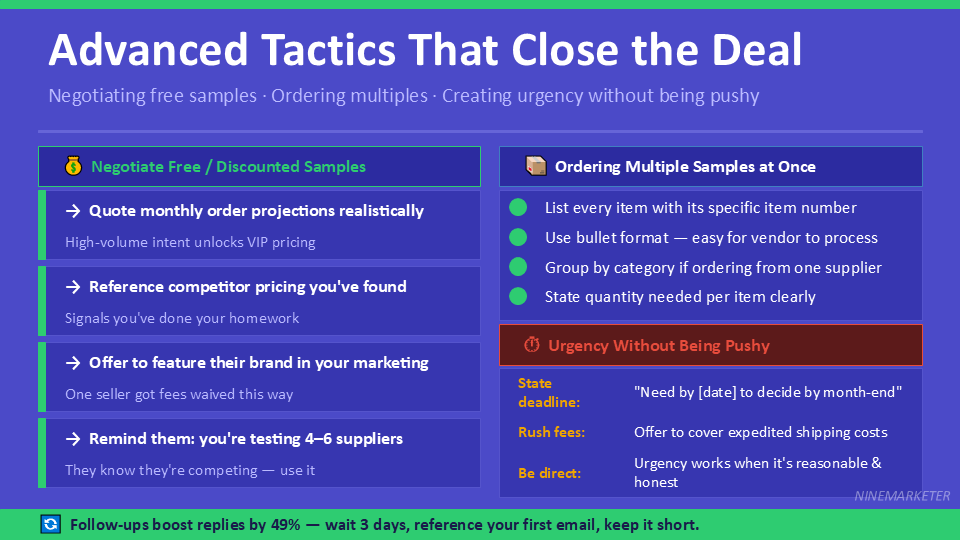
Mention realistic monthly order projections or point out competitor pricing you’ve seen.
Most dropshippers test 4-6 suppliers before committing long-term, so vendors know they’re competing for your business.
One seller got sample fees waived by promising to feature the supplier’s brand in their marketing materials if quality matched expectations.
If a vendor ghosts you after a week, don’t get annoyed, just follow up.
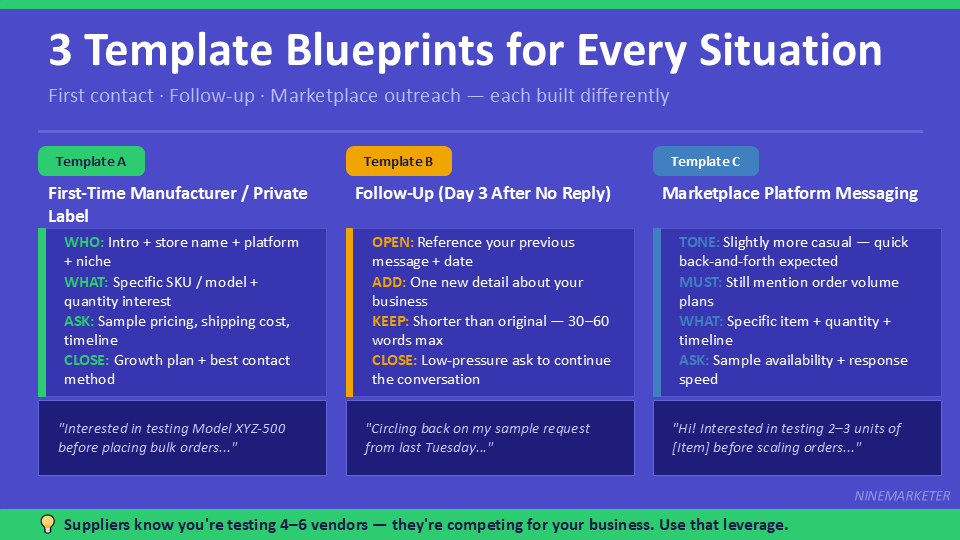
Only 8.5% of outreach emails get responses, so persistence matters.
Your follow-up template should be shorter than the original, maybe just “circling back on my sample request from last Tuesday, still interested in testing your products.”
For requesting multiple product samples at once, list everything with specific item numbers in a simple bullet format.
Makes it super easy for the vendor to process.
And if you need expedited shipping, be upfront about timeline constraints and offer to cover rush fees.
Urgency gets attention when you’re reasonable about it.
Negotiating Sample Costs and Shipping Fees
Here’s what catches people off guard, sample costs ain’t standardized across suppliers.
Products with typical retail prices of $20 to $50 usually cost between $50 to $100 for sample orders including shipping.
That’s way more than beginners expect when they’re just starting out.
Free samples exist, but they’re rare unless you’ve got serious leverage.
Most quality vendors charge something because they’re protecting themselves from tire-kickers who request samples and vanish.
When you’re negotiating though, ask about getting those sample fees credited back toward your first bulk purchase.
Lots of suppliers will do this if you commit to actual order volumes.
Smart operators bundle multiple sample requests from the same vendor to split shipping costs.
Instead of ordering one phone case, then another one next week, grab three or four different SKUs in a single shipment.
Bundling items together leads to lower overall shipping costs since you’re sending things in bulk rather than separately.
Shipping fees can hammer your testing budget fast.
Express services especially get expensive, sometimes the shipping costs more than the actual product.
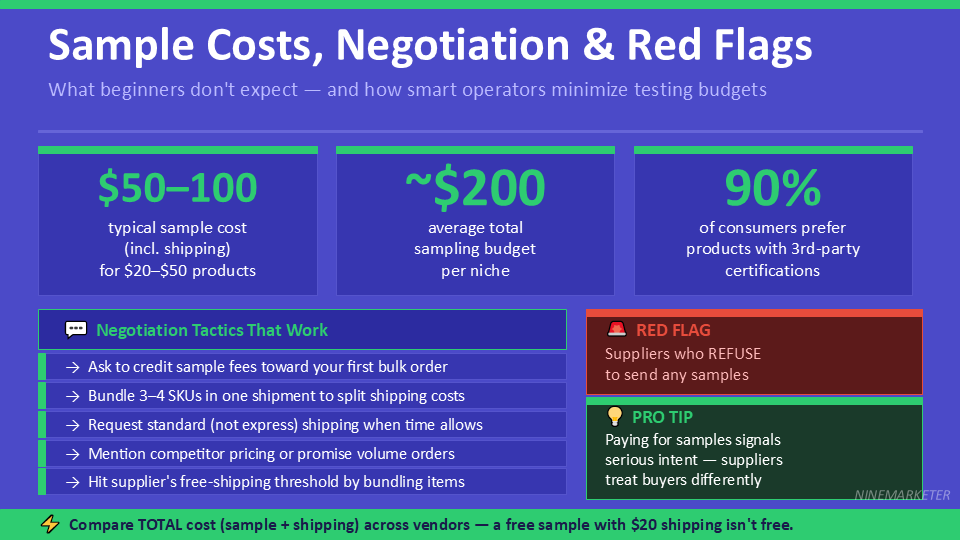
If time isn’t critical, request standard shipping options.
Some suppliers waive shipping on orders over a certain threshold, so bundling helps you hit that minimum.
Before committing to any partnership, compare sample policies across multiple vendors.
One manufacturer might charge fifteen bucks per sample with free shipping.
Another charges nothing for samples but hits you with twenty-dollar express fees.
Do the math on total cost rather than just sticker price.
Here’s something most folks don’t realize: paying for samples actually signals you’re serious.
Testing 1-2 products per supplier is recommended, with average sampling costs around $200 depending on niche.
Suppliers treat paying customers way different than freebie hunters because it shows commitment.
Red flag territory?
Any supplier who completely refuses to send samples.
Suppliers unwilling to provide product samples or documentation are major warning signs that something’s off.
Legit operations understand that testing builds trust and happily accommodate sample requests, even if they charge nominal fees.
When budget’s tight, negotiate reduced rates by mentioning competitor pricing or promising volume orders.
Just be honest about your situation, most vendors respect transparency and might work with you if they see long-term potential.
What to Include in Your Sample Request
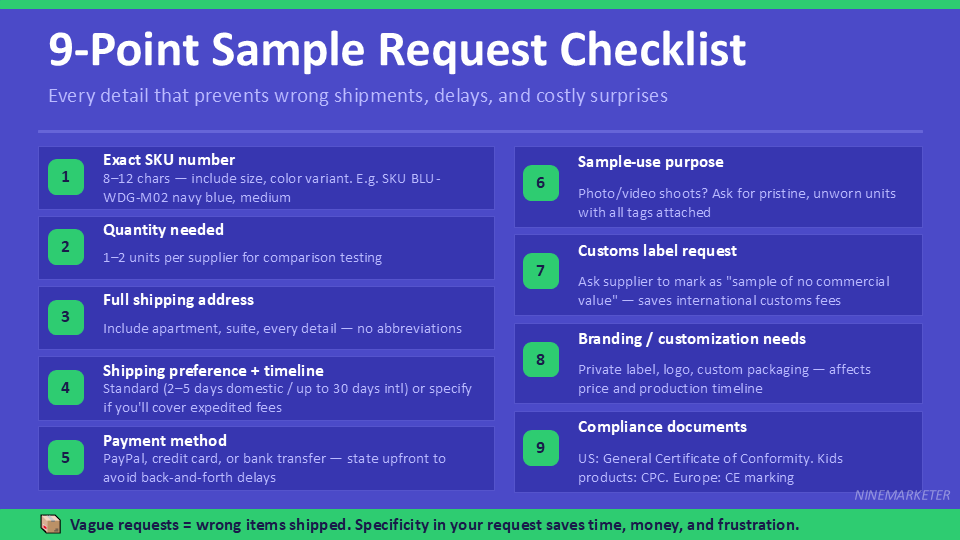
Being super specific in your sample request saves time and headaches later.
Vague messages get vague responses,or worse, the wrong stuff shipped to your door.
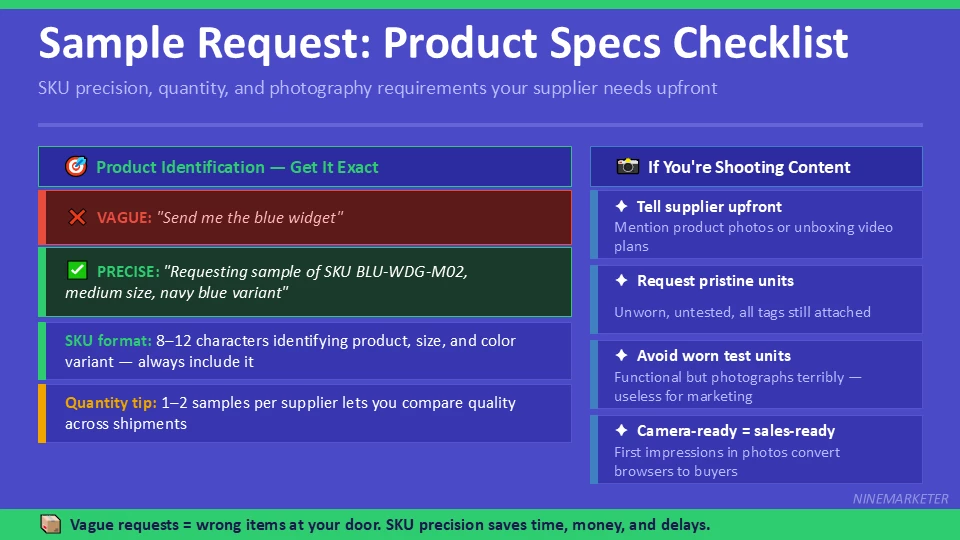
Start with exact product details including the SKU number.
Most SKUs contain 8-12 characters that identify everything about an item right down to size and color.
Don’t just say “send me the blue widget.”
Instead: “requesting sample of SKU BLU-WDG-M02, medium size, navy blue variant.”
That level of precision matters.
Quantity’s important too.
Some sellers test just one unit while others grab 1-2 samples per supplier to compare quality across multiple shipments.
If you’re planning product photos or unboxing videos, mention that upfront so suppliers send pristine, camera-ready samples.
Your complete shipping address is non-negotiable, include apartment numbers, suite details, everything.
And here’s a trick: ask suppliers to mark packages as “sample of no commercial value” to dodge customs fees on test orders.
Works especially well for international shipments.
Shipping preferences matter more than people realize.
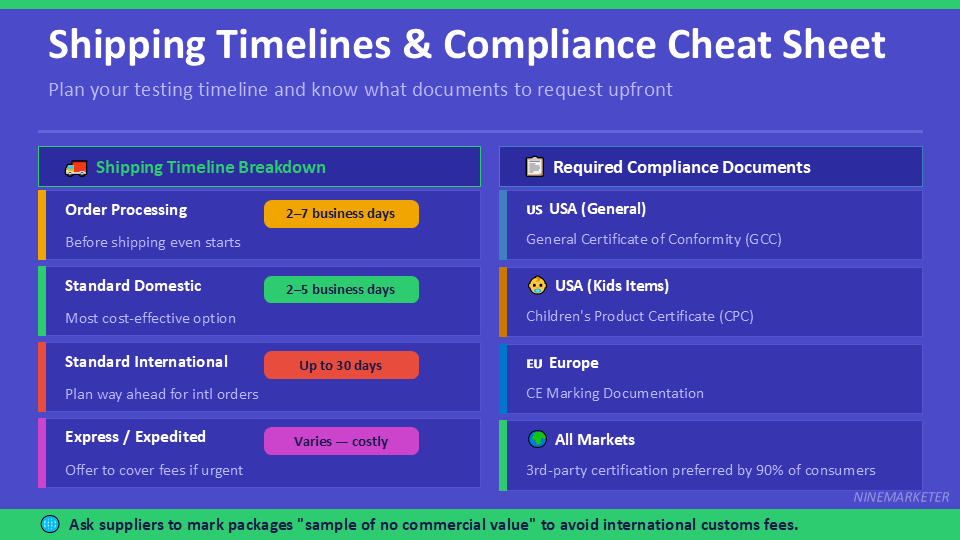
Standard shipping takes 2-5 business days domestically but can stretch up to 30 days internationally.
If you need items faster, specify whether you’ll cover expedited fees.
Most orders process within 2-7 business days before shipping even starts, so factor that into your timeline.
Payment method preferences should be clear from the jump.
Some vendors only accept PayPal while others take credit cards or bank transfers.
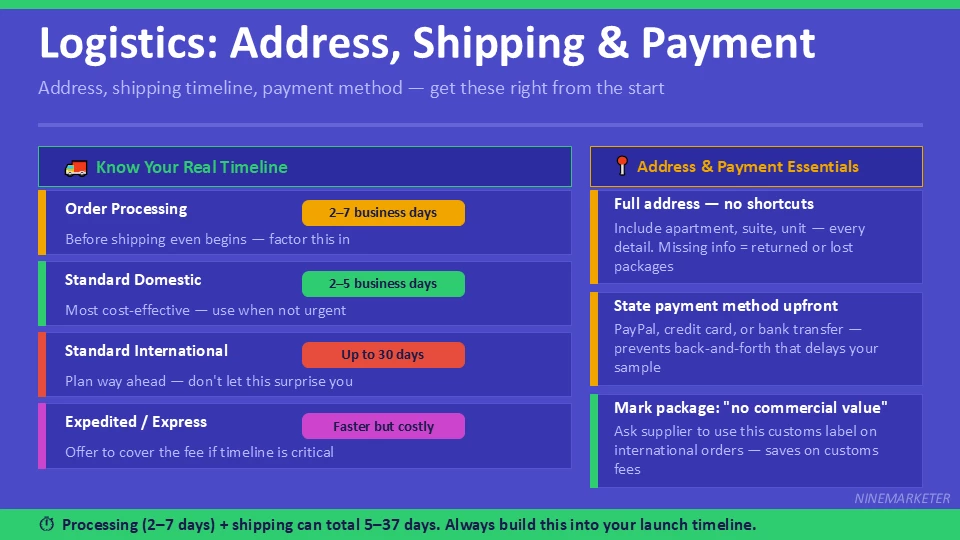
Laying this out prevents back-and-forth that delays your sample.
If customization or branding’s on your radar, bring it up now.
Private labeling, custom packaging, logo placement, these details affect pricing and production timelines significantly.
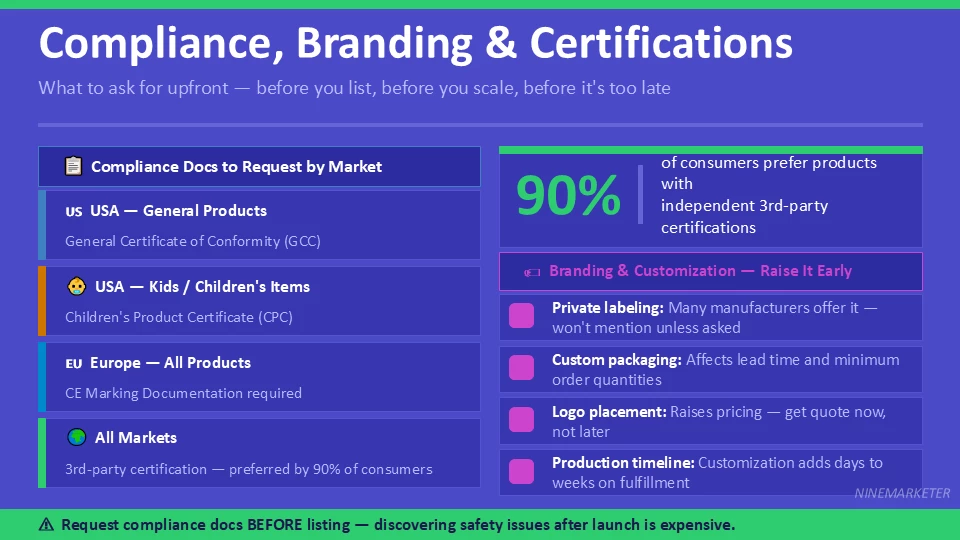
For compliance-heavy niches, request quality certifications or safety documents immediately.
Products sold in the U.S. might need a General Certificate of Conformity, while kids’ items require Children’s Product Certificates.
In Europe? You’ll need CE marking documentation.
Almost 90% of consumers prefer products with third-party certifications verified by independent bodies.
Photography requirements deserve mention if you’re creating marketing materials.
Tell suppliers you need unworn, pristine samples with all tags attached for content creation.
Otherwise you might receive slightly worn test units that look great functionally but photograph terribly.
Evaluating Product Samples: A Quality Checklist
Once your samples arrive, don’t just toss them on a shelf and assume everything’s fine.
The whole point is scrutinizing every detail like a detective looking for clues.
Start by comparing what you’re holding against those gorgeous supplier photos.
Research shows 22% of returned products come back because they look different in person than they did online.
That’s brutal.
Check if colors match exactly, not kinda close, but dead-on accurate.
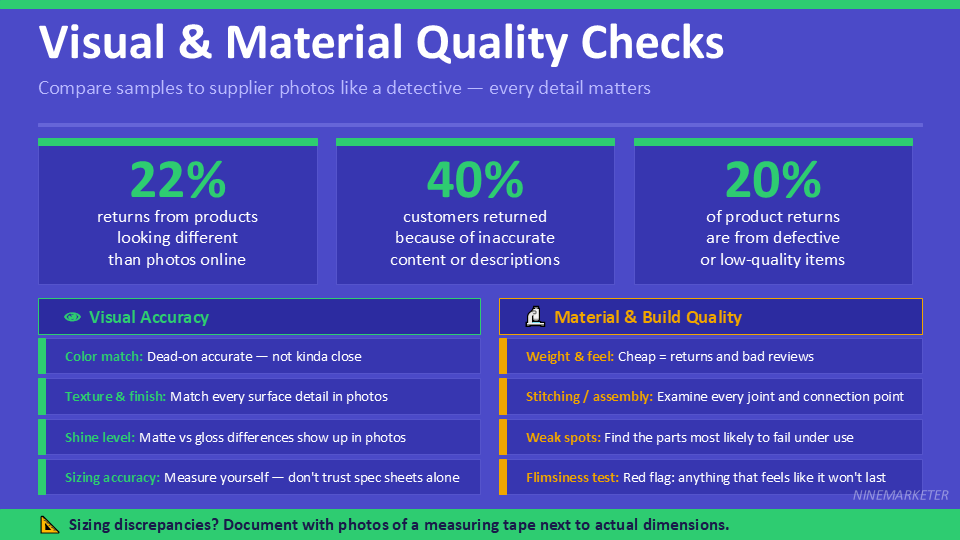
Textures, finishes, even the shine level matters.
Forty percent of customers have returned purchases in the past year specifically because of inaccurate product content and descriptions.
Material quality tells you everything about whether this partnership’s gonna work long-term.
Feel the weight, examine stitching or assembly points, look for weak spots that’ll fail after a few uses.
Construction matters way more than pretty marketing photos.
Items feeling cheap or flimsy?
That’s your red flag moment.
Sizing accuracy can make or break you, especially in clothing or furniture niches.
Measure everything yourself and compare against the specs listed.
If a “large” shirt fits like a medium, customers will rage about it in reviews.
Document these discrepancies with photos showing a measuring tape next to the actual dimensions.
Test the functionality hard, don’t baby it.
If it’s a kitchen gadget, use it multiple times.
Electronics?
Put them through their paces.
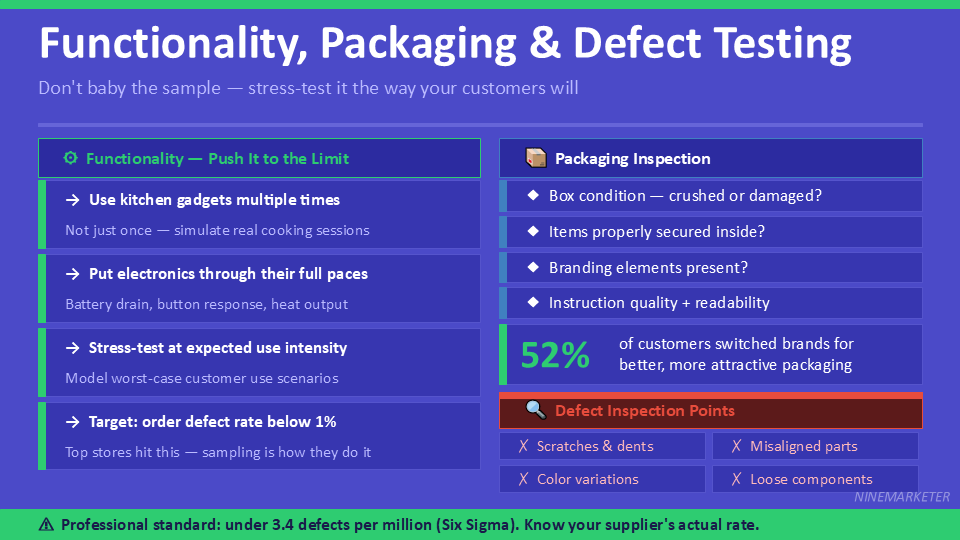
Top-performing stores maintain order defect rates below 1%, and catching problems during sampling is how they achieve that benchmark.
Packaging deserves serious attention too.
Is the box crushed from shipping?
Items poorly secured inside?
Around 52% of customers have switched brands because competitors offered better, more attractive packaging.
Check for branding elements, instruction quality, and whether everything arrives intact.
Defects and inconsistencies are deal-breakers.
Examine every angle for scratches, dents, misaligned parts, or color variations.
Professional manufacturers aim for defect rates under 3.4 parts per million at Six Sigma Level 6, but realistically most suppliers operate at higher rates.
Know what you’re getting.
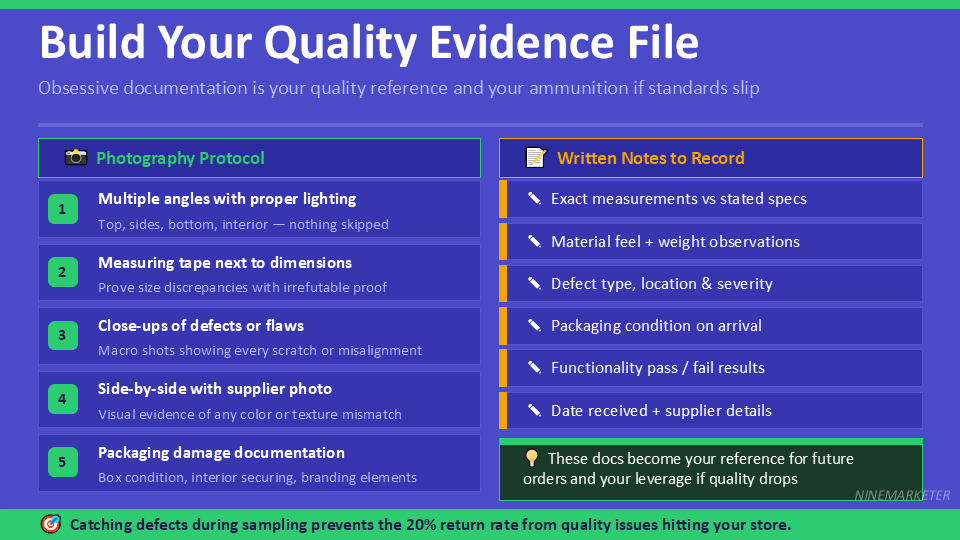
Document everything obsessively with detailed photos and written notes.
Shoot items from multiple angles with proper lighting.
These images become your reference point for future orders and your ammunition if quality slips later.
Twenty percent of product returns are from defective or low-quality items, catching issues during sampling prevents that nightmare scenario entirely.
Red Flags to Watch for When Receiving Samples
When that package finally arrives, the moment of truth hits.
Sometimes what you see ain’t what you expected, and those red flags need immediate attention.
The biggest warning sign?
Samples that look totally different from supplier listings.
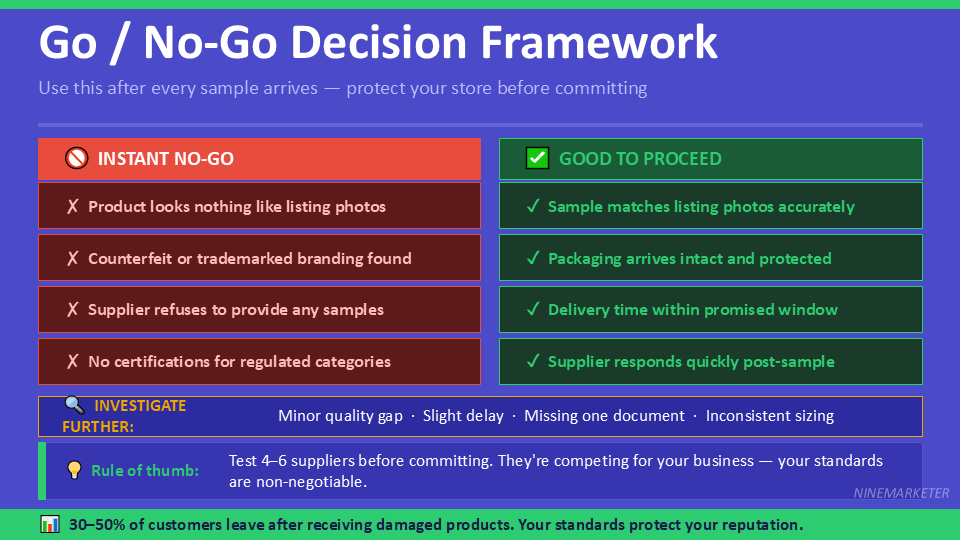
If photos showed premium materials but you’re holding something that feels cheap or flimsy, that’s your cue to bail.
Research shows that copyright infringement penalties range from $200 to $150,000 per work violated, and counterfeit items are everywhere in this business.
Packaging quality tells you everything about how customer orders will arrive.
50% customers report receiving damaged products because of inadequate packaging, that’s brutal.
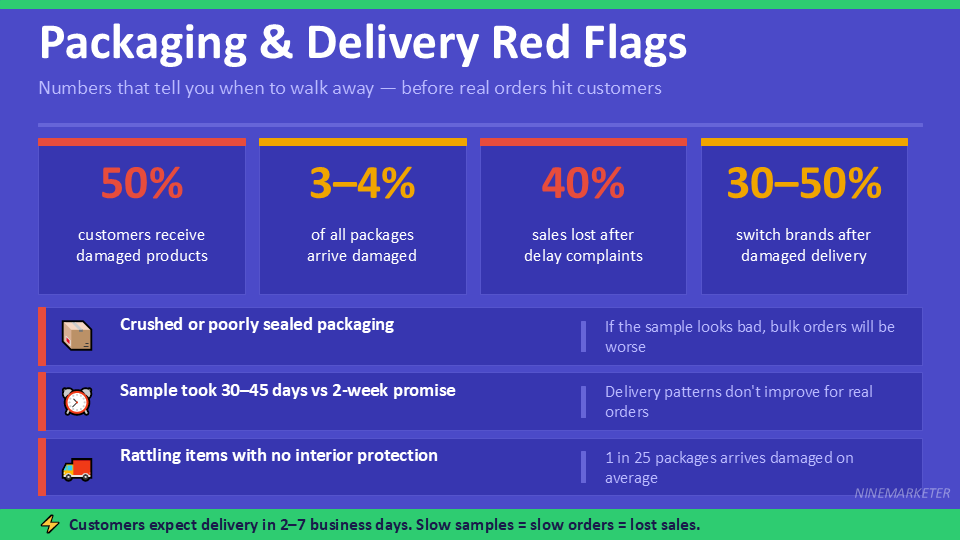
If your sample shows up crushed, poorly sealed, or with items rattling around loose inside, imagine what hundreds of customer packages will look like.
Industry data confirms 3-4% of all packages arrive with damage, which translates to nearly one in 25 shipments getting messed up.
Shipping times matter too.
If your sample took forever to arrive,like 30 or 45 days when they promised two weeks, that pattern won’t magically improve for actual orders.
One dropshipper lost 40% of sales after complaints piled up about delays and quality issues.
Customers today expect delivery within 2-7 business days, not months.
Here’s something wild: suppliers who flat-out refuse to send samples are major red flags.
Legitimate operations understand testing builds trust and will happily accommodate reasonable sample requests, even if they charge nominal fees.
Inconsistency between multiple samples from the same vendor screams quality control problems.
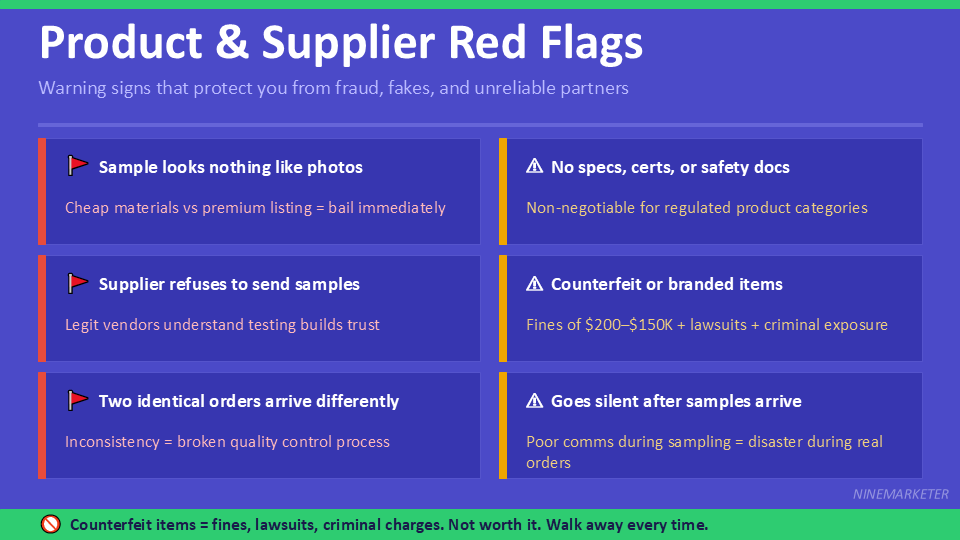
Order two identical items and they arrive looking completely different?
That’s gonna translate to angry customers and returns.
Missing product specs or certifications should immediately raise concerns, especially for regulated categories.
And if suppliers ghost you after samples arrive, won’t answer questions, dodge follow-ups, that communication pattern will only get worse once you’re placing real orders.
Counterfeit or trademarked products are deal-breakers.
Selling unauthorized branded items can result in fines, lawsuits, and criminal charges.
Not worth the risk, period.
Thirty to fifty percent of customers switch brands after receiving damaged products, so these red flags directly impact your bottom line and reputation.
Using Samples to Create Better Product Listings
Stock photos from suppliers are basically begging customers to scroll past your store.
When you shoot your own content with physical samples, everything changes, suddenly your listings feel real and trustworthy.
Here’s what most sellers miss: high-quality product images boost conversion rates by 94% compared to low-resolution photos.
That’s not a typo, nearly double the sales just from better visuals.
Natural lighting works wonders for capturing authentic colors and textures.
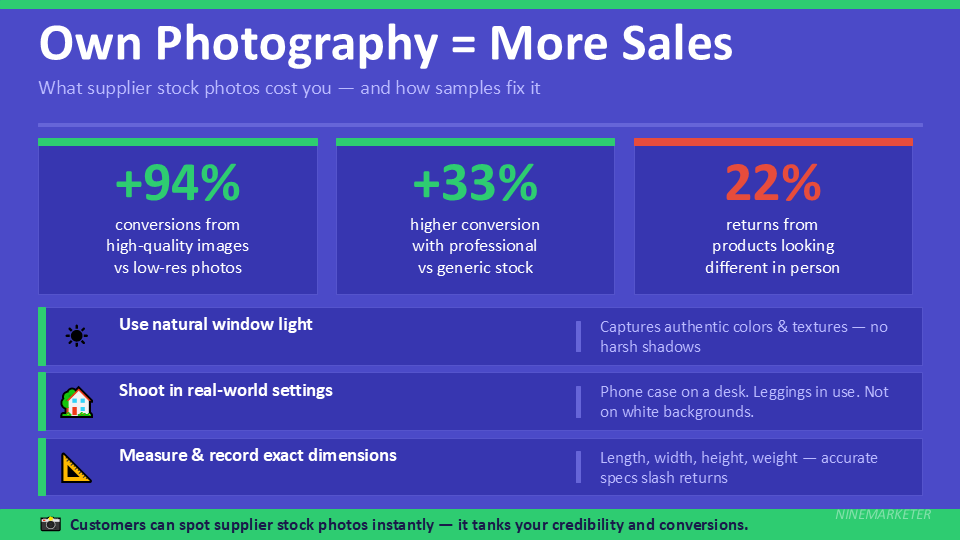
Shoot near a window during daytime and watch how much better your items look compared to harsh overhead lights.
Lifestyle photos make a huge difference too.
Instead of just showing the product on a white background, style it in real-world settings.
Show that phone case on an actual desk with a coffee mug nearby, or photograph those workout leggings on a person doing yoga.
Research shows conversion rates jump 33% higher when products feature professional-quality imagery versus generic stock photos.
Unboxing videos are absolutely crushing it right now on social media.
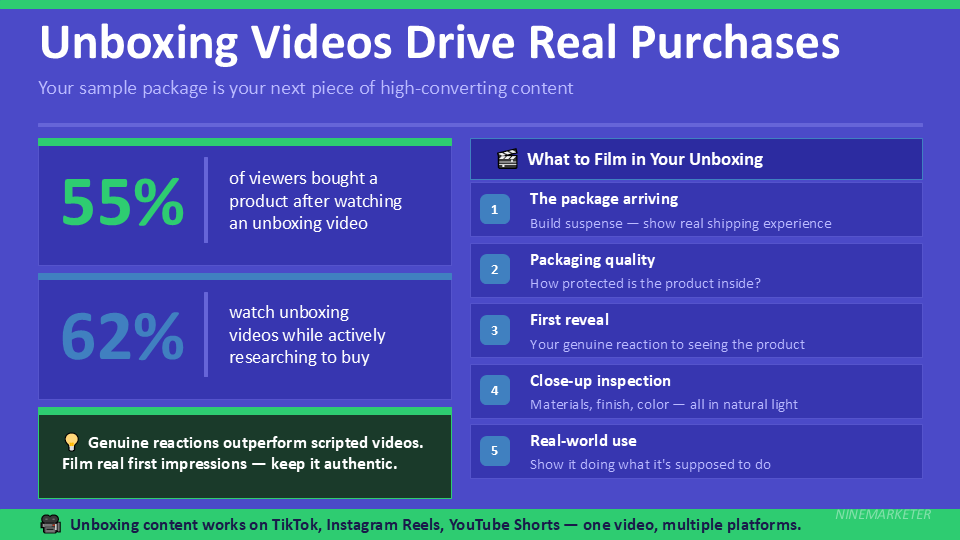
55% of viewers have purchased products after watching unboxing content, and 62% of people watch them specifically while researching what to buy.
Film yourself opening that sample package, showing packaging quality, revealing the actual product, and discussing first impressions. Keep it real—scripted videos perform way worse than genuine reactions.
Measuring dimensions yourself prevents nightmare scenarios later.
Grab a tape measure and record exact measurements for length, width, height, and weight.
Twenty-two percent of returns happen because products look different in person than online listings showed.
Accurate specs cut down returns massively.
When writing descriptions, forget generic fluff.
Get specific about what you discovered during testing, material quality, how sizing runs, potential issues you noticed.
87% of shoppers say accurate product descriptions directly influence their purchase decisions, and well-written descriptions can increase conversions by up to 78%.
Address concerns proactively based on your testing experience. If the color photographs darker than it appears in real life, mention that upfront.
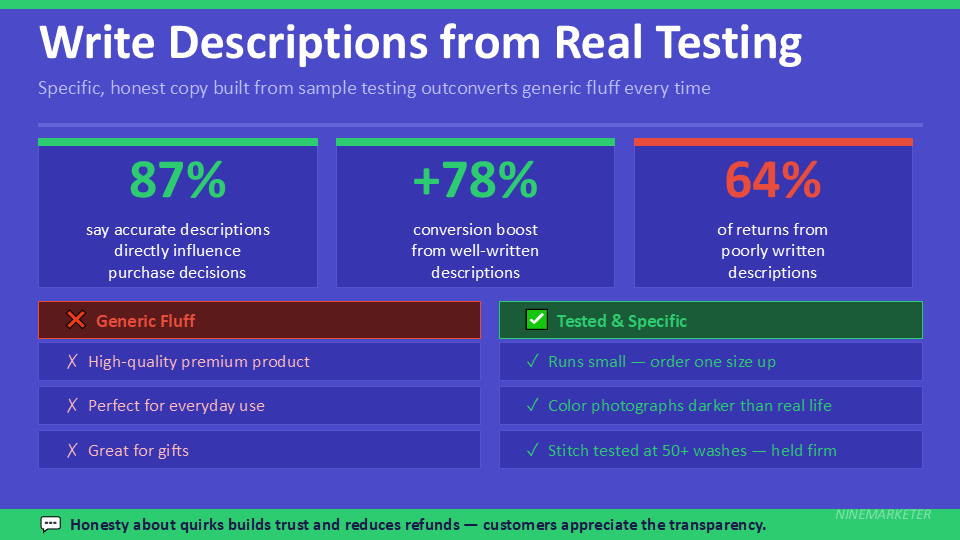
64% of returns stem from poorly written descriptions, so being honest about quirks actually builds trust and reduces refunds.
Real product photography separates pros from amateurs.
Customers can spot dropshippers using supplier images from a mile away, and it tanks credibility instantly.
Testing Shipping Times and Packaging Quality
When that sample package finally hits your doorstep, start the clock and document everything.
Note the exact date you ordered, when it shipped, and when it arrived, this timeline reveals whether your vendor’s promises match reality.
Average delivery times dropped to 3.7 days in 2024, but many suppliers still miss the mark by a week or more.
Packaging quality tells you everything about what customers will experience.
50% of shoppers report receiving damaged products because of inadequate packaging, which is absolutely brutal for your reputation.
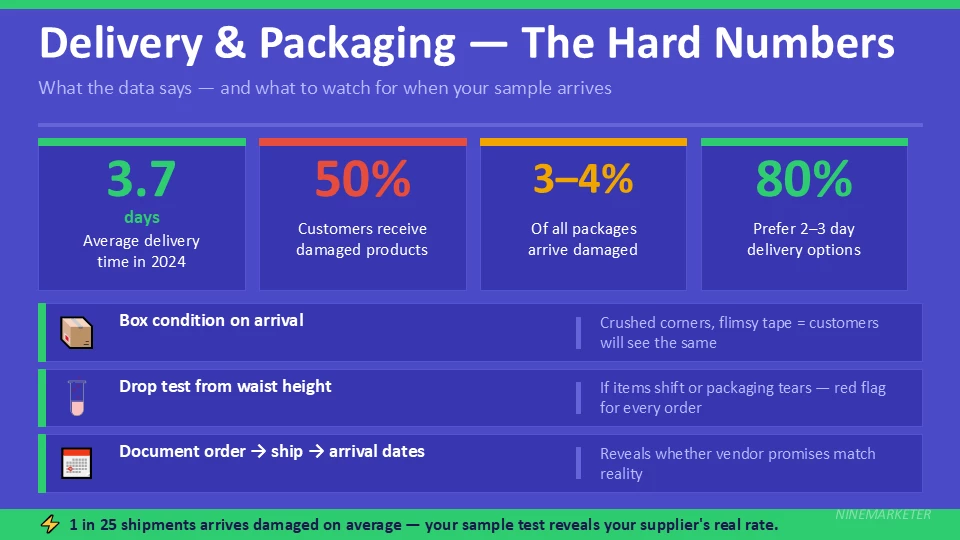
Inspect the box when it arrives, crushed corners?
Flimsy tape?
Items bouncing around loose inside?
Those problems will plague every single customer order.
Here’s what catches people off guard: industry data shows 3-4% of all packages arrive damaged during transit.
That’s nearly one in every 25 shipments getting messed up.
Test your sample packaging by dropping it from waist height or shaking it around.
If items shift or packaging tears easily, that’s a massive red flag.
International shipments bring their own headaches.
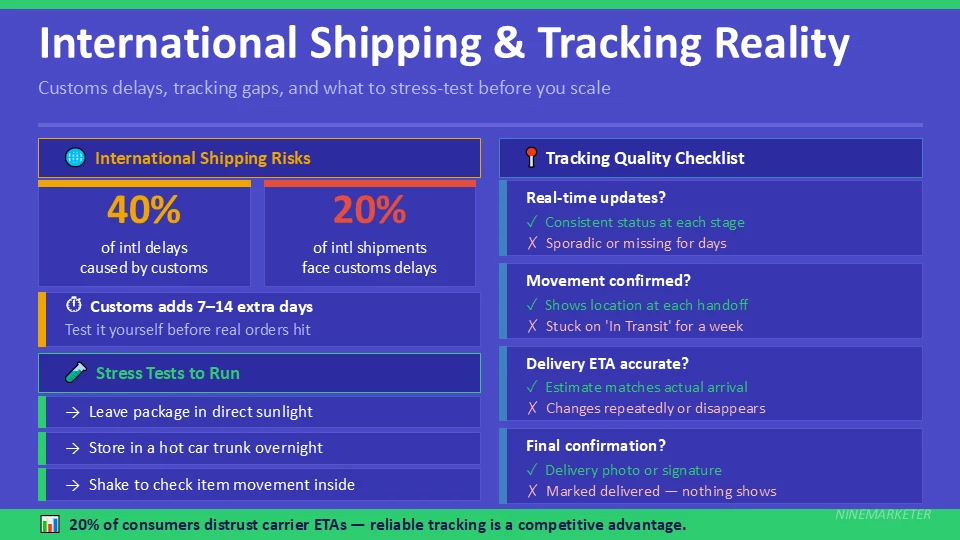
Customs holds account for 40% of international shipping delays, adding anywhere from 7-14 extra days to delivery times.
About 20% of international ecommerce shipments face customs-related delays, so testing this process yourself prevents nightmare scenarios later.
Tracking accuracy matters more than most realize.
Check if updates happen in real-time or if they’re sporadic and unreliable.
Around 20% of consumers don’t trust estimated delivery dates from carriers, and sketchy tracking only makes this worse.
Your sample order should have consistent status updates showing movement.
Evaluate the unboxing experience like you’re the customer.
Eighty percent of consumers prefer 2-3 day delivery options, making speed critical.
But packaging presentation matters too, are items wrapped carefully?
Does everything feel premium or cheap?
Compare multiple shipping methods if suppliers offer them.
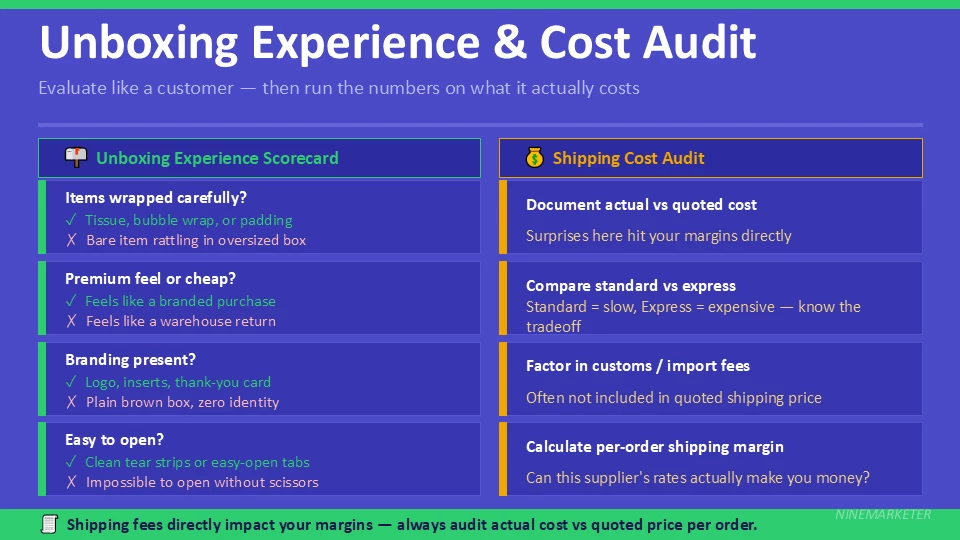
Standard might take forever while express costs a fortune.
Document actual costs versus quoted prices, because shipping fees directly impact your margins.
Test packages in different conditions if possible, leave one in the sun, another in your car trunk overnight.
Extreme temperatures reveal whether items hold up or fall apart.
Managing Multiple Supplier Samples Effectively
Testing samples from five different vendors at once without a system?
That’s a guaranteed mess.
You’ll forget who sent what, lose track of costs, and end up making decisions based on vague memories instead of hard facts.
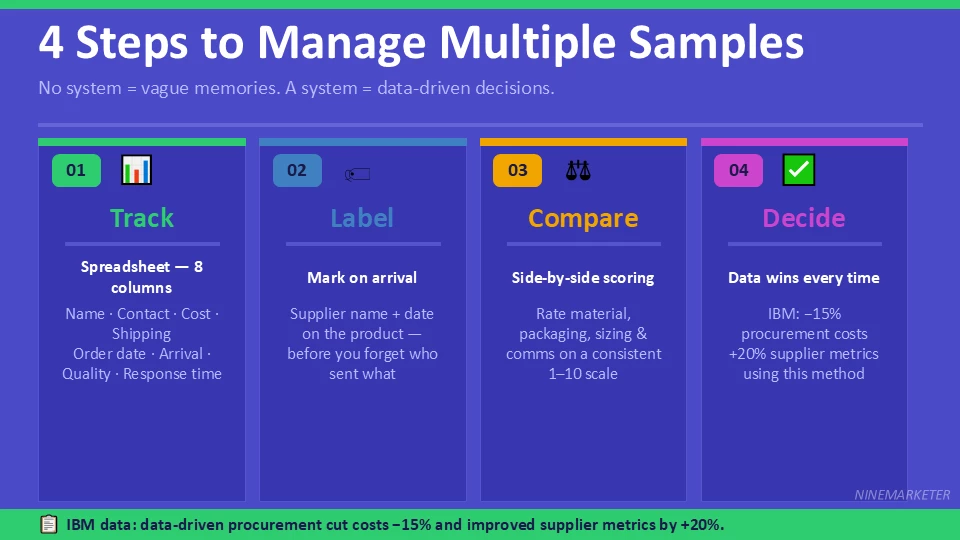
A simple tracking spreadsheet is your best friend here.
Set up columns for supplier name, contact info, sample costs, shipping fees, order dates, arrival dates, and quality ratings.
Many procurement teams still rely on spreadsheets for tracking supplier data before it gets integrated into larger systems.
Nothing fancy, just organized data you can actually use.
Labeling samples the second they arrive saves headaches later.
Grab a marker and write the supplier name plus arrival date directly on products or packaging.
When you’re comparing three identical phone cases two weeks later, you won’t be playing guessing games about which vendor sent which one.
Document everything obsessively, costs, timelines, quality observations, and communication speed.
Research on supplier performance management shows that tracking key metrics like delivery time and responsiveness provides objective ways to compare vendors and spot trends.
You need this data when making final decisions, not fuzzy impressions.
Side-by-side comparison is where the magic happens.
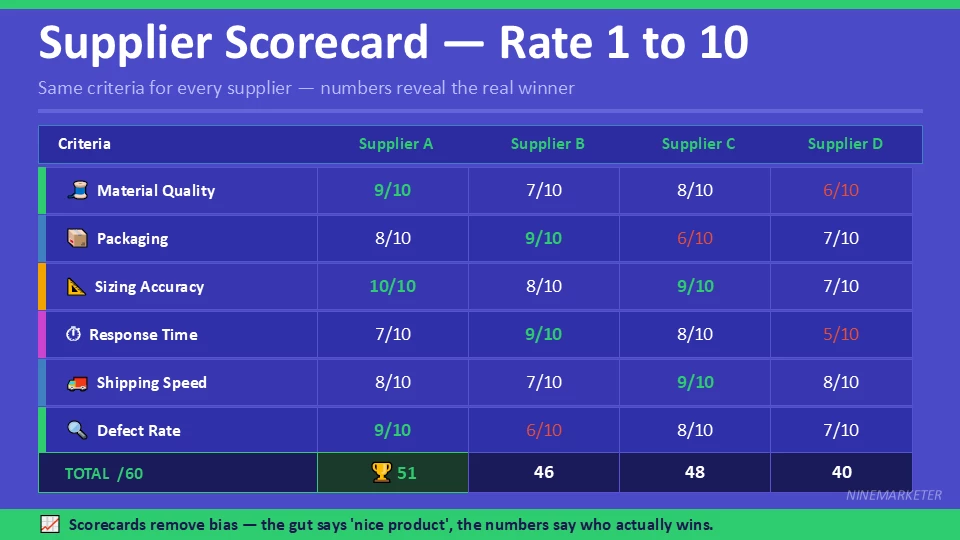
Lay samples from different suppliers next to each other and evaluate them against identical criteria.
Material quality, packaging, sizing accuracy, rate everything on a consistent scale like 1-10.
Studies show that establishing clear performance metrics and using supplier scorecards leads to better vendor relationships and more strategic partnerships.
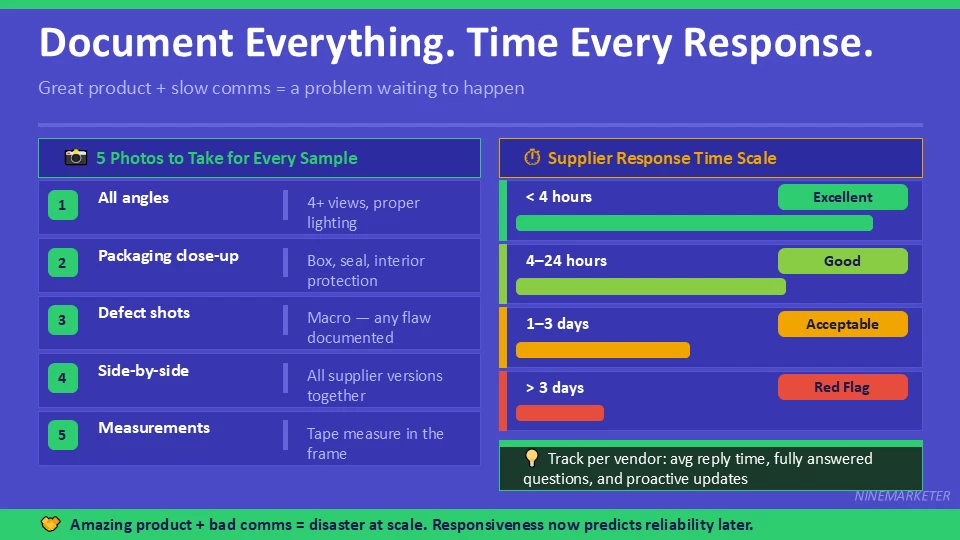
Keep photographic records of absolutely everything.
Shoot each sample from multiple angles with proper lighting.
Capture packaging quality, any defects, and comparison shots with different suppliers’ versions side-by-side.
These images become your reference library when revisiting decisions months later.
Track communication response times too.
Note how long each supplier takes to answer questions or provide tracking info.
Responsiveness is a critical supplier performance metric because fast responses keep projects on track and build trust.
A vendor with amazing products but terrible communication will cause problems down the line.
Making data-driven supplier selections beats gut feelings every time.
Organizations using data analytics for procurement decisions see significant improvements, companies like IBM reduced procurement costs by 15% and improved supplier metrics by 20% through this approach.
Your spreadsheet full of actual numbers tells the real story about which partnership makes sense.
Final Thoughts
Requesting product samples from dropshipping suppliers isn’t just a checkbox on your business setup list, it’s the foundation of a sustainable, profitable dropshipping operation.
Every sample you test is money saved on future returns, time saved on customer complaints, and credibility earned with your audience.
The suppliers who make sampling easy, deliver quality products, and communicate professionally are the ones who’ll help you build a real business, not just a storefront.
Start by reaching out to your top three supplier candidates today using the email templates provided above.
Order those samples, test them ruthlessly, and don’t settle for anything less than products you’d be proud to receive yourself.
Your future customers, and your profit margins, will thank you for doing the homework upfront.
Remember: in dropshipping, the quality of your suppliers determines the quality of your business.