


Picture this. A customer orders a jacket from your store on a Monday. By day twelve, there’s no tracking update, no email, and no idea where the package is. So she does what every frustrated buyer does: she opens a chargeback. Your product was fine. Your supplier shipped it. The real culprit? A vague, one-line shipping policy that promised “fast delivery” and explained nothing.
I’ve seen this play out again and again in dropshipping. Store owners obsess over ads, product research, and branding, then paste a generic shipping policy from a template and move on. Big mistake! Because in a model where you don’t control the warehouse, your shipping policy is the only thing standing between your customer’s expectations and a supplier’s real-world timelines. Get it right, and you cut support tickets, disputes, and refund requests. Get it wrong, and you pay for it in chargebacks and one-star reviews.
In this guide, you’ll learn exactly what a customer-friendly shipping policy includes, how to set honest delivery times with overseas suppliers, how to handle costs, tracking, international orders, and lost packages, and how to write it all in plain language that builds trust instead of legalese that scares buyers off. You’ll also get a checklist to audit your own policy today.
1. Why Your Shipping Policy Matters More in Dropshipping Than in Traditional Ecommerce
A dropshipping shipping policy matters more than it would for a regular shop because you never touch the package.
A supplier packs it, a carrier moves it, and your store eats the blame when something goes sideways.
That gap between what you promise and what you actually control is exactly what your policy has to cover.
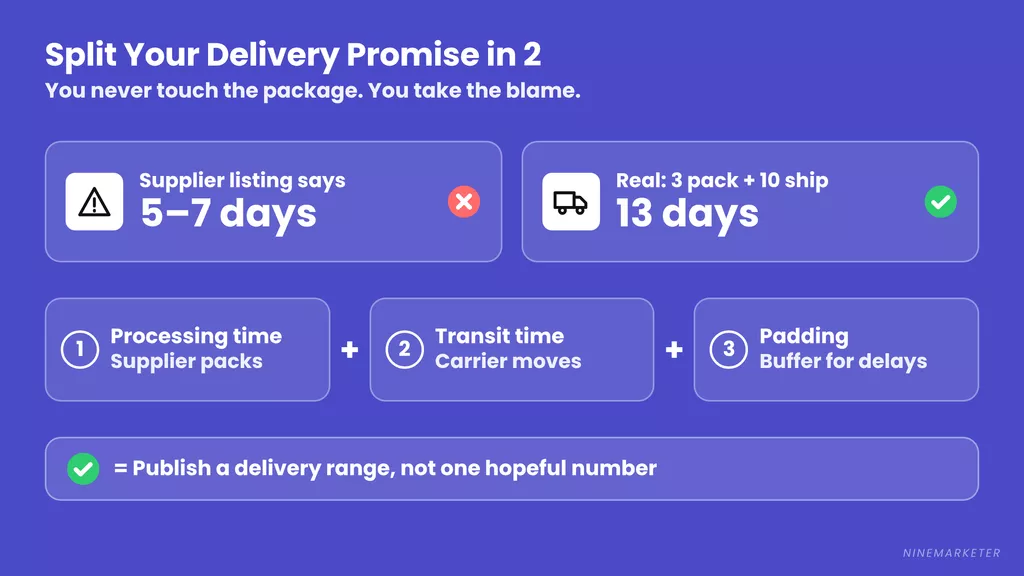
Picture a store owner who copies “delivery in 5-7 days” straight off a supplier listing (those numbers are famously optimistic).
The supplier needs three days just to pack the box, the carrier adds ten more, and the inbox fills up with “where is my order??” emails.
Frustrating? You bet.
Here’s the fix sellers tend to learn the hard way: split the promise in two.
Order processing time is how long the supplier needs before the parcel leaves the building, and transit is how long the carrier needs after that.
Add both together, pad it a bit, and publish a delivery time range instead of one hopeful number.
Why does a clear promise move money?
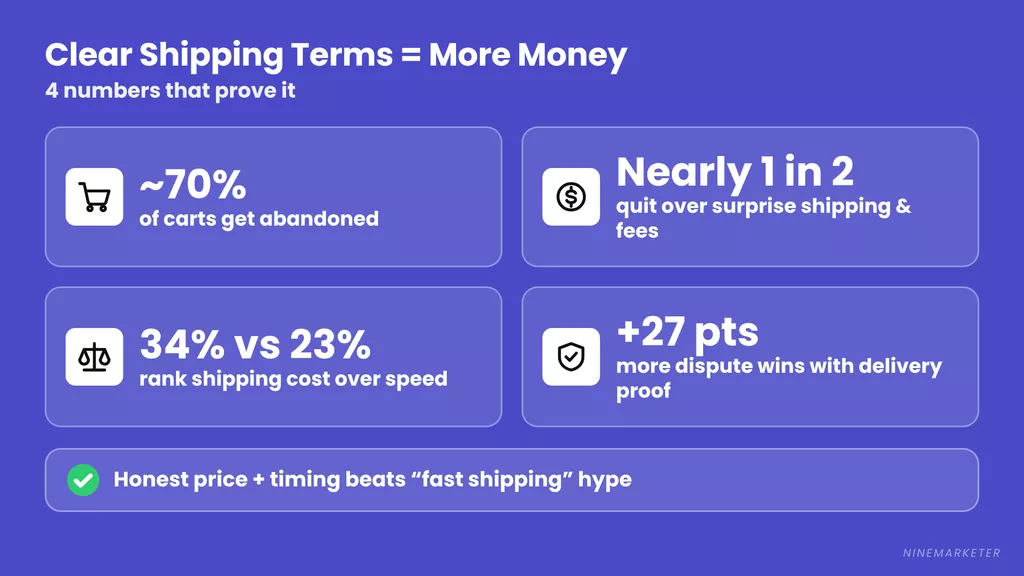
Shoppers ditch carts all the time, and Baymard’s roundup of dozens of studies lands on an average abandonment rate of about 70%. The loudest trigger isn’t the product itself, though.
In a February 2024 Baymard survey, nearly half of the US adults surveyed said surprise shipping, tax, and fees made them quit at checkout.
Here’s a twist. A ShipStation survey found 34% of shoppers worldwide rank delivery cost as their top ordering factor, compared with just 23% who put speed first.
So a straight answer about price and timing often beats a flashy “fast shipping” claim.
A late package that was explained up front feels like a fair trade.
A late package nobody warned about feels like getting played, and those buyers aren’t exactly lining up for a second order.
That’s the quiet link between transparent shipping and repeat purchases.
Unclear delivery terms cost real money, too. Over on Stripe, “product not received” is the most common nonfraud dispute category, and sellers who submit delivery confirmation win about 27 percentage points more often than those who can’t.
That’s chargeback prevention and payment dispute reduction in one tidy habit: keep tracking proof on every order.
PayPal adds its own hurdles.
Its Seller Protection program sets extra requirements for “item not received” claims, so a fuzzy delivery promise plus a missing order tracking number is a rough combo.
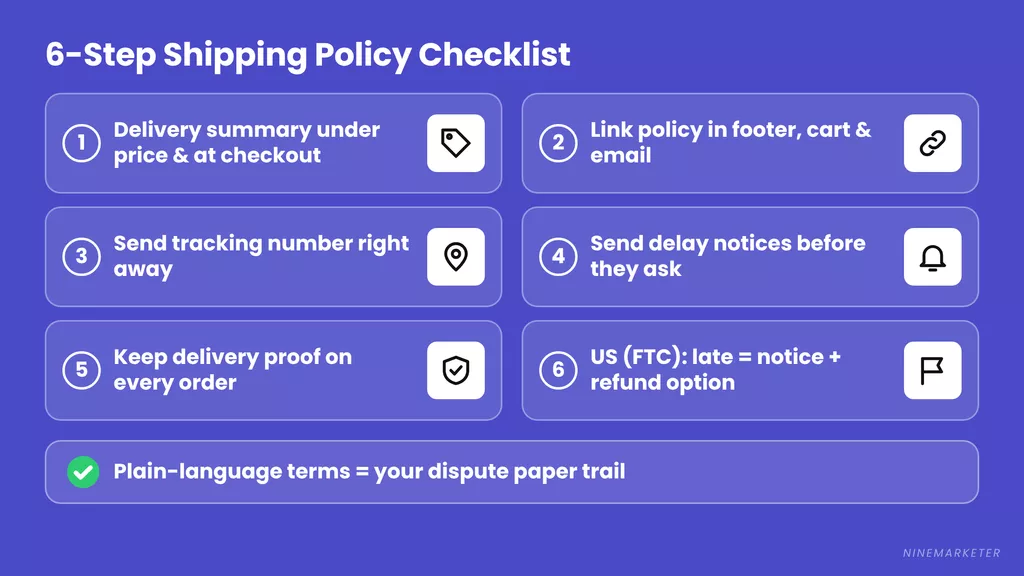
Send the number the second your supplier hands it over, and if a date slips, fire off a shipping delay notification before anybody has to ask.
If you sell to US shoppers, there’s a legal layer on top of all this.
The FTC’s rule for internet orders says merchants need a reasonable basis to ship within the time they advertise, or within 30 days when no time is stated.
Miss that window and the customer is owed a delay notice with a new date, plus the option to cancel for a full, prompt refund.
Last piece, and it’s an easy one: your policy page works like a handshake.
Shoppers who can’t find delivery terms near the Add to Cart button start wondering what else is being hidden, so a one-line summary under the price (repeated at checkout) goes a long way.
Link the full page from the footer, the cart, and the confirmation email, and you’ll probably reduce support tickets too.
And here’s a sneaky bonus.
When a dispute does land, Stripe’s evidence guide says to cite your terms of service, including the sections on delivery confirmation and disputes, which means the page you wrote for customers doubles as your paper trail.
Write it in plain language and it works for everybody.
2. What to Include in a Dropshipping Shipping Policy (The Essential Elements)
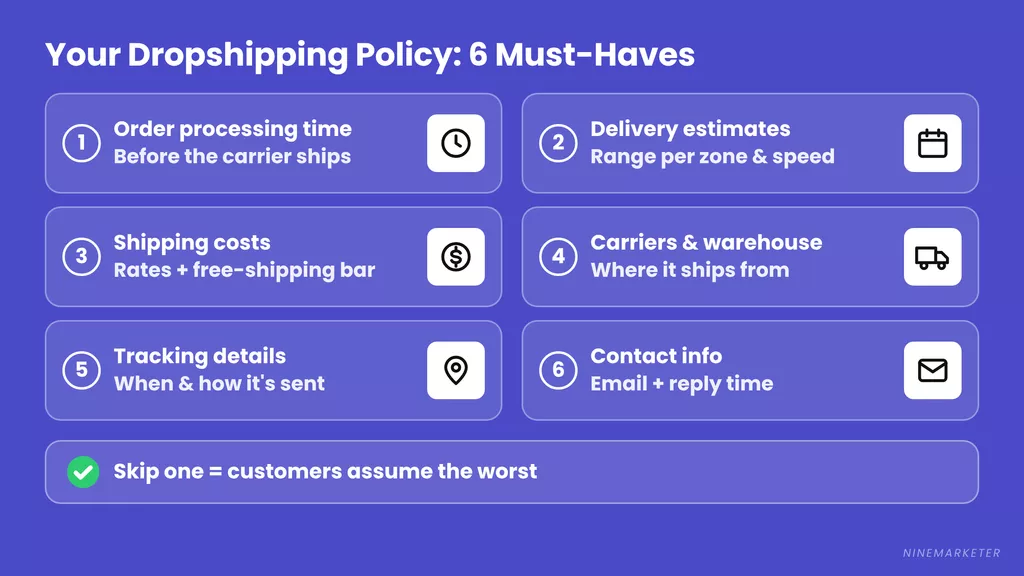
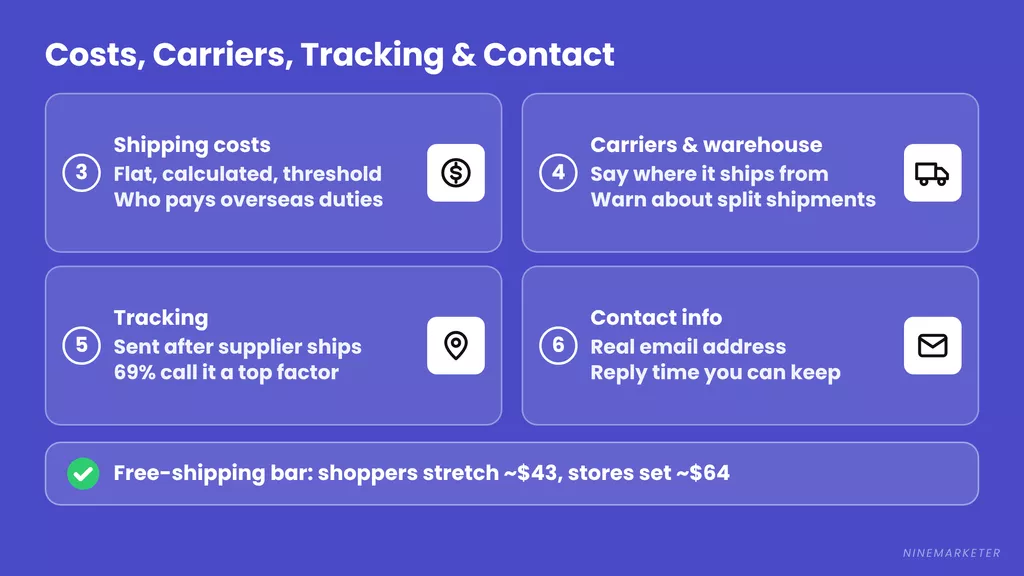
A solid dropshipping shipping policy covers six things: order processing time, delivery estimates, shipping costs, carriers and warehouse locations, tracking details, and a way to reach you.
Skip any one of them and customers will fill the gap with their own assumptions.
Usually the worst-case ones.
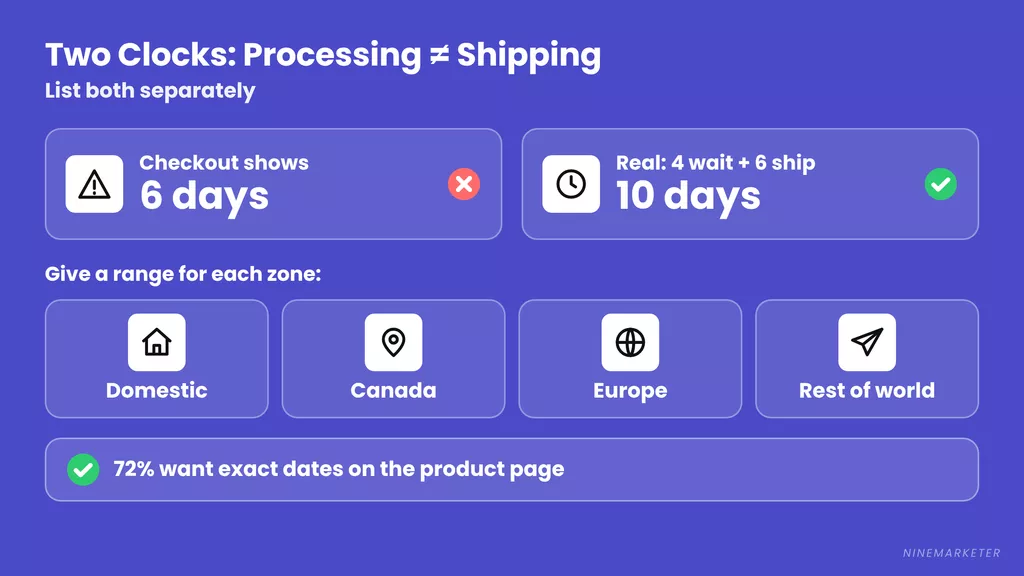
Start with the one that trips up most newbies: order processing time and shipping time are two separate clocks.
Processing is the stretch before your supplier hands the parcel to a carrier, while shipping is the carrier’s trip after that.
Shopify’s help docs point out that carrier-calculated rates often show transit time at checkout but exclude processing time, which is exactly how a “3-day” promise quietly turns into ten.
Picture a shopper who sees “arrives in 6 days” at checkout, then waits four days for the supplier to even ship.
By day eight she’s emailing support, and by day ten she’s filing a dispute.
Ugh. List both clocks separately and the whole mess gets avoided.
Next up, delivery estimates by region and method.
Give a delivery time range for each zone (domestic, Canada, Europe, rest of the world) and each speed, not one hopeful number.
Baymard’s research found that 41% of sites show only a shipping speed like “5-7 business days” instead of a real date, which leaves shoppers doing math in their heads.
Dates matter on the product page, too.
In Forrester’s March 2025 survey, 72% of adults said specific delivery dates on a product detail page are important. And 80% wanted an order confirmation with a date in it.
For overseas orders, also say who covers customs and import duties, because a surprise bill at the door goes over badly.
Now the money part.
Flat rates are easy to explain, calculated rates follow the carrier’s real price, and a free shipping threshold can nudge shoppers into bigger carts.
Shopify walks through all three rate types if you need the setup steps.
One fulfillment-industry roundup found that 58% of shoppers add items to qualify for free delivery, yet they’ll stretch only about $43 on average while the typical store sets the bar near $64.
Translation: a threshold set too high just annoys people. Run the math on your supplier’s real costs first, then adjust.
Then name your carriers and fulfillment locations.
If parcels ship from a US warehouse for local fulfillment, say so, since a domestic origin changes transit time a lot.
And if your supplier picks the carrier, “major carriers” is more honest than naming one you can’t guarantee.
Orders with items from more than one supplier are their own headache.
Split shipments mean two tracking numbers and two arrival dates, so warn people before it happens, not after.
Which is why one clear sentence in your delivery terms can save a dozen angry emails.
Tracking needs honest timing, too.
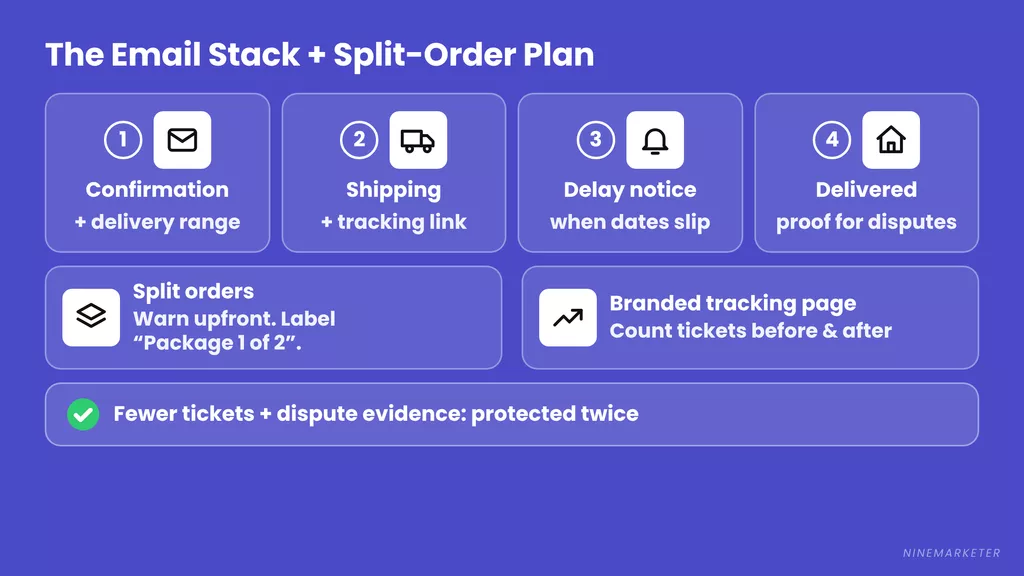
Say when the order tracking number will show up (after the supplier ships, not at checkout) and how it’s sent, like a shipping confirmation email with a link to a branded tracking page.
Shopify’s blog says 69% of consumers call real-time order tracking a top factor when shopping online, and “where is my order?” ranks among the most common questions merchants field.
Last item, and the easiest to forget: contact info for shipping questions.
Give a real email, a response-time promise you can actually keep, and the order number format people should include.
Tiny change, big win, because nobody has to play ping-pong over missing details, and that helps reduce support tickets.
Once it’s written, put the page where people will see it.
Shopify automatically links your policies in the checkout footer, and its help center adds that you’re responsible for following whatever you publish, template or not.
So write it in plain language, run a quick shipping policy checklist against your real supplier setup, and update it whenever suppliers change.
3. Setting Honest Delivery Times Without Scaring Customers Away
Honest delivery times start with real numbers, not the ones printed on a supplier’s product page.
Those listings are written to win the sale, so treat them like a sales pitch.
Your own test orders are the real report card.
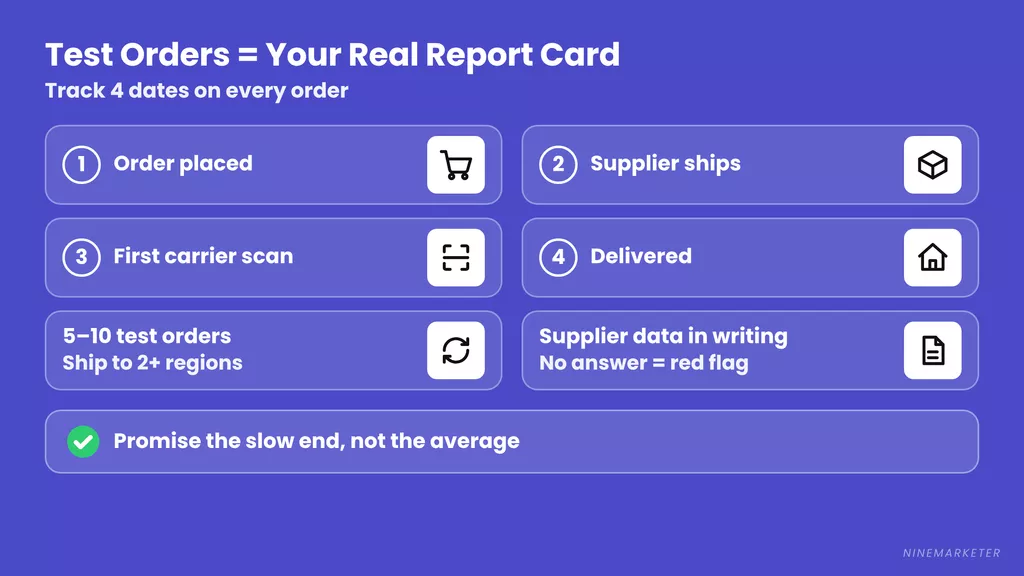
Order your own product from each supplier, ship it to your own address, and write down four dates: placed, shipped, first carrier scan, and delivered.
Do it five or ten times, ideally to a couple of different regions.
Then base the promise on the slow end of what you saw, not the average, because Murphy’s Law loves a brand-new store.
Ask each supplier for recent supplier shipping times in writing, including how long they take to process an order and how often orders slip.
A supplier who won’t share that?
Red flag.
That paper trail also helps legally, since US rules expect sellers to have a reasonable basis for the timeframe they advertise.
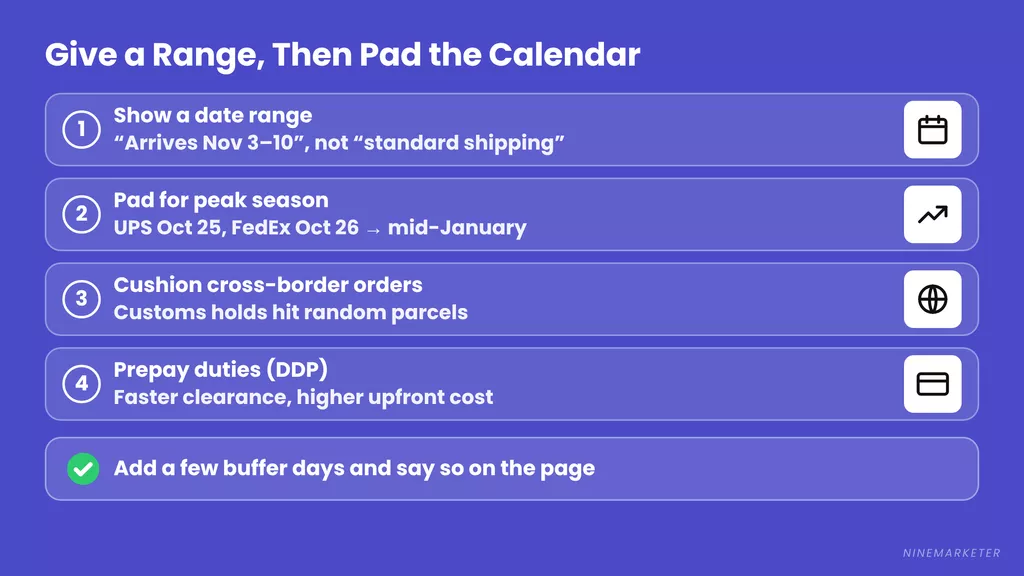
Next, ditch the single exact date and use a delivery time range. Baymard’s guidance, relayed by Amazon Pay, is to show a date range at checkout instead of a vague label like “standard shipping.” A window like “arrives Nov 3-10” gives you wiggle room without sounding evasive.
Why not just one date?
A lead-time study found that a quote acts as a reference point for customers, and that satisfaction dropped as quotes got less accurate.
One date means one chance to miss. A range lets reality land inside it.
Now pad for the calendar.
Peak season starts October 25 at UPS and October 26 at FedEx this year, and it runs into mid-January, when parcel demand sits far above normal capacity.
Add a few buffer days to your range during that stretch and say so on the page.
Cross-border orders need extra cushion too.
Customs holds happen when paperwork is off or duties go unpaid, and with duties left for the buyer to settle, the parcel just sits there until somebody pays.
One shipping-protection company points out that any promise built on average transit time can’t account for a hold that hits some random slice of orders.
Prepaying duties (that’s the delivered duty paid route) usually speeds clearance up.
It costs more upfront, though, so run the math before you promise it.
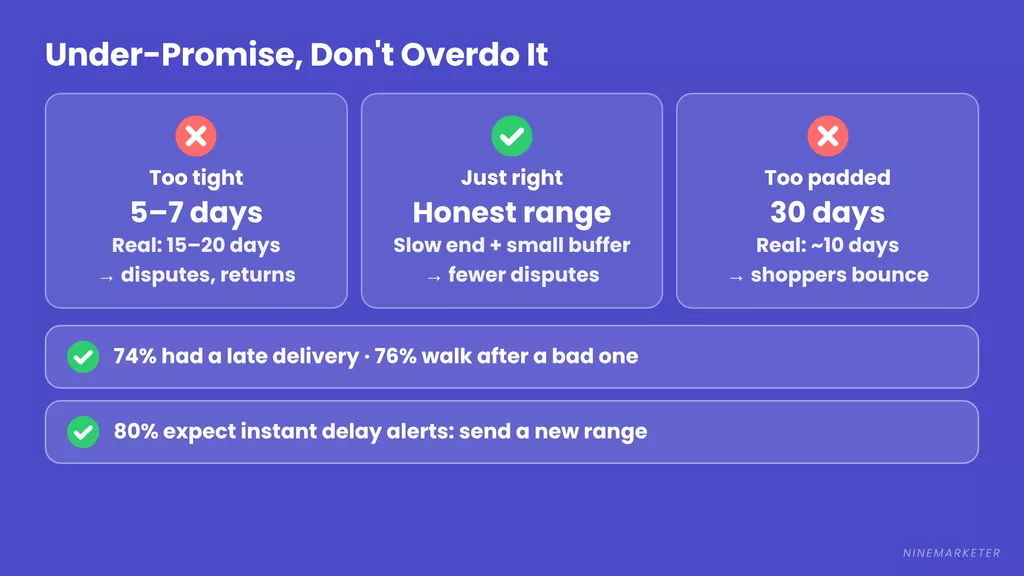
Then there’s the psychology of under-promising and over-delivering. Satisfaction mostly comes from the gap between what was promised and what showed up, so a package that beats a cautious window feels like a small win.
But it’s no magic trick: a 2017 study found the payoff depends on what each customer expects going in, and sometimes simply keeping a promise works just as well as beating it.
So don’t pad into silly territory.
Quote “30 days” on something that usually lands in ten, and some shoppers will bounce before they even reach checkout.
You’ve swapped one problem for another.
Here’s why “5-7 days” backfires when reality is 15-20. A 2024 operations study found that aggressive delivery promises tend to overpromise, which can mean longer-than-expected waits, lower satisfaction, and more returns. Picture a store copying that supplier-page promise: by day 12 the tracking page hasn’t moved, and by day 17 the box finally arrives at a customer who already filed a dispute.
The fallout isn’t small. Narvar’s 2025 report says 74% of shoppers had a late delivery in the past year, and 76% walk away after a poor experience.
Worse, 90% check first by reading the policy before they buy, so a shaky promise gets spotted fast.
When delays hit anyway, say so early.
Narvar research shared with Retail Dive shows shoppers will accommodate shipping delays when retailers communicate, and Sendcloud’s survey found 80% of shoppers expect immediate notifications about delays.
A quick shipping delay notification with a new range costs one email and saves a dozen angry ones.
Honest ranges, a little padding, and fast updates won’t scare anybody off.
Surprises will. It’s the cheapest chargeback prevention you’ll ever buy.
4. Writing in Plain Language: Making Your Policy Easy to Read and Understand
Here’s the uncomfortable truth about your shipping policy page: people do read it, just not like a contract.
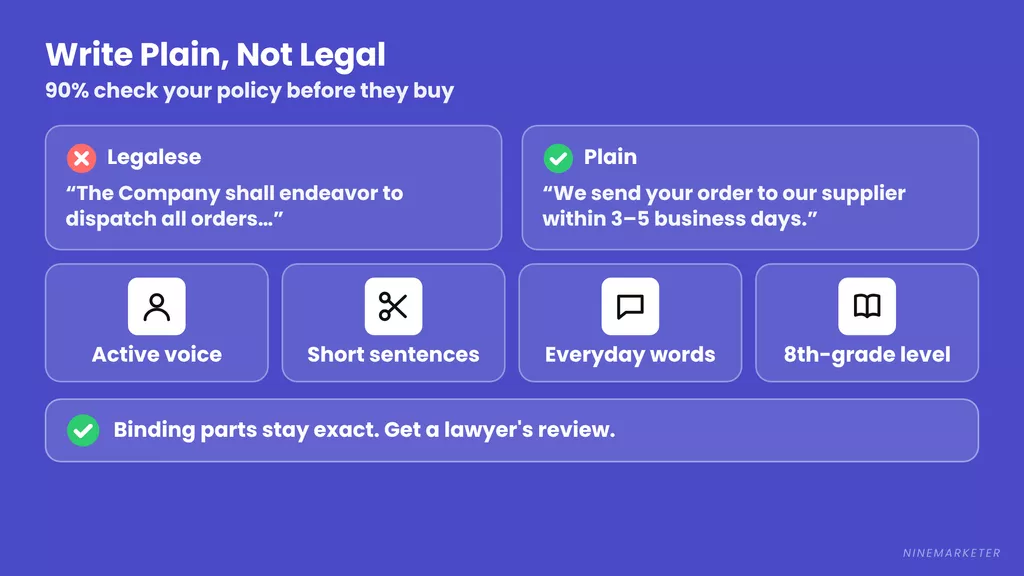
Narvar’s 2025 research says 90% check first, meaning they look at the policy before they buy.
They’re hunting for one answer, though, and if it’s buried under “heretofore” and “notwithstanding,” they bail.
So start by swapping legalese for plain talk.
Plainlanguage.gov defines it as writing people understand the first time they read it, using tools like active voice, short sentences, and everyday words.
Aim low on grade level, too, since the average American adult reads at roughly an 8th-grade level.
Picture this clause: “The Company shall endeavor to dispatch all orders within three to five business days, subject to availability.”
Now try: “We send your order to our supplier within 3-5 business days, and they ship it from there.” Same promise, half the headache.
Plain doesn’t mean careless, though.
Keep the binding parts (refund rights, liability, who pays duties) exact, and have a qualified lawyer look over anything that could end up in a dispute.
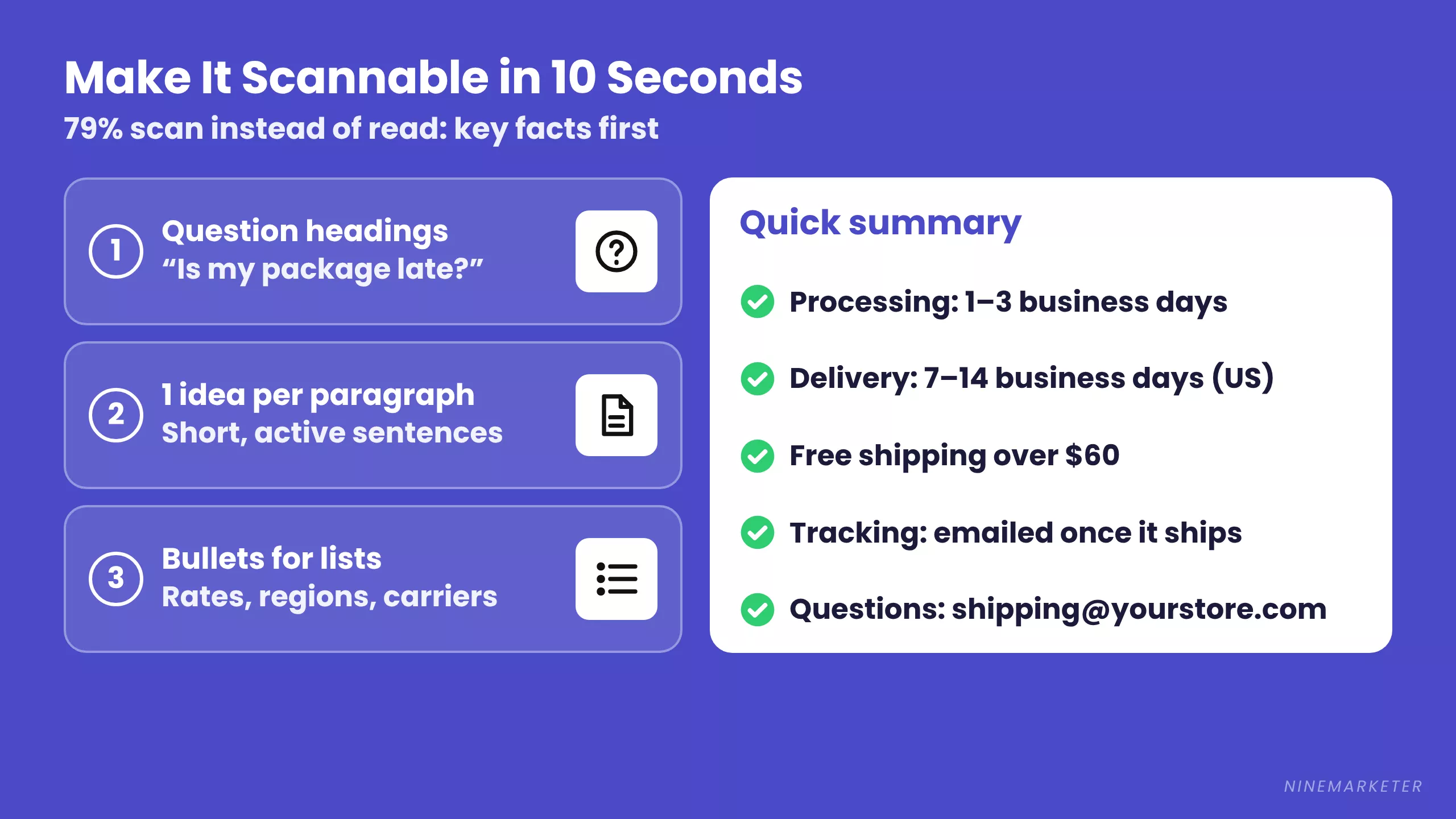
Next, chop the page into short sections with real questions as headings, like “How long will my order take?” and “What if my package is late?”
Nielsen Norman Group testing found 79% of users scan a new page instead of reading it word for word, so clear sub-headings and bulleted lists do the heavy lifting.
Keep one idea per paragraph, write short, active sentences, and let bullets carry the lists (rates, regions, carriers).
Then add a quick-summary box at the very top.
NN/g recommends the inverted pyramid, putting the key facts first so readers can stop at any point and still walk away with the main point.
For a delivery page, that’s five lines max, like this (swap in your own numbers):
Quick summary
Order processing: 1-3 business days
Delivery: 7-14 business days in the US
Free shipping on orders over $60
Tracking number: emailed once your order ships
Questions: shipping@yourstore.com
Everything below the box is just backup for the curious.
And honestly, most shoppers will never scroll past it, which is exactly the point.
Now, about brand voice.
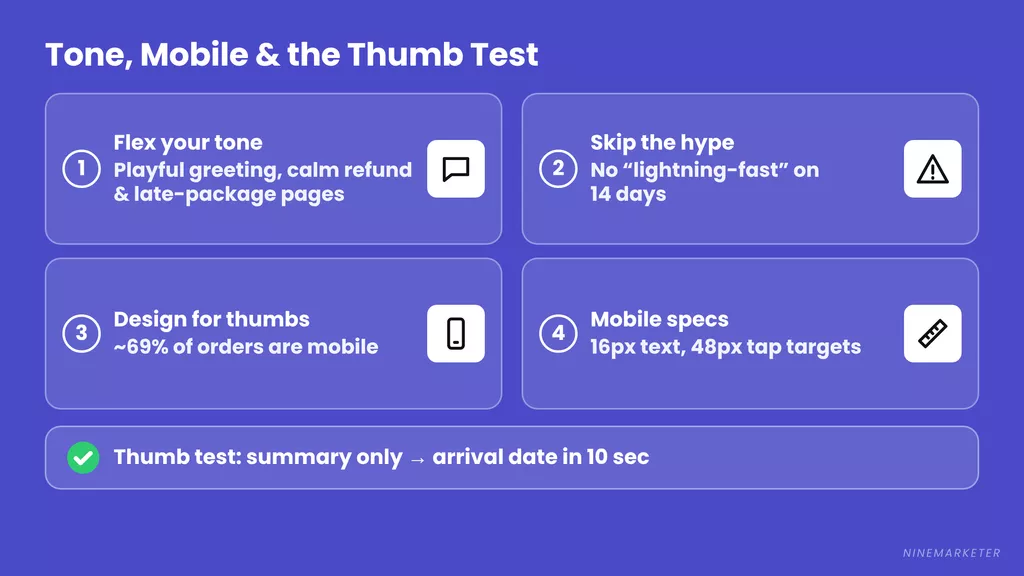
A playful store can stay playful, but tone should flex: Brandwatch’s tone of voice guide notes that a brand can keep its personality while dialing back the humor when it answers a complaint.
So save the jokes for the greeting, and go calm and clear in the late-package and refund sections.
Skip the hype, too.
NN/g’s early research found readers detested marketese, and credibility took a hit whenever a site clearly exaggerated.
“Lightning-fast delivery!” next to a 14-day range? Ouch.
Last, design for thumbs.
One data roundup of Shopify’s 2025 Black Friday weekend put mobile at about 69% of orders, so there’s a good chance your reader has one hand free and a lot on their mind.
Set body text to a 16-pixel base, and keep links and buttons at least 48 pixels wide or tall with a little breathing room between them.
Skip wide tables that force sideways scrolling, and stack the info or collapse long sections into tap-to-open blocks instead.
Then do a thumb test: open the page on your own phone, read only the summary box, and see if you can answer “when will it arrive?” in ten seconds.
Nail that and it feels amazing, and the support inbox gets quieter too.
5. Shipping Costs and Free Shipping: Pricing Strategies That Protect Your Margins
Shipping costs in dropshipping are weird, because you pay somebody else’s rate and still have to set your own.
Get the math wrong and a “sale” quietly turns into a loss.
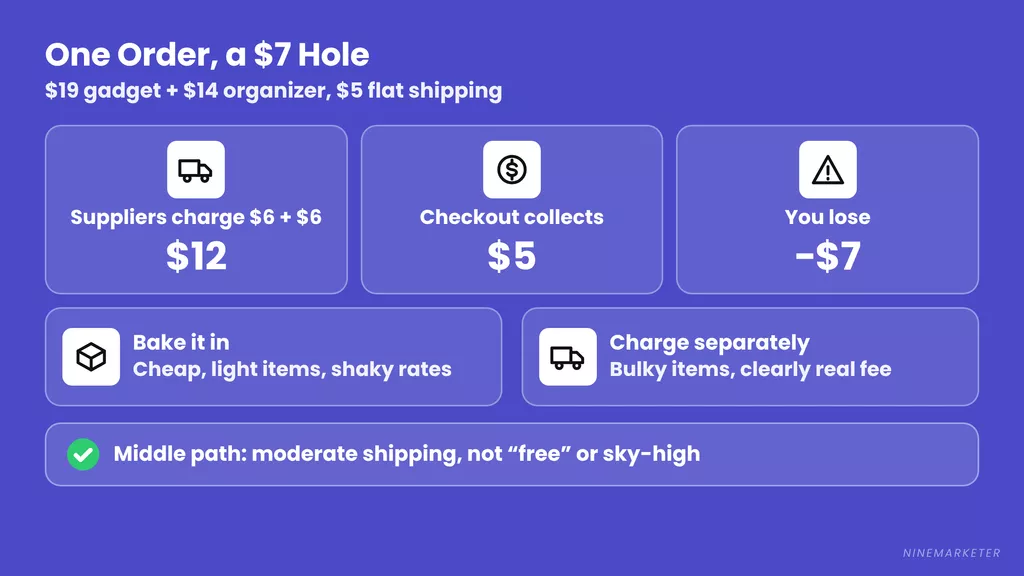
Picture a store selling a $19 gadget and a $14 organizer from two suppliers who each charge $6 to ship, while checkout collects a flat $5, and that order opens a $7 hole before anybody even counts product costs.
So the first big decision is whether to bake shipping into the product price or charge it separately.
Research on price partitioning found that retailers selling big, heavy items usually charge shipping separately, while retailers facing unpredictable costs lean toward folding it into the price.
Dropshipping often sits in that second camp, since a supplier can change rates without asking you first.
DropCommerce’s help docs make the same call for multi-supplier stores.
Each supplier is a separate business that has to be paid its shipping, so they generally recommend adding shipping into your product price for your own protection.
There’s a middle path, too.
A study of more than 500,000 price-comparison offers found shoppers paid the lowest total at stores that charged moderate shipping, not at the ones shouting “free” or the ones charging a fortune.
A sensible rule of thumb: bake it in for cheap, light items with shaky supplier rates, and charge separately for bulky stuff where the fee is obviously real.
Now the free shipping threshold.
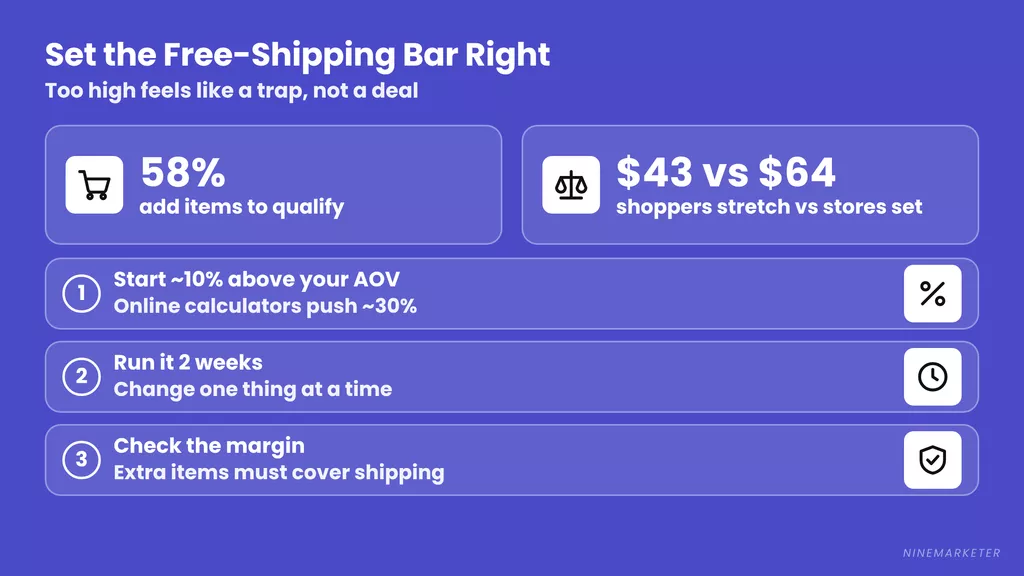
One fulfillment-industry roundup found 58% of shoppers add items to qualify, yet they’ll stretch only about $43 on average while the typical store sets the bar near $64.
That gap is why a threshold set too high feels like a trap instead of a deal.
Where should you set it?
Klaviyo’s Academy suggests starting about 10% above your current average order value, while plenty of online calculators push toward 30%.
Pick a number, let it run a couple of weeks, and change one thing at a time.
A bigger cart means nothing if the margin on those extra items doesn’t cover the shipping you’re now eating.
Flat versus calculated shipping comes down to simplicity versus accuracy.
Shopify’s help center shows price-based flat rates like $4 under $50 and $10 above it, while calculated rates pull the carrier’s price.
Since most are weight-based, big cart changes can make the quoted rate wrong.
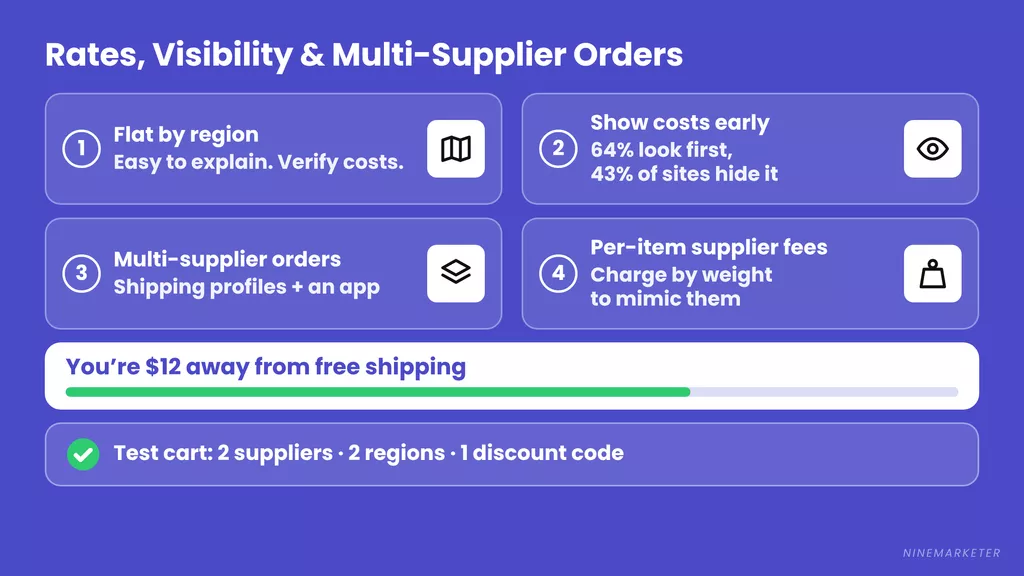
For most small stores, flat rates by region are easier to explain on the page.
Just check them against what each supplier really charges, because a rate that’s easy to explain but loses money isn’t a win.
Then show costs early.
Baymard’s product page testing found 64% of users looked for shipping costs before adding an item to the cart, yet 43% of sites still don’t show them there.
Put a short estimate under the price, repeat it in the cart, and make your threshold visible on product pages, in the cart, and at checkout, which EasyPost says is where it works best.
A little message like “You’re $12 away from free shipping” does the nudging for you.
Multi-supplier orders are where margins go to die, so plan for them.
ShipperHQ points out that when checkout charges as if everything came from one warehouse, the business eats the difference on the separate shipments happening behind the scenes.
Shopify’s shipping profiles help, since they let you charge different amounts based on where products ship from.
Heads-up, though: Shopify creates one order per checkout, so charging a separate fee per supplier usually takes an app, according to one community answer from a store with ten-plus suppliers.
Another Shopify thread covers a classic headache, suppliers who charge per extra item. One workaround there is charging by weight and setting each product’s weight to mimic the supplier’s cost.
Whatever setup you land on, test it with a real cart before launch: two suppliers, two regions, one discount code.
If the shipping line makes you wince, fix it before a customer finds it.
Then spell the rules out on your policy page in plain words, split shipments included, and enjoy the feeling of seeing a healthy margin on a messy two-supplier order.
6. Handling International Shipping, Customs, and Duties
International orders can double your market overnight, and they can also double your headaches.
The trick is deciding up front where you’ll ship, who pays the customs bill, and how you’ll explain the wait.
Skip that homework and a $25 sale turns into a refused parcel, a support ticket, and maybe a dispute.
Start by picking your countries on purpose.
Suppliers often offer different options and prices depending on the destination, and one Shopify community answer points out that you can’t set your own rates with confidence without that info.
List the countries you serve on your page, and if some are off-limits, say so plainly.
Per the same thread, a shopper whose country has no matching rate can’t finish checkout, so remove zones you don’t serve instead of leaving a mystery error.
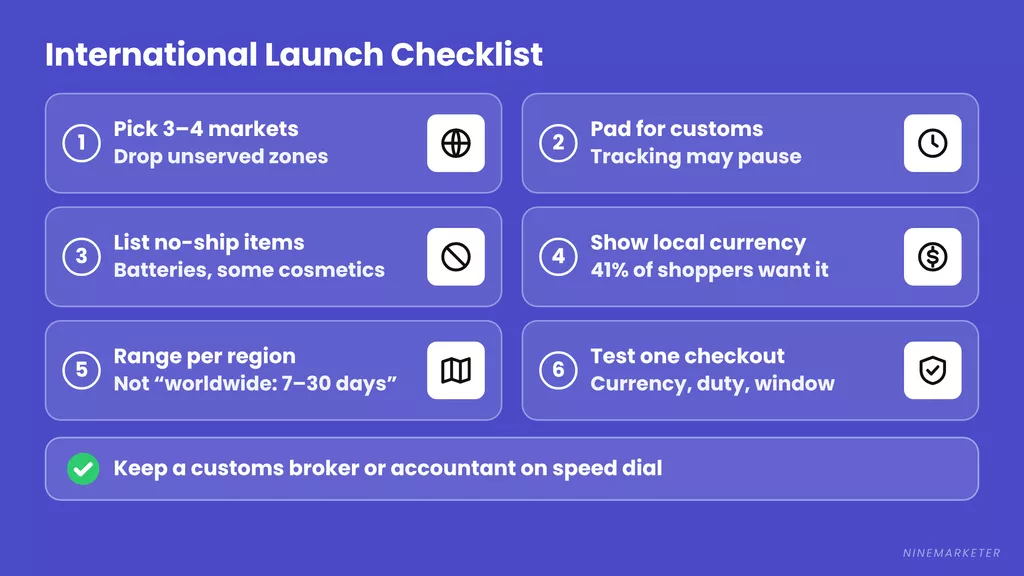
Begin with three or four markets where you’ve tested delivery times, then add more once real orders prove the numbers.
Now the big one: who pays duties and import taxes?
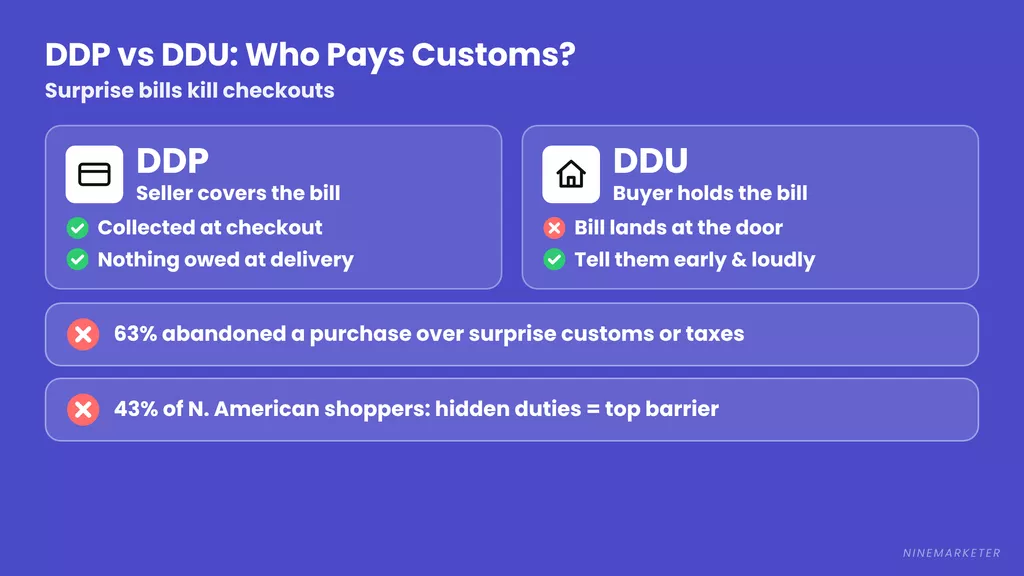
DHL’s guide explains that delivered duty paid means the seller covers duties, taxes, and clearance, while delivered duty unpaid leaves the buyer holding the bill.
In ecommerce, DDP usually means you collect those amounts at checkout, so the shopper sees the full cost before paying and owes nothing at the door.
Why bother?
Because surprise bills hurt.
A DHL survey reported by Practical Ecommerce found 63% of shoppers had abandoned a purchase over unexpected customs or taxes, and Landmark Global’s index calls hidden duties the top barrier for 43% of North American shoppers.
Different surveys, same message.
If you stick with DDU, say so loudly.
DHL advises telling shoppers what they owe early in the buying journey, not after the parcel is stuck at the border.
Setup has traps, too.
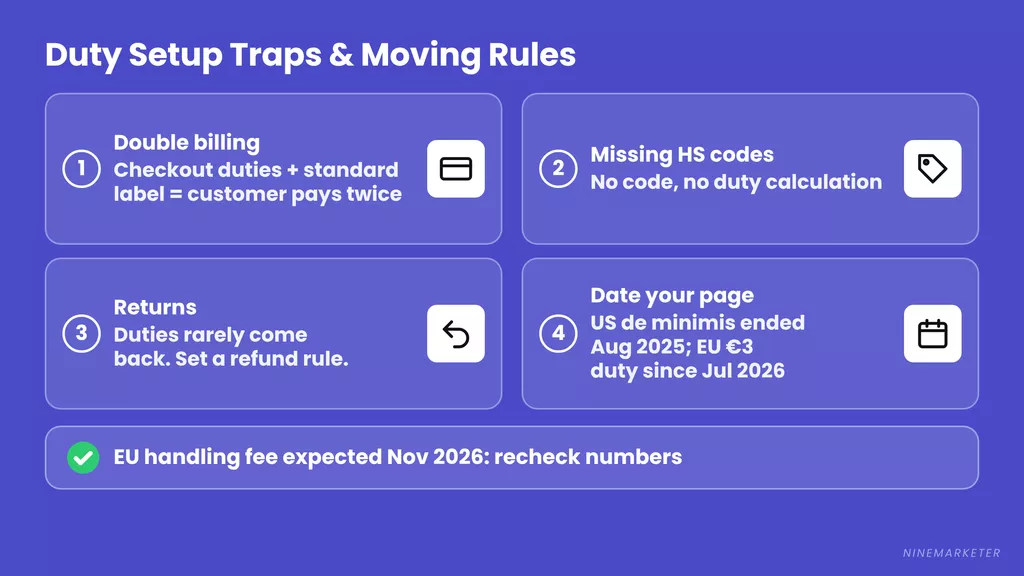
Shopify’s help center warns that if you charge duties at checkout but print a standard label, your customer pays twice because the carrier bills them again at delivery.
It also says products with missing HS codes won’t get duties calculated at all, so fill those in before you flip the switch.
Returns are the sneaky part.
One merchant guide notes that duties paid to a foreign customs authority are rarely recoverable, so a return can mean eating that cost twice.
Decide now whether you’ll refund duties, and write it down.
Rules keep shifting, so date your page.
The US ended duty-free de minimis treatment for low-value shipments from all countries on August 29, 2025, and since July 1, 2026 the EU charges a flat €3 duty on many parcels worth €150 or less.
More may follow.
An EU-wide handling fee was expected from November 2026, so recheck the numbers before you quote them to anyone.
Then set honest expectations for customs delays.
Unpaid duties are among the most common reasons parcels get held, so DDP helps, but it won’t make clearance instant. Build a cushion into your international delivery time range, and tell buyers that tracking may pause at customs for a while.
Next, restricted items.
USPS says you must follow both its rules and the destination country’s, and some goods are prohibited outright while others are restricted with conditions.
Lithium batteries are the classic trap, since batteries shipped on their own, or packed with equipment instead of installed in it, sit on USPS’s prohibited list.
Some countries ban surprising stuff, too.
One national postal service’s destination guides list cosmetics and even non-hazardous liquids as prohibited for certain destinations.
Ask each supplier what they can legally send, list your no-ship categories on the page, and cancel and refund those orders fast instead of letting them stall at the border.
Finally, talk like a local. In DHL’s survey, 41% of shoppers wanted to see prices in their own currency, so show local currency where you can and say whether duties are included.
Pair that with a delivery time range per region (not “worldwide: 7-30 days”) and a short note on peak-season and customs padding.
Test one international checkout end to end before launch: pick a country, check the currency, the duty line, and the delivery window, then read your page like a stranger would.
If anything makes you squint, fix it. And keep a customs broker or accountant on speed dial, since this is general info, not tax or legal advice.
7. Order Tracking and Proactive Communication
Here’s a little secret about customer service: most “where is my order?” emails aren’t really questions, they’re anxiety.
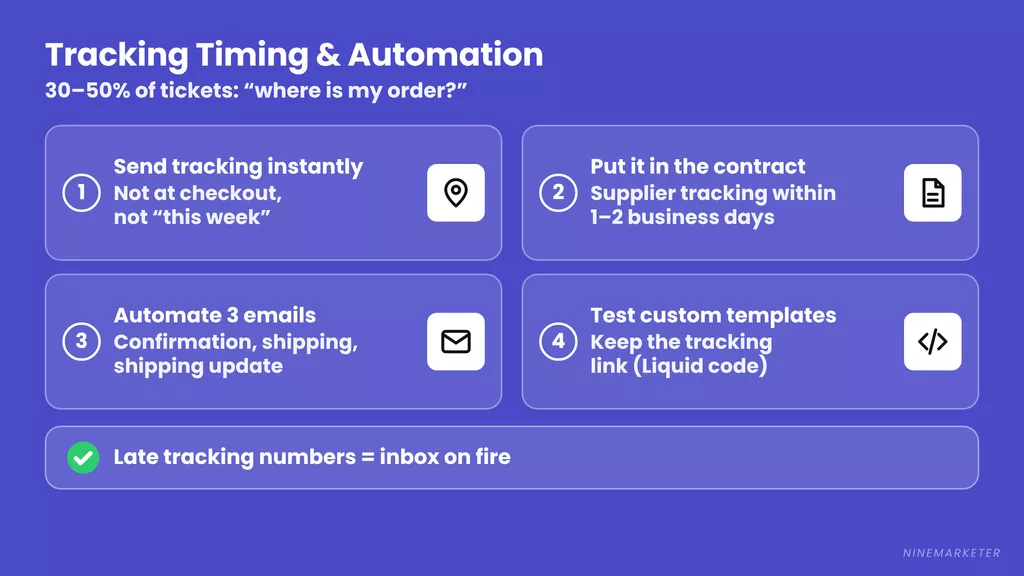
One write-up citing Gorgias’s own numbers says order-status questions can eat 30 to 50% of an ecommerce ticket queue.
And in dropshipping, where you never even touch the package, silence makes it worse.
Start with timing.
Send the tracking number the moment your supplier produces one, not at checkout and not “sometime this week.”
Shopify’s help docs say that once a number is attached, the customer’s order status page shows real-time carrier updates, and the number rides along in the shipping confirmation email.
If your supplier sends it late, you can still add it afterward, and the customer gets a shipping update email unless you untick the notification box.
Just don’t let that gap stretch for days.
Put “tracking number within 1-2 business days” in your supplier agreement, since late numbers are how the inbox catches fire.
Next, automate the emails.
Shopify has three built-in emails (order confirmation, shipping confirmation, and shipping update), and the default templates link to the order status page automatically.
Customize them and you may need a bit of Liquid code to keep that tracking link, so test before you celebrate.
Delay notices are the one email nobody wants to send and the one customers want most.
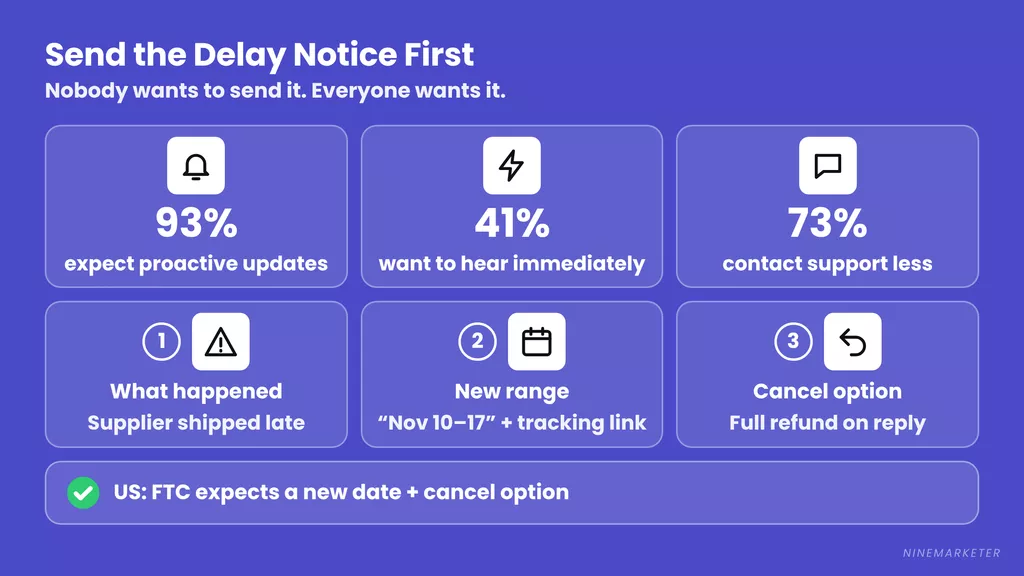
A Convey survey found 93% of shoppers expect proactive shipment updates, and when a delivery goes wrong, 41% want to hear immediately, with email preferred over phone calls by a wide margin.
Only 7% wanted no contact at all.
And it pays off.
In a Ware2Go survey of 1,000 US shoppers, 73% said they’d be less likely to contact support if told about a delay proactively.
Write the notice like a human: what happened, the new delivery range, and what you’ll do if it slips again.
In the US, FTC rules also expect a delay notice with a new date and a cancel option, so this isn’t just good manners.
Here’s the shape of a decent one (swap in your own details):
Subject: A quick update on your order #1234
Hi Sam, your order is running about 4 days behind our estimate because our supplier shipped late. Your new delivery range is Nov 10-17, and your tracking link is below. Would you rather cancel for a full refund? Just reply to this email.
Now, tracking pages.
Shopify’s built-in order status page covers the basics, but one roundup calls it functional but basic, with no dedicated branded tracking experience.
Shopify’s own blog suggests installing a tracking app, and these add your logo, estimated delivery dates, and product recommendations.
Do they work?
One shipping platform reports a store that cut WISMO queries by 50% with a branded tracking page, though vendor claims deserve a grain of salt.
Count your own order-status tickets before and after, and keep the winner.
It’s a retention thing, too, since 23% won’t reorder without tracking, according to the same source.
Bonus: those emails double as evidence.
Stripe’s sample evidence packets for “product not received” disputes suggest showing notification emails that told the customer about the shipment before, during, and after delivery.
So a simple stack (confirmation with a delivery range, shipping email with tracking, delay notice when dates slip, delivered email) protects you twice.
Split shipments from multiple suppliers need their own game plan.
Shopify’s docs say an order that can’t ship from one location is split into separate fulfillments, and you fulfill each separately, with multiple tracking numbers allowed as long as they share a carrier.
The messy part is communication.
One merchant noted that fulfilling everything at once sends one email with several tracking numbers, but customers can’t tell which number belongs to which product, while partial fulfillments send one email per item.
Picture a shopper who sees one package parked for six days and assumes the store scammed her, when the second item just hasn’t left a different supplier yet. Ugh.
Another thread points out that Shopify sends a separate shipping confirmation per fulfillment, yet nothing warns customers about the split upfront.
That thread’s suggested fix is a single heads-up message for split orders using Shopify Flow.
So say on the product page and in the order confirmation that items may arrive in separate packages, name which item comes from where, and label each tracking email “Package 1 of 2.”
Final check: place a test order that splits across two suppliers, then read every email as the customer.
Can you tell what’s coming, from where, and when?
If yes, you just saved yourself a pile of tickets, and maybe a chargeback or two.
8. Lost, Delayed, Damaged, and Undeliverable Packages
Packages go sideways.
It’s not a question of if, it’s when, and in dropshipping the fix usually runs through a supplier you don’t control.
So your policy needs a plan before the first angry email shows up.
Start by defining “lost” in plain numbers.
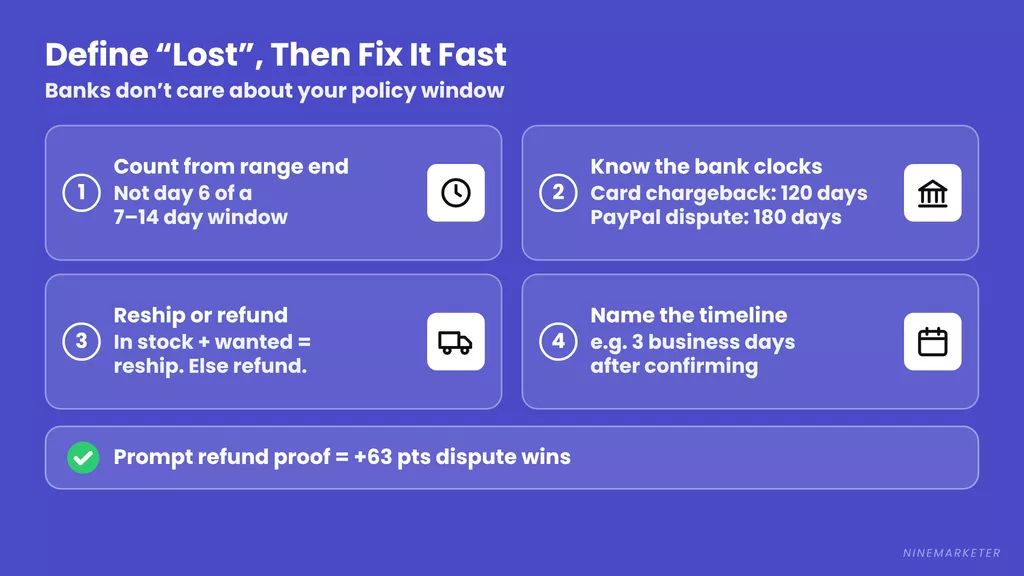
A simple rule is to count from the end of your delivery range, not the order date, so a package isn’t “lost” on day six of a 7-14 day window.
Printful’s own guidance tells sellers to give a missing package a couple more days and to report it no later than 30 days after the estimated delivery date.
Carriers run on their own clocks, too.
One merchant guide says USPS takes insurance claims for most domestic services starting around 15 days after mailing, with a 60-day cutoff.
Check current rules with your carrier, since these windows change.
Remember that the bank doesn’t care about your policy window.
Cardholders usually get 120 days to file a chargeback, and PayPal buyers get 180 days to open a dispute.
Stripe says “product not received” disputes are often filed while a package is still in transit, and evidence submitted at that stage improved win rates by just two percentage points.
So a fast, friendly fix beats a strict deadline.
Next, spell out your fix.
If the item is still in stock with the supplier and the customer wants it, reship.
Otherwise, refund to the original payment method.
Say how long each takes (3 business days after confirmation, say) and who makes the call.
Don’t drag it out, either.
Stripe’s data also shows disputes that included evidence of a refund issued had a 63 percentage point higher win rate, which is one more reason to refund promptly when a package is truly gone.
Tell customers exactly what you need from them.
For damaged items, that means a clear photo of the box, the shipping label, and the damaged part, within a set window after delivery.
Printful asks for five photos at most and wants part of the product’s design visible so the item can be identified, while Red Stag warns that claims without photos are likely denied.
Ask them to keep the box, too, because USPS may inspect the damaged packaging before approving a claim. Here’s a sample you can adapt (swap in your own windows):
If your order seems lost: Wait 5 business days after the end of your delivery range, then email us your order number. If it arrives damaged: Send photos of the box, label, and damage within 14 days of delivery, and keep the packaging. We’ll reship or refund within 3 business days of confirming the problem.
Wrong addresses deserve their own rule.
Once a parcel is undeliverable, one merchant guide says the merchant eats outbound shipping, the carrier’s return fee, and the reshipment cost if the buyer still wants the order. Ouch.
A fair, common rule is that if the customer typed it wrong, they pay to reship, or you refund the item minus shipping.
A Shopify Community thread lays out that exact approach, and one small shop’s published policy offers both choices, deducts the cost of free shipping from refunds, and reships free when the error was theirs or the carrier’s.
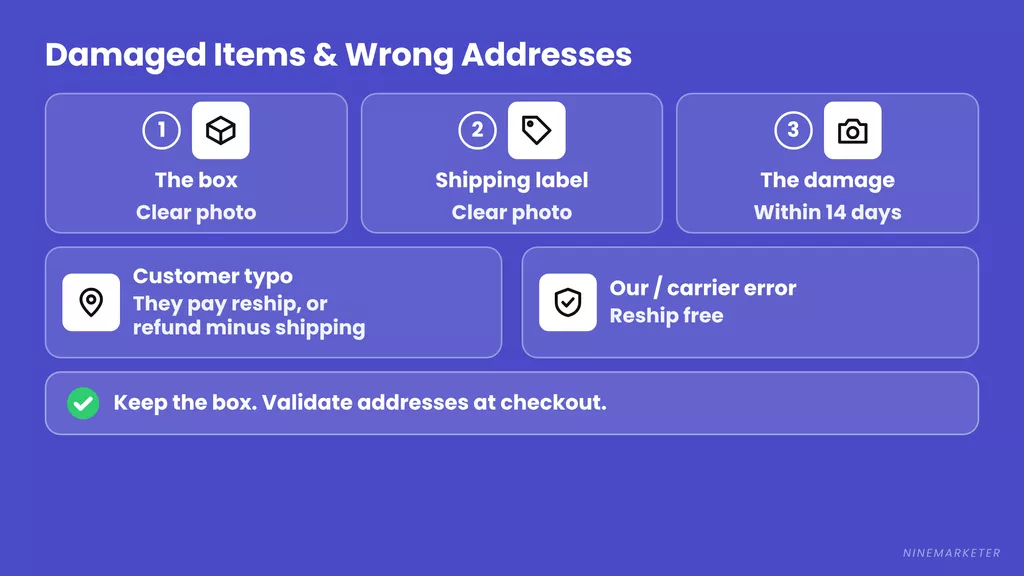
Prevention beats cure. Turn on address validation at checkout, and add a “double-check your address” line to the order confirmation email. Also ask suppliers what happens to returned parcels, since Printful donates unclaimed returns after 30 days, so a slow reply can mean the item is gone for good.
Finally, line your policy up with your suppliers’ rules so you’re never stuck paying for a claim you can’t win.
Printful’s own advice is to tell customers to report damaged items within 30 days, which matches the window it gives sellers.
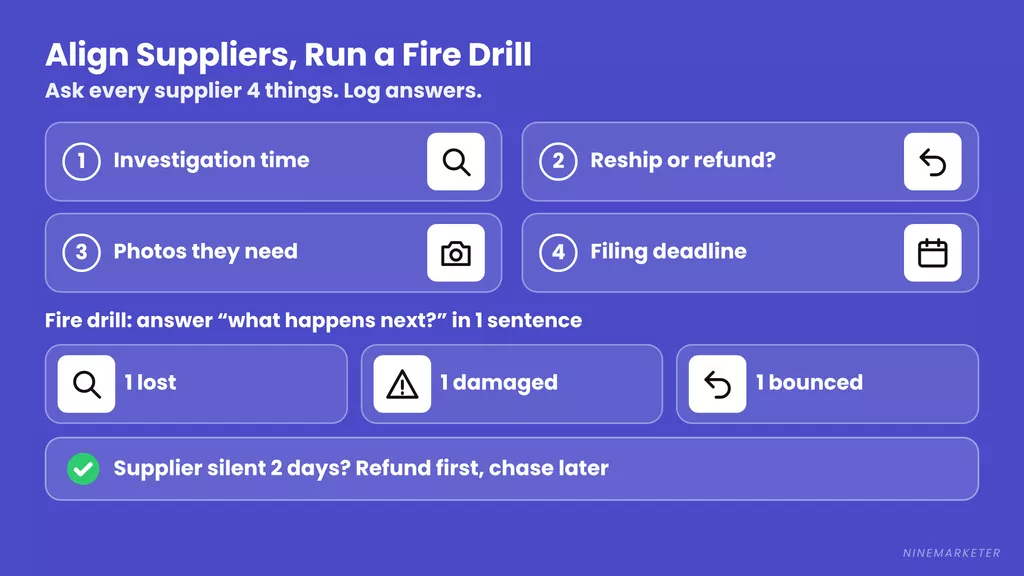
Ask every supplier four things up front: how long they take to investigate a lost parcel, whether they reship or refund, what photos they need, and how long you have to file.
Put those answers in a spreadsheet and set your public windows a few days inside theirs.
And if a supplier goes quiet for two business days, refund or reship the customer first and chase the supplier afterward.
For plain delays, remember the basics from earlier: tell people early, give a new date, and offer a cancel option, which FTC rules expect for US orders anyway.
Do a fire drill before launch: pretend one package is lost, one is damaged, and one bounced back.
Walk each through your policy and see where you get stuck. If you can answer every “what happens next?” in one sentence, you’re ready.
9. Aligning Your Shipping Policy with Your Returns and Refund Policies
Here’s where good stores quietly sabotage themselves: three separate policy pages that don’t agree with each other.
The shipping page says one thing about lost orders, the returns page says another, and the refund page has a third opinion.
Shoppers notice, and so do banks.
And yes, shoppers read these pages.
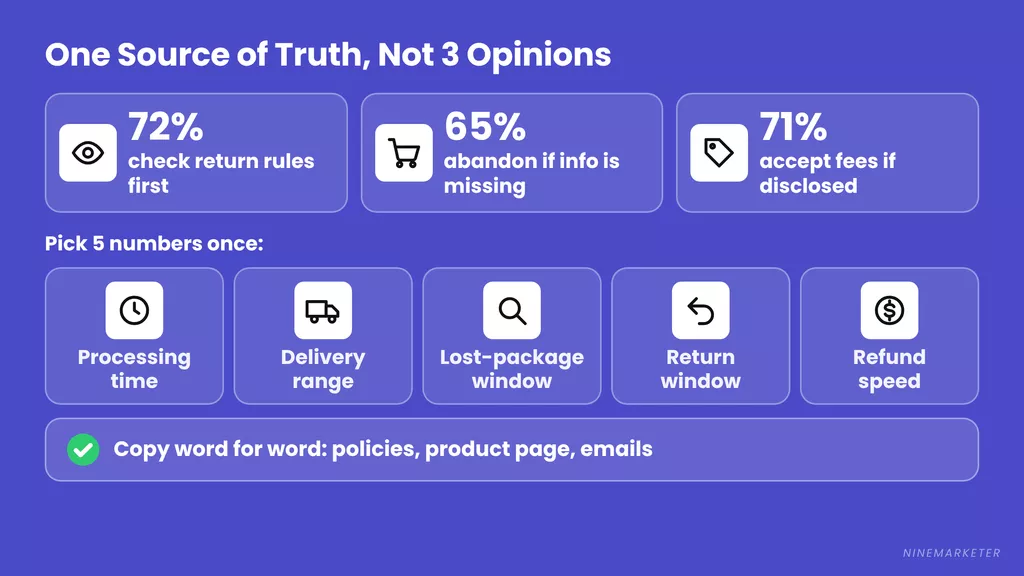
In a UK survey by Sendcloud, 72% said they almost always check return conditions before ordering, and 65% said they’d abandon an order if clear return info is missing.
They want specific details, too.
The same survey says a policy should at least state the cost of returns, whether a prepaid label is included, and the refund period.
Hidden return fees sting.
In a 2026 ICSC survey, 56% said retailers aren’t upfront about return fees, and 71% said they’d accept fees more readily if they were disclosed upfront.
So build one source of truth.
Pick your numbers once (processing time, delivery range, lost-package window, return window, refund speed) and copy them word for word into every policy page, product page, and email. Picture a shipping page that allows 30 days to report a lost order, a returns page that gives 14, and a product page promising “hassle-free 30-day returns.”
A customer can quote whichever one favors them, and a reviewer reading all three side by side may side with the shopper.
Shopify’s help center reminds merchants that templates are only starting points and you’re responsible for following whatever you publish.
Write accordingly.
Next, settle who pays return shipping and where the box goes.
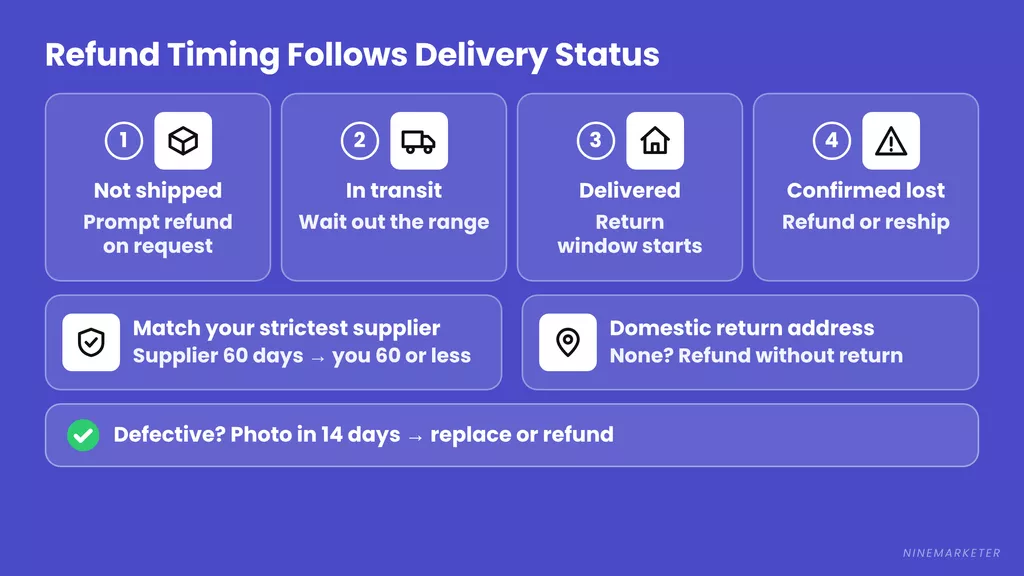
Dropshipping makes this tricky because the item lives with your supplier, so Red Stag’s returns guide says your policy should meet your strictest supplier requirements.
If a supplier accepts returns for 60 days, give customers 60 days or less.
Where returns go matters just as much.
Redo’s guide calls a domestic return address the single most valuable thing to look for in a supplier, since cross-border return shipping can erase the margin.
If no domestic address exists, a refund without return is often the cheapest answer, especially for low-value items.
Whatever you choose, say it in one line: “Damaged or defective?
Send a photo within 14 days and we’ll replace it or refund you, no return needed.”
Your public pages don’t need to name suppliers, but they do have to stay accurate about who ships, where returns go, and how long it all takes.
Now tie refund timing to delivery status, because that’s where policies collide.
A simple ladder works: not shipped yet means a prompt refund on request, in transit means wait out the delivery range, delivered means the return window starts on the delivery date, and confirmed lost means refund or reship under your lost-package rule.
Then say how long refunds take once approved.
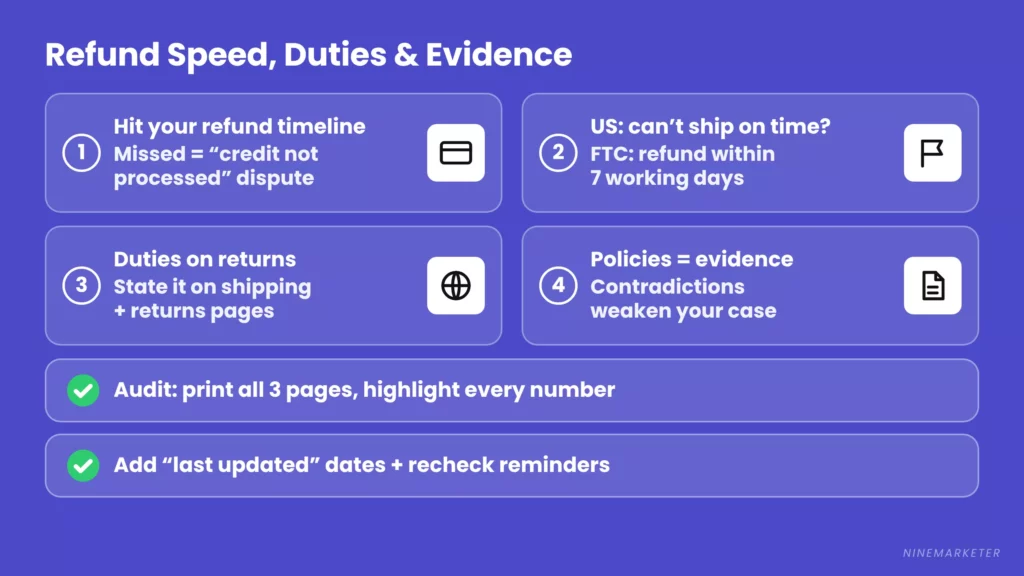
In the US, the FTC rule from earlier adds hard numbers when you can’t ship on time: refunds to third-party credit cards are due within seven working days.
That rule covers orders you can’t ship, while ordinary returns follow your own policy plus other laws.
Whatever timeline you publish, hit it.
Stripe’s docs describe “credit not processed” disputes as what happens when a promised refund never shows up on the statement within a reasonable time.
Ugh, and those are entirely avoidable.
International orders add one more trap: duties.
If you collect them at checkout, say whether they’re refunded on a return, since duties paid to a foreign customs authority are rarely recoverable.
Pick a rule, put it on both your shipping and returns pages, and don’t leave shoppers guessing.
Finally, remember that your policy pages are evidence.
Stripe tells sellers to include a copy of their terms of service and refund policy when answering a dispute, and for credit-not-processed claims it lists the policy’s wording as a key piece of proof.
If your pages contradict each other, that evidence gets a lot weaker.
Run a quick audit: print all three pages and highlight every number (days, dollars, windows). If any two don’t match, fix them today.
Then put a “last updated” date on each page and set a reminder to recheck them whenever a supplier changes its terms.
10. Legal and Platform Compliance Checklist
Quick heads-up before we dive in: this section is general information, not legal advice, and the rules change by country and product category.
Think of it as a map of where the traps usually hide. A lawyer helps you walk the actual road.
Start with the US.
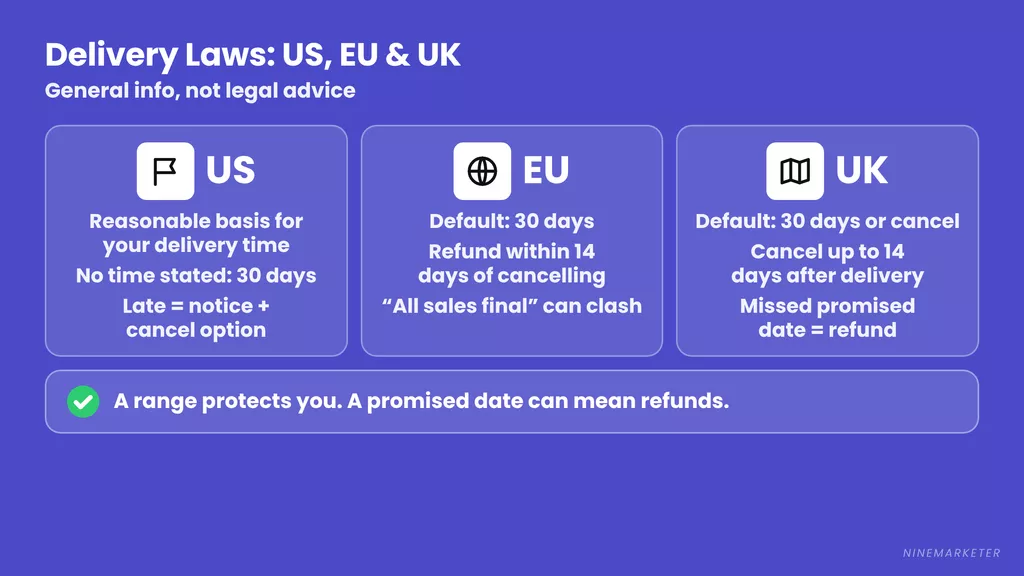
The FTC’s 30-day rule says sellers need a reasonable basis for any delivery time they advertise, or for 30 days when none is stated.
If you can’t keep the promise, you owe the customer a delay notice with a new date and the option to cancel for a full refund.
In the EU, the ECC-Net shopper guide says online purchases should arrive within 30 days unless you agree otherwise, and buyers who cancel are owed a refund within 14 days.
They also have a right to withdraw from distance purchases, which is why a blanket “all sales final” line can clash with local rules.
The UK looks similar.
Which? explains that without an agreed timeframe, retailers must deliver within 30 days or the buyer can cancel for refunds, and the cancellation right runs until 14 days after delivery.
If you promised delivery by a specific date, like a Christmas deadline, missing it can entitle the customer to a full refund.
That’s one more reason to pad your holiday ranges, as we covered earlier, and to skip date guarantees you can’t control.
A delivery range protects you, while a promised date can turn into a cancellation right.
Now the platforms.
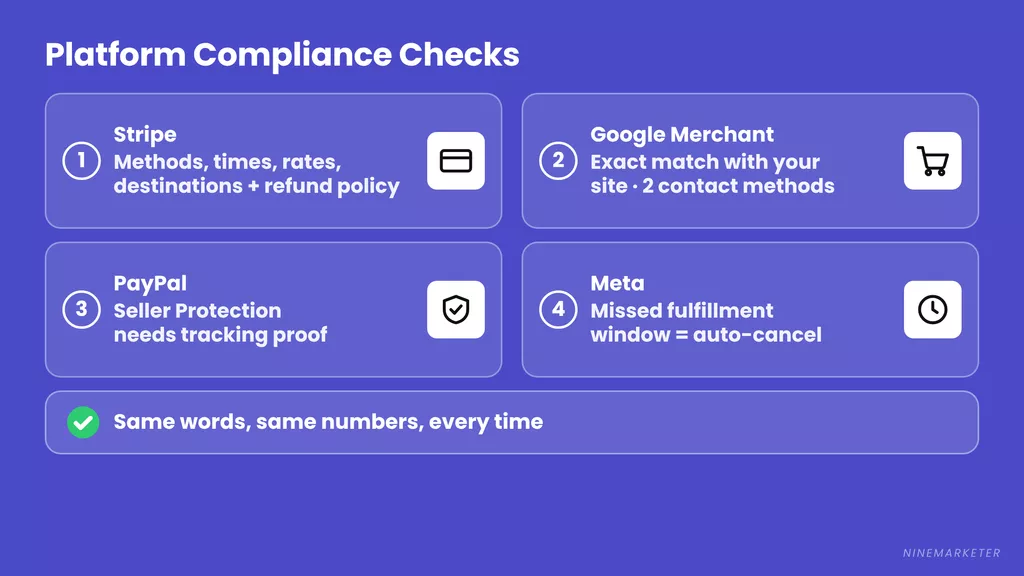
Stripe’s website checklist says a shipping policy should describe methods, times, rates, and eligible destinations, alongside a refund policy and contact options beyond a simple form.
Stripe also says it regularly checks that your site stays compliant, and an account may not activate until the required info is live.
Google is pickier than most.
Merchant Center “misrepresentation” suspensions often trace back to policy pages, and Search Engine Land notes your shipping methods, handling times, costs, and return timelines must exactly match what your site says.
A Shopify support reply adds that Google wants two contact methods, and contact forms don’t count.
PayPal attaches extra requirements to Seller Protection for item-not-received claims, so keep tracking proof for every order.
And on Meta, the commerce order docs say unfulfilled items can be auto-canceled if the seller misses the fulfillment window, which matters a lot when a supplier is slow.
Where does it all go?
Shopify automatically links policies in the checkout footer, but add them to your store menu too, since customers may want to read them before checkout.
Put a one-line shipping summary on every product page as well, because 64% of users in Baymard’s tests looked for shipping costs there before adding anything to the cart.
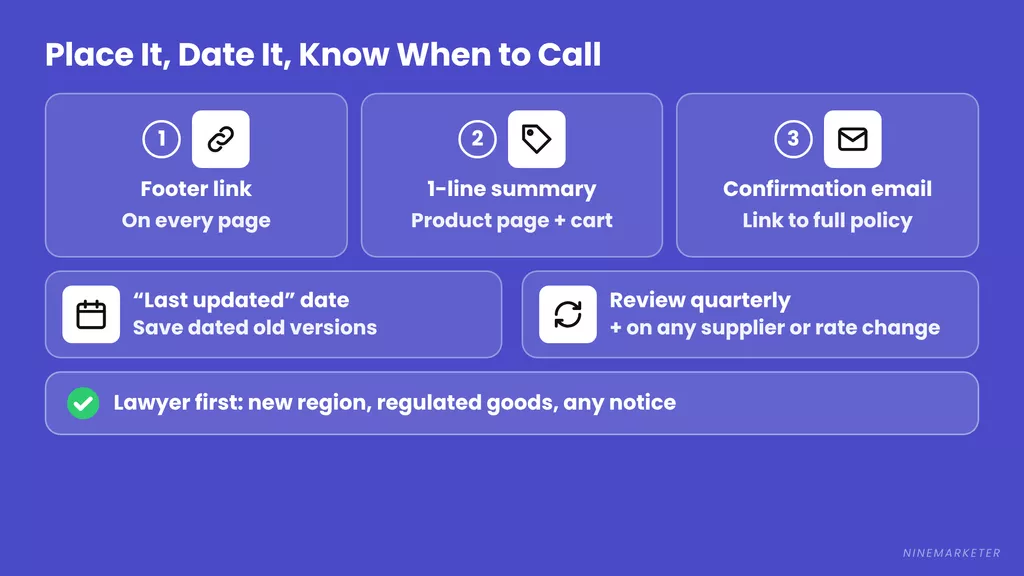
Use three layers: a footer link on every page, a short summary on product pages and the cart, and a link in the order confirmation email. Same words, same numbers, every time.
Keep it fresh and dated. Put a “last updated” line at the top, and save old versions with their dates, because you may need to show what you promised on the day someone ordered.
Review the page whenever a supplier, carrier, rate, or regional rule changes, and set a quarterly reminder anyway, since Stripe re-checks sites and Google compares your pages against your product feed.
When should you call a legal professional?
Before launching in a new region, selling regulated goods (supplements, cosmetics, electronics with batteries), taking preorders or subscriptions, collecting duties and taxes, or writing disclaimers and liability limits.
And right away if a regulator, payment processor, or card network sends you a notice. A one-hour consult can be cheaper than untangling a frozen payout later.
11. Shipping Policy Examples and a Template You Can Adapt
Time to turn all that theory into a page you can actually publish.
Below you’ll find a section-by-section breakdown, the mistakes that wreck weak policies, a fill-in-the-blank template, and a final audit.
Copy what fits, delete what doesn’t, and swap every bracket for your own real numbers.
Start with how strong policies are built.
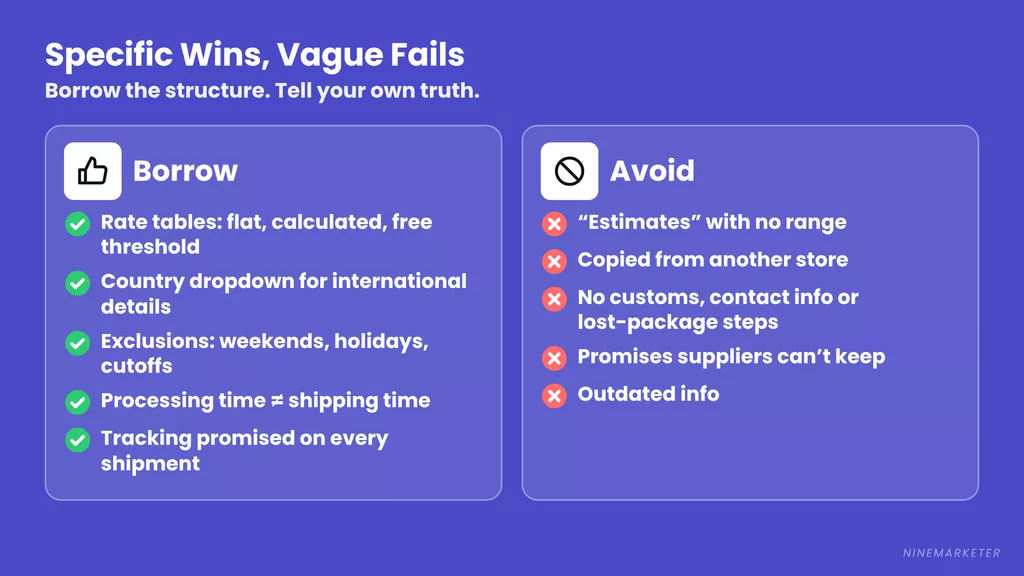
Shopify’s free policy template is a three-page download with tables for flat-rate, calculated, and free shipping thresholds, so shoppers can scan rates at a glance.
The point isn’t to copy it word for word, it’s to borrow the structure and then tell the truth about your own suppliers.
Real stores show what “specific” looks like.
Barner lists a one-to-two business day processing time, promises tracking on every shipment, and says customs fees aren’t included in its rates.
Gymshark adds a dropdown so shoppers pick their destination country and see the right details, which beats making them dig through one giant international paragraph.
Small details matter too.
Drip’s roundup suggests spelling out exclusions like weekends and bank holidays, plus any cutoff times for faster delivery options.
Bench adds that processing times are separate from shipping times shown at checkout, and that high order volume can cause delays.
Now the mistakes.
The biggest one is writing “delivery times are estimates” and leaving it there, since customers still need a meaningful range.
UK lawyers at Sprintlaw say polished policies that are vague or unrealistic or inconsistent with the rest of your site don’t actually protect the business.
Dropshippers have their own blind spots.
One guide notes that a generic template will include processing time but skip customs entirely, and a roundup of real examples says Lux Skin leaves shipping costs and international duties a bit unclear.
Then there’s staleness, since ShipScience warns that outdated information leads to operational headaches and compliance issues.
Add a few more to the list: no contact info, no steps for a missing package, promises your suppliers can’t keep, and policies copied from another store.
Ugh, I’ve seen all of those in one page.
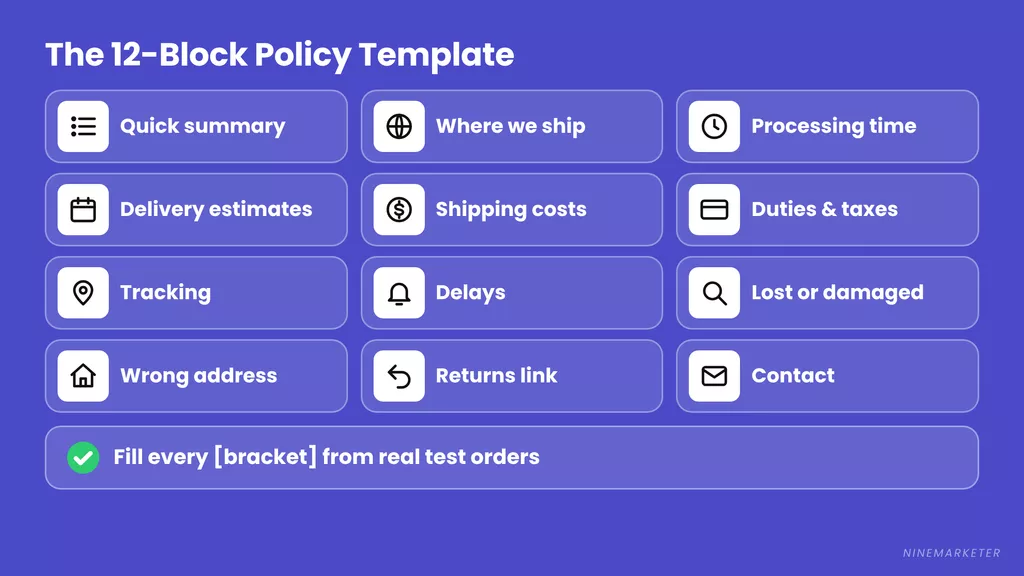
Here’s the template. It’s built from everything in the earlier sections, so each block matches a promise you’ve already tested. Swap every [bracket] for your real numbers, and have a lawyer glance at it before launch.
Shipping Policy (Last updated: [date])
Quick summary
Processing: [1-3] business days. Delivery: [7-14] business days in [country]. Free shipping over [$X]. Tracking emailed when your order ships. Questions: [email].Where we ship
We ship to [countries/regions]. We can’t ship to [list] or to [PO boxes/other restrictions].Processing time
Orders are processed within [X] business days after payment, excluding weekends and [holidays]. Orders placed after [time, time zone] start the next business day. During [peak dates], allow [X] extra days.Delivery estimates
| Destination | Method | Estimated delivery | Cost |
| [Domestic] | Standard | [X-Y] business days | [$ / free over $X] |
| [Region 2] | Standard | [X-Y] business days | [$] |
| [Rest of world] | Standard | [X-Y] business days | [$] |Estimates start after processing and aren’t guaranteed. Customs clearance can add time.
Shipping costs
We charge [flat rates by region / carrier-calculated rates]. Orders over [$X] ship free to [regions]. You’ll see your exact shipping cost in your cart before you pay.Duties and taxes (international orders)
[Option A: Duties and import taxes are collected at checkout, so nothing more is due on delivery.] [Option B: Duties, taxes, and fees charged by your country are your responsibility and are collected on delivery.] [State whether duties are refunded on returns.]Tracking
We email your tracking number within [X] business days of shipping. Orders with items from more than one supplier may arrive in separate packages with separate tracking numbers.Delays
If your order will arrive later than our estimate, we’ll email you a new delivery range and the option to cancel for a full refund.Lost, damaged, or incorrect orders
If your order hasn’t arrived [X] business days after the end of its delivery range, email [address] with your order number. For damage, send photos of the box, label, and item within [X] days of delivery. We’ll reship or refund within [X] business days of confirming the problem.Wrong address
Please double-check your address at checkout. If an order is returned because of an incorrect address, we can reship for [$X] or refund the item minus shipping.Returns and refunds
See our Returns and Refund Policy for return windows, return shipping, and refund timing.Contact
[Email] and [second contact method]. We reply within [X] business days.
Use it as a starting point, not a final draft. Fill every bracket from your real test orders and supplier terms, read it out loud, and cut anything you can’t actually deliver.
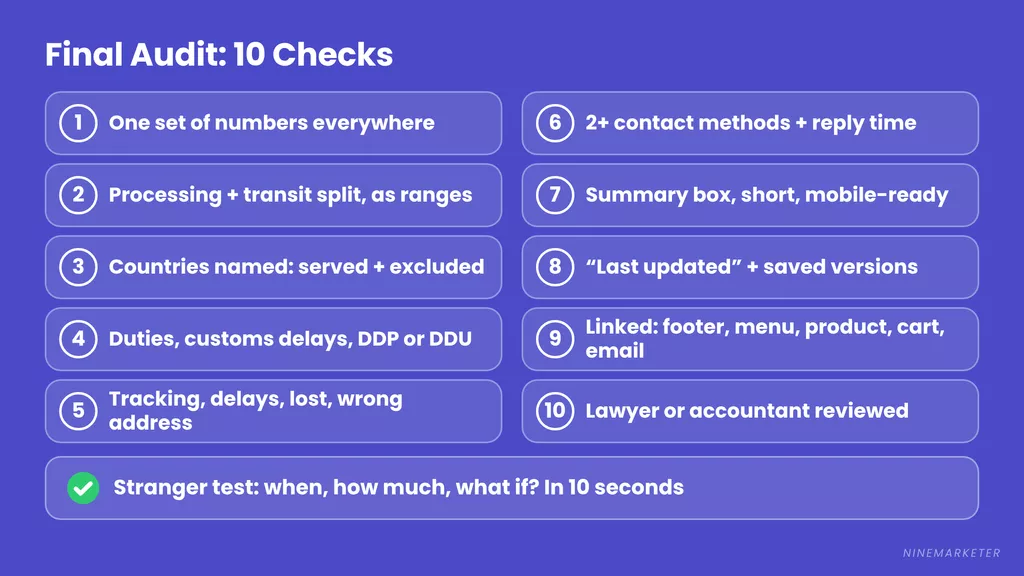
Final audit checklist before publishing:
- Every number (days, dollars, windows) matches your returns page, product pages, and emails
- Processing and transit times are listed separately, as ranges rather than single dates
- Countries you ship to (and don’t) are named
- Duties, taxes, and customs delays are explained, and your DDP or DDU choice is stated
- Tracking timing, delay notices, lost or damaged steps, and the wrong-address rule are all included
- Two or more contact methods are listed, with a response time
- A summary box sits at the top, paragraphs are short, and it reads well on a phone
- A “last updated” date is on the page, and old versions are saved
- The page is linked from the footer, menu, product pages, cart, and confirmation email
- A stranger can answer “when, how much, and what if it goes wrong?” in ten seconds
- A lawyer or accountant has reviewed it for your markets and products
Next Steps: Turn Your Shipping Policy Into a Selling Point
Use short, punchy sentences mixed with longer ones.
Encourage the reader to audit their current policy this week, update delivery times with real supplier data, and add a plain-language summary at the top.
Close with a call to action, such as downloading the template or reading related posts on returns policies and supplier vetting. Don’t open the final paragraph with “In conclusion” or “Ultimately.”