



Your dropshipping store has great products.
Your website looks professional.
But here’s the problem: nobody knows you exist.
While your competitors are racking up thousands of views and sales on TikTok without spending a dime on ads, you’re stuck wondering how they’re doing it.
The secret?
They’ve cracked the code on TikTok’s organic reach, and it’s not about luck.
TikTok has become the goldmine for dropshippers in 2026, but not in the way you might think.
Forget expensive influencer partnerships or throwing money at TikTok ads.
The real opportunity lies in organic marketing strategies that leverage the platform’s unique algorithm and user behavior.
I’ve seen countless dropshipping stores explode from zero to six figures purely through organic TikTok content, and the best part?
It’s completely replicable.
In this guide, you’ll discover the exact TikTok organic marketing strategies that successful dropshippers use to generate consistent sales.
From understanding the algorithm to creating viral-worthy content and building a loyal community, you’ll learn everything you need to turn TikTok into your most profitable traffic source, without spending a penny on advertising.
Understanding the TikTok Algorithm for Dropshipping Success
You’ve probably noticed how your cousin posts a random video about her morning coffee routine and somehow gets 50,000 views, while your carefully crafted product demo sits at 200.
That’s TikTok’s algorithm doing its thing, and honestly, it’s nothing like what you’ve dealt with on Instagram or Facebook.
Here’s the deal: TikTok doesn’t care about your follower count the way other platforms do.
Instagram will show your posts primarily to people who already follow you, maybe tossing in a few extras if you’re lucky.
But TikTok?
It’s built different.
The platform actively pushes content to people who’ve never heard of you, which is why dropshippers are seeing conversion rates between 4.9% to 5% on TikTok Shop.
Way higher than most traditional platforms where you’d be lucky to hit 2%.
The algorithm doesn’t give established creators preferential treatment.
Your brand new account has the exact same shot at virality as someone with 500k followers, which is wild when you think about it.
TikTok has openly stated that follower count and past viral videos aren’t direct factors in the For You Page recommendations.
This levels the playing field in ways Instagram never did.
The Four Ranking Factors You Actually Need to Know
Let’s talk about what TikTok is really looking at when it decides whether your dropshipping video deserves the FYP or gets buried.
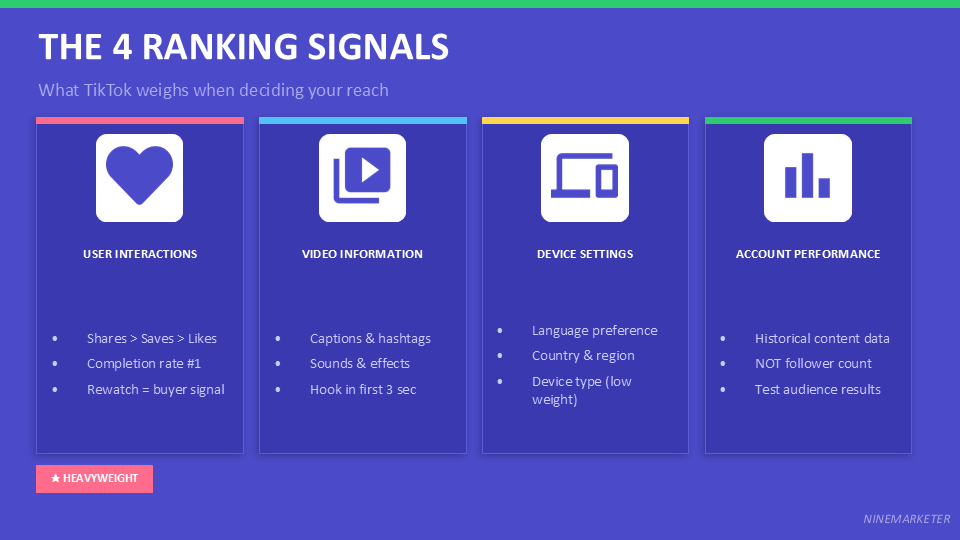
There are four main categories of signals the algorithm weighs: user interactions, video information, device settings, and account performance.
User interactions are the heavyweight here.
We’re talking about how people engage with your video – likes, comments, shares, saves, and most importantly, whether they watched the whole damn thing.
Video information includes your captions, hashtags, sounds, and effects.
Device settings cover language preference, country, and device type, but these carry less weight.
Account performance isn’t about how many followers you have, but how well your content has historically performed with test audiences.
Here’s where it gets interesting for dropshippers.
The algorithm doesn’t just count interactions – it weighs them.
A share signals way more interest than a like.
Someone saving your video to reference later? That’s gold.
These are people who might actually buy your product.
Why Completion Rate Crushes Everything Else
Look, I’m gonna level with you.
You can get a thousand likes on your dropshipping video, but if people are swiping away after two seconds, the algorithm will bury it faster than you can say “viral.”
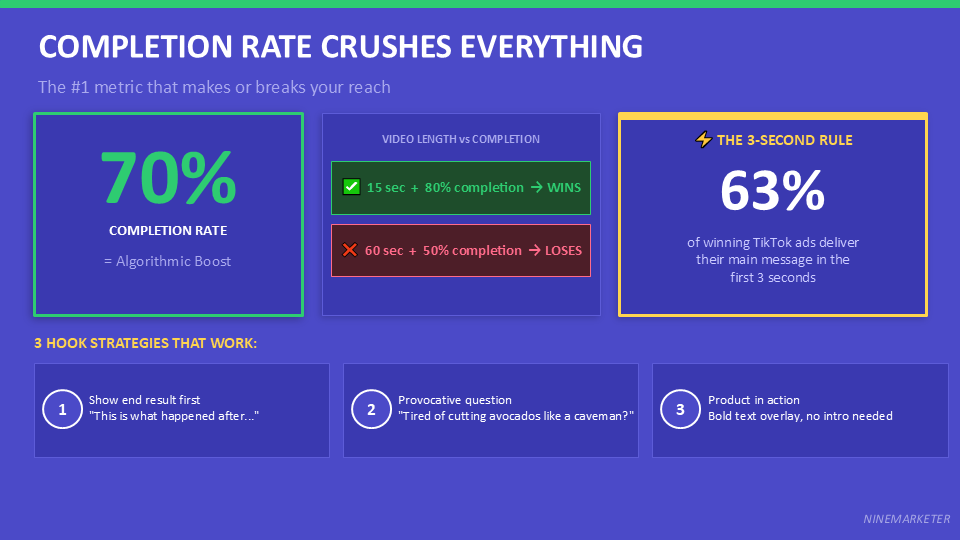
Completion rate is arguably the number one ranking factor, and dropshippers who ignore this are leaving serious money on the table.
The math is brutal: videos with 70% completion rates and strong early engagement get significant algorithmic boosts.
Meanwhile, videos with low completion get shown to fewer and fewer people until they just… die.
The platform is basically saying “if your own viewers don’t wanna watch this, why should I show it to anyone else?”
For dropshipping content specifically, this changes everything.
Those 60-second product demonstrations you’ve been making?
They’re probably killing your reach.
A 15-second video with 80% completion rate will typically outperform a 60-second video with 50% completion, even though the longer video has more total watch time.
Think about it from a customer’s perspective.
They’re scrolling through TikTok at midnight, not actively shopping.
You’ve got seconds to show them why they need your product before their thumb moves to the next video.
The completion rate tells TikTok: “hey, this person just watched an entire ad for a product they weren’t even looking for.”
That’s powerful signal.
Cracking the For You Page Code
The FYP is where the magic happens for dropshippers, because it’s pure discovery.
Your customers aren’t following you yet – hell, they don’t even know you exist.
But TikTok reaches 1.59 billion users through its ad reach, and the FYP is how you tap into that massive pool of potential buyers who’ve never heard of your brand.
What’s crazy is how the algorithm tests content.
When you post, TikTok doesn’t blast it everywhere immediately.
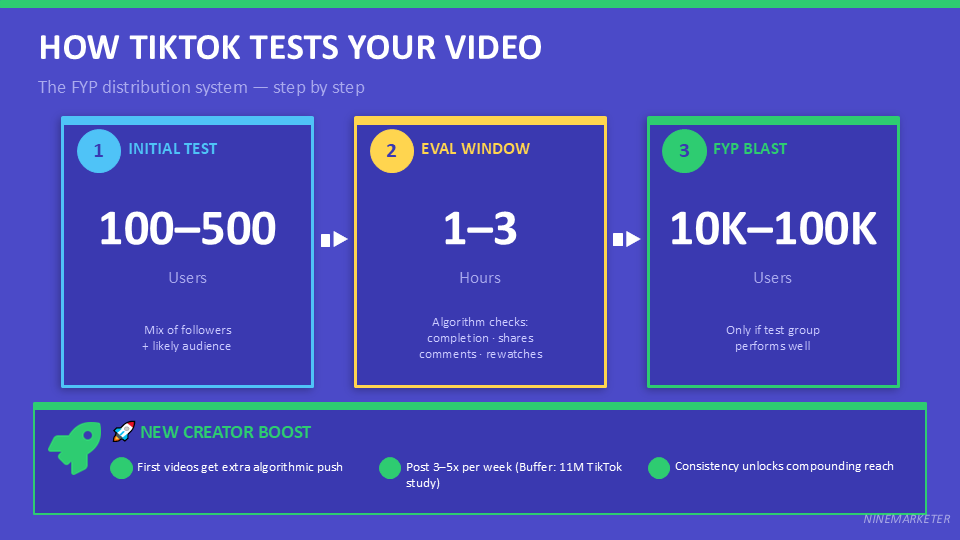
It shows your video to a small batch of 100-500 users first – a mix of your followers and people it thinks might be interested.
If the video performs well in that initial 1-3 hour window, it gets pushed to 10,000-100,000 users on the FYP.
The algorithm is looking for specific signals during that test phase.
High completion rate, people watching it multiple times, shares, comments that show genuine interest.
If your dropshipping video nails these metrics with that first small group, you’re golden.
If it flops, well, that’s it.
The algorithm has spoken.
Here’s something most dropshippers miss: the FYP isn’t just about going viral once.
It’s about understanding what makes your target customer stop scrolling.
When someone watches your entire video about that kitchen gadget, TikTok learns “oh, this person likes kitchen stuff.”
Now your video becomes a data point that helps TikTok serve better recommendations to similar users.
The First 3 Seconds Are Make or Break
I cannot stress this enough – if you’re not hooking people in the first three seconds, nothing else matters.
Your product could cure cancer and it wouldn’t matter if viewers scroll past before they see it.
The “3-second rule” is TikTok’s way of saying you’ve got three seconds to hook viewers, and if you can keep them engaged beyond that point, your chances of ranking on the FYP rise dramatically.
The stats on this are nuts.
63% of all successful TikTok ads convey their main message in the first three seconds.
Not “start building up to the message”
They hit you with it immediately.
For dropshipping, this means showing the product transformation, the problem solution, or the “wow factor” right away.
Some hook strategies that actually work for product content: start with the end result (“this is what my kitchen looked like after”), ask a provocative question that your product answers (“tired of cutting avocados like a caveman?”), or show the product in action immediately with bold text overlay.
The worst thing you can do?
Start with “hey guys” or a long intro about who you are.
Nobody cares yet.
I’ve seen dropshippers test different hooks on the same product and get wildly different results.
One guy was selling a portable blender – his first video started with him explaining the features.
300 views, dead in the water.
His second video started with him making a smoothie in his car, text overlay: “They said I couldn’t make a protein shake during my commute.”
47k views, sold out in two days. Same product, different hook.
The visual component matters just as much as what you’re saying.
People scroll with the sound off, so your hook needs to work visually too.
Movement, bright colors, unexpected angles
Anything that breaks the pattern of the endless scroll.
Watch Time Metrics That Actually Move the Needle
Let’s get specific about what watch time really means for your dropshipping success.
TikTok tracks average watch time differently than you might think, it’s not just total seconds, but the percentage of your video that gets watched.
Videos with over 70% completion and strong early engagement around 15%+ in the first hour typically explode in reach.
The algorithm looks at multiple watch time signals: average watch time, completion rate, and rewatch rate.
Rewatch is especially powerful for dropshipping because it signals intense interest.
When someone watches your product demo twice, that’s a person who’s considering buying.
TikTok sees that and thinks “this is valuable content” and pushes it harder.
Here’s where it gets tactical.
The algorithm evaluates watch time across entire interest groups, not just individuals.
If people in the “kitchen gadget enthusiast” group spend more time on your video than average, TikTok identifies your account as a reliable source for that topic.
Your future videos get tested on groups with exceptionally high watch times, giving you a built-in advantage.
For dropshippers, this means niching down actually helps you.
When you’re the “portable blender guy” instead of the “general kitchen stuff guy,” the algorithm can more easily identify your target audience and serve your content to them.
Each video that performs well trains the algorithm to understand exactly who wants to see your products.
The New Creator Boost Is Real
Okay, this might sound too good to be true, but TikTok genuinely favors new accounts during their first few videos.
It’s not an official “boost” that TikTok advertises, but creators consistently see their first handful of videos get pushed harder than expected.
The platform wants to see if you can create engaging content, so it gives you a legitimate shot at reaching people.
Creators who are new on the platform can go viral if their content does well during the initial testing phase.
This is huge for dropshippers who are just starting out.
You don’t need to spend months building a following before making sales.
Your very first product video could hit thousands of potential customers.
The trick is making those first few videos count.
Don’t waste the new creator period testing weird content or posting inconsistently.
Come out strong with your best product, your best hook, and your best production quality (which, on TikTok, means authentic and native-feeling, not overly polished).
What kills me is seeing dropshippers create an account, post one lazy video, get disappointed with the results, and give up.
That new account advantage doesn’t last forever, but it’s there.
Take advantage of it by posting consistently 3 to 5 times per week is the sweet spot according to Buffer’s data analysis of over 11 million TikToks.
The algorithm is also more forgiving with new accounts in terms of testing.
It’ll try showing your content to different audiences to figure out who responds best.
Once your account is established, the algorithm has already categorized you, which can be limiting if you want to pivot.
New accounts get to experiment more freely.
One more thing: starting fresh can actually be strategic even if you’ve had a TikTok account before.
If your old account was getting terrible engagement, sometimes the algorithm has basically given up on you.
A new account gets that fresh start, that renewed algorithmic attention.
Just saying.
Creating Viral-Worthy Product Showcase Content
Let’s be real: scrolling through TikTok and seeing some random dropshipper’s product video hit 2 million views while your carefully edited showcase gets 300 views is frustrating as hell.
But here’s what most people miss.
Viral product content isn’t about having the fanciest setup or the biggest budget.
It’s about understanding what makes viewers stop scrolling, engage with your content, and actually click through to buy.
The anatomy of a viral dropshipping video isn’t rocket science, but it does require you to think differently than you would on Instagram or Facebook.
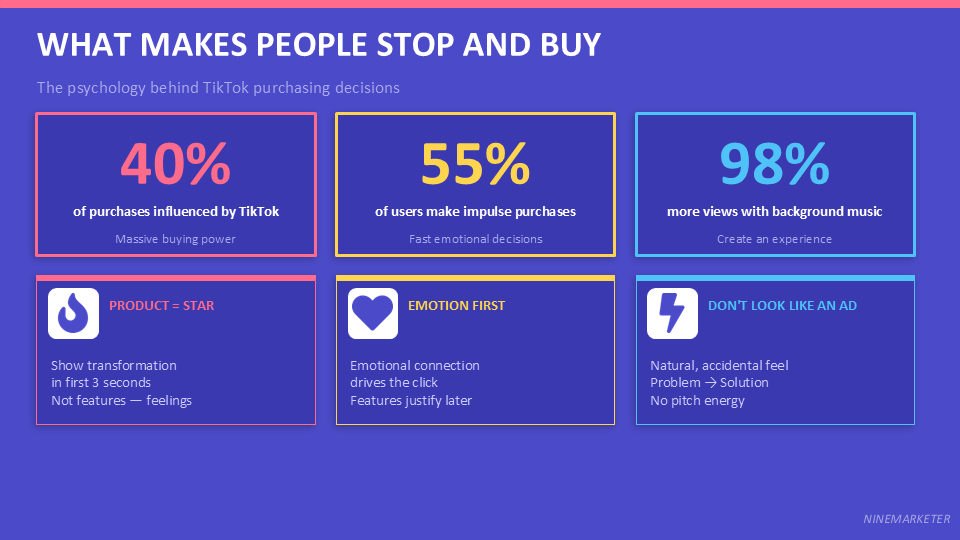
Nearly 40% of all purchases made by users are influenced by TikTok, which means the platform has massive power to drive actual sales, not just awareness.
Your job is to create content that taps into that buying intent.
What Actually Makes People Stop and Buy
There’s this misconception that viral content is just luck or timing.
But when you look at successful dropshipping videos, patterns emerge real quick. First off, your product needs to be the star without feeling like an ad.
Sounds contradictory, right?
But think about the last product you bought from TikTok, chances are, it didn’t feel like someone was selling to you.
The most effective videos show your product solving a problem in the first three seconds.
Not talking about solving it, not building up to it, actually showing the transformation or benefit immediately.
About 55% of TikTok users make impulse purchases after discovering something new on the platform, and those purchasing decisions happen fast.
If your hook doesn’t grab them instantly, they’re gone.
Here’s something that trips up a lot of dropshippers: they focus too much on features and not enough on feelings.
Nobody cares that your kitchen gadget has “five interchangeable blades” unless you show them how that translates to making meal prep less of a nightmare.
The emotional connection drives the click, the features justify the purchase later.
Product demonstration techniques need to feel natural, almost accidental.
Like someone just happened to be filming when they discovered this amazing solution.
The moment your video screams “I’m trying to sell you something,” engagement drops.
Videos with background music see 98% more views on average, which tells you something about creating an experience rather than a pitch.
Before and After: The Format That Actually Converts
If you’re not using before-and-after content for problem-solving products, you’re leaving money on the table.
Period.
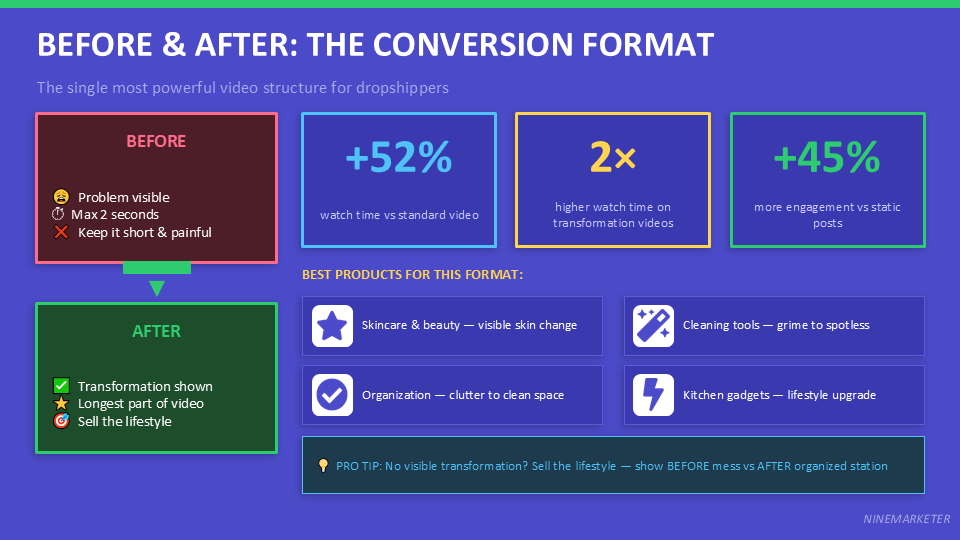
Before/after formats increase watch time by 52% compared to standard product videos, and that extended watch time signals to TikTok’s algorithm that your content is worth pushing to more people.
The reason this format works so well is psychological.
People love seeing transformations, it activates the part of their brain that imagines themselves experiencing that same change.
A cleaning product that shows a grimy countertop becoming spotless in 10 seconds?
That’s not just a demo, that’s a mini story with a satisfying payoff.
But here’s where most people screw it up: they make the “before” section too long or too boring.
You’ve got maybe two seconds to establish the problem, then you need to jump into the solution.
The transformation itself should be the longest part of your video, because that’s what keeps people watching.
Transformation videos average 2× higher watch time than regular product showcases, making them algorithmic gold.
Think about skincare, organization products, or anything that creates a visible change.
These are tailor-made for before-and-after content.
Even if your product doesn’t have an obvious visual transformation, you can often create one through creative filming.
A portable blender?
Show the cluttered kitchen counter versus the clean, organized breakfast station.
You’re selling the lifestyle transformation, not just the product.
Unboxing Content That Builds Real Anticipation
Unboxing videos might seem played out, but the data says otherwise.
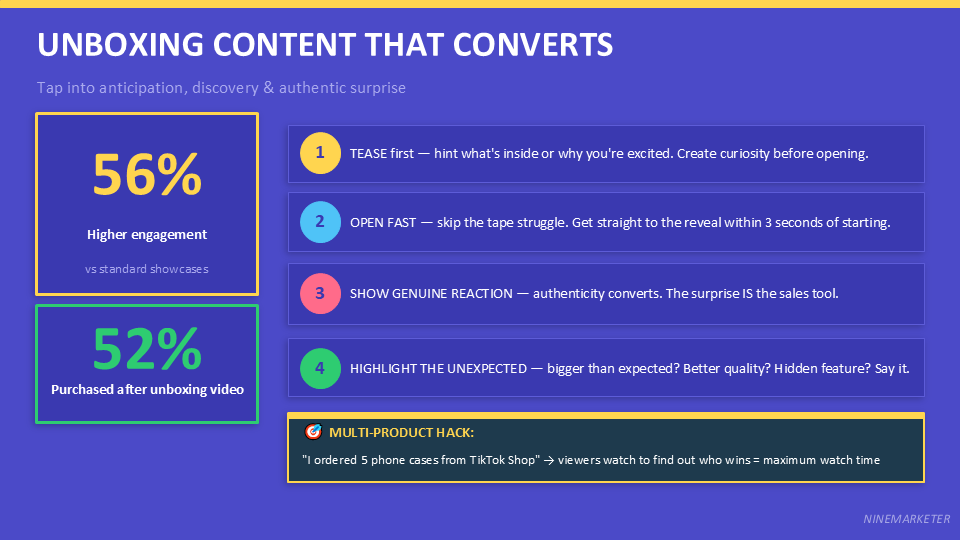
Unboxing videos get 56% higher engagement than standard product showcases, and there’s a specific reason why.
They tap into something primal, anticipation and discovery.
When done right, they make viewers feel like they’re experiencing that “new product joy” alongside you.
The mistake most dropshippers make with unboxing content is treating it like a formal product review.
They film themselves carefully opening boxes, talking through every feature, explaining specifications.
That’s YouTube content, not TikTok content.
On TikTok, your unboxing needs to have energy, surprise elements, and immediate payoff.
Start with a quick tease of what’s inside or why you’re excited about it.
Then get to the actual unboxing fast, no one wants to watch you struggle with tape for 15 seconds.
The key is showing genuine reactions.
About 52% of consumers say they’ve purchased a product after watching an unboxing video, and that purchasing decision is heavily influenced by the authenticity of the person’s reaction.
Here’s a technique that works incredibly well: the “I didn’t expect this” angle.
Order something, film yourself opening it, and highlight something surprising about the product, maybe it’s bigger than expected, the quality is better than the price suggests, or there’s a feature you didn’t know about.
That genuine surprise translates to credibility, and credibility converts.
Unboxing also works great for testing multiple products from the same category.
“I ordered five different phone cases from TikTok Shop”
Now you’re creating entertainment value while showcasing products.
People will watch through to see which one you actually liked best, and that watch time is exactly what the algorithm rewards.
Trending Sounds: Your Secret Weapon
This is where a lot of dropshippers get timid, and I don’t get it.
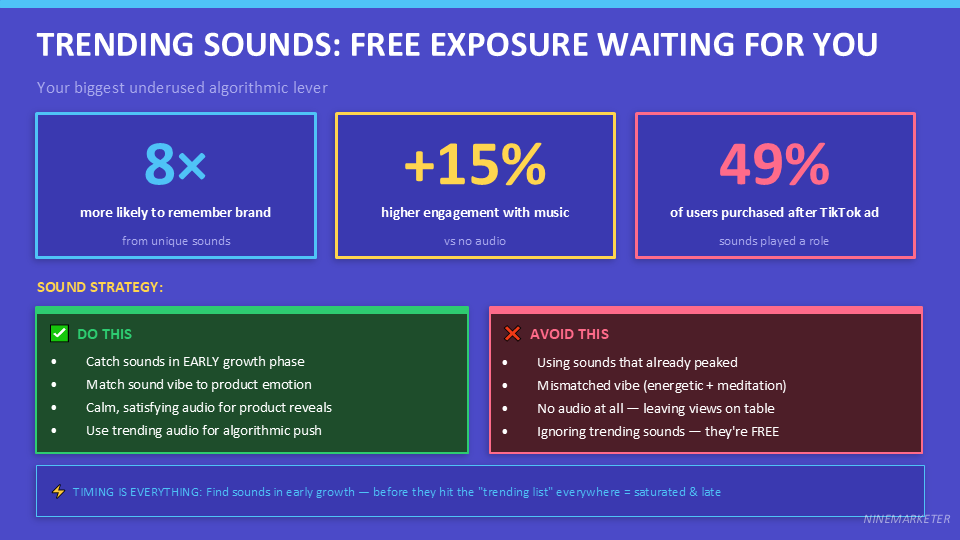
TikTok users are 8 times more likely to remember a brand because of the unique sounds it uses in its videos.
Trending sounds are literally free exposure sitting there waiting for you to use them, yet people worry about their product getting “lost” in the audio.
Here’s the thing: videos featuring music experience a 15% higher engagement rate than those without, and trending audio gives you an algorithmic boost right out of the gate.
The trick is matching the right sound to your product in a way that feels natural, not forced.
Let’s say there’s a trending sound about being obsessed with something.
You can use that for literally any product, show your product being used with the audio playing.
The sound doesn’t have to directly relate to your product, it just needs to create the right vibe or emotion.
A meditation app using an energetic trending sound?
That’s a disconnect.
But using a calm, satisfying sound with product reveals?
Perfect match.
Nearly half of all TikTok users (49%) report purchasing a product after seeing it advertised or reviewed on the app, and many of those purchases came from videos using trending sounds.
Why? Because trending sounds get your content in front of more people who are already primed to engage with that type of content.
The biggest mistake is using trending sounds that have already peaked.
By the time a sound has been used by massive accounts and shows up on “trending sound” lists everywhere, you’re late to the party.
The real move is catching sounds in their early growth phase, when usage is climbing but hasn’t hit saturation yet.
Satisfying Content That Loops Forever
You know those videos you can’t stop watching?
The ones where someone peels a screen protector perfectly, or organizing content where everything clicks into place?
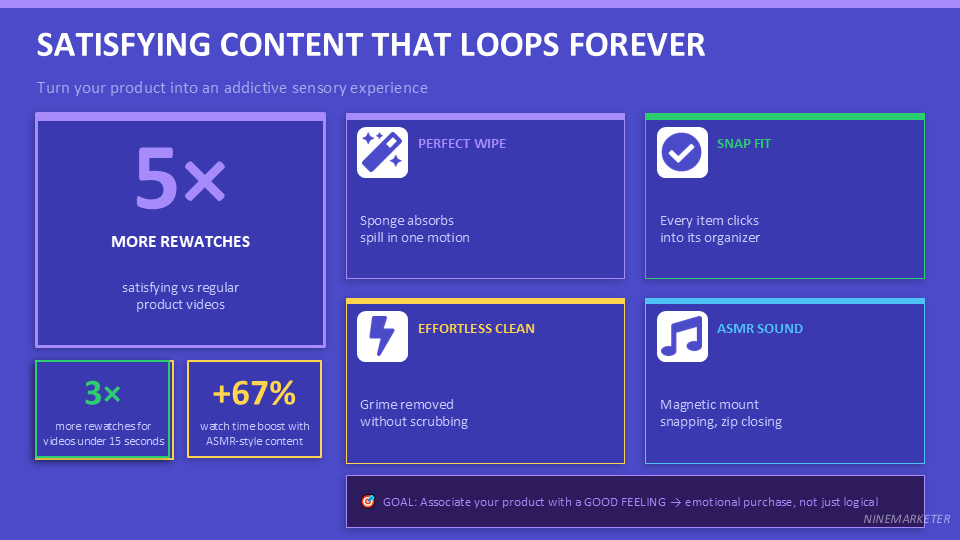
That’s satisfying content, and satisfying-style videos generate 5× more rewatches than regular product videos.
The beauty of satisfying content for dropshipping is that it naturally showcases your product while creating an almost meditative viewing experience.
A sponge that picks up spilled liquid in one wipe?
That’s satisfying.
A organizer where everything fits perfectly? Satisfying.
A cleaning tool that removes grime effortlessly? Extremely satisfying.
Here’s what makes this content format so powerful: people watch it multiple times.
And every rewatch tells TikTok “this content is engaging,” which pushes it to more users.
Videos under 15 seconds get 3× more rewatches, so if you can create that satisfying moment in a tight loop, you’ve got algorithmic dynamite.
Think about ASMR elements too.
ASMR-style content grows watch time by 67%, and for product content, this could be as simple as the sound your product makes when it works.
A magnetic phone mount clicking into place, a zip closing smoothly, a blade cutting cleanly, these sounds paired with satisfying visuals create an almost addictive viewing experience.
The goal isn’t just to show that your product works.
It’s to create a sensory experience that makes people feel good watching it.
And when your product is associated with that good feeling?
The purchase becomes emotionally motivated, not just logical.
The UGC Style: Making Ads That Don’t Feel Like Ads
This is probably the most important shift dropshippers need to make: your content needs to look and feel like regular TikTok content, not advertisements.
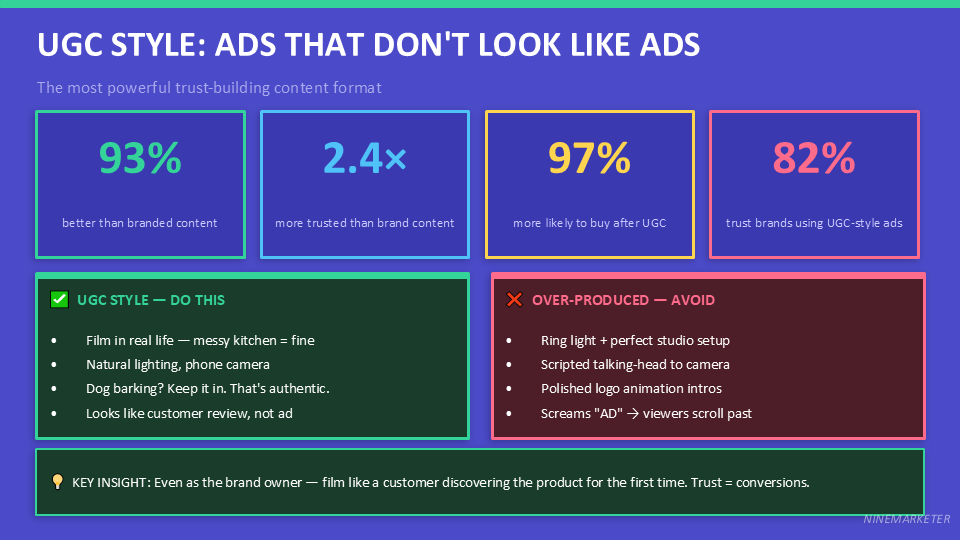
User-generated content drives 60% of TikTok brand engagement, and there’s a simple reason why, people trust real users way more than they trust brands.
UGC performs 93% better than traditional branded content across TikTok, Instagram, and YouTube.
That’s not a small difference, that’s a completely different ballgame.
The problem is most dropshippers hear “UGC style” and think that just means filming on your phone instead of with a fancy camera.
It’s way more than that.
Real UGC style means imperfect filming, natural lighting, genuine reactions, and most importantly, it looks like something your target customer would actually post.
About 82% of customers trust brands more when they include UGC-style ads in their marketing.
The second your video looks too polished or scripted, that trust evaporates.
Here’s a practical example: instead of filming yourself holding up your product to the camera with perfect lighting and a ring light, film yourself using the product in real life.
Messy kitchen? Keep it in frame.
Dog barking in the background? That’s authenticity.
The video doesn’t need to be pretty, it needs to be relatable.
People trust UGC 2.4 times more than brand-created content, and that trust directly translates to conversion rates.
The other massive advantage of UGC style content is that it doesn’t trigger people’s “ad filters.” We’re all so conditioned to scroll past obvious advertisements that we do it without thinking.
But content that looks like it came from a regular person?
We actually stop and watch.
Consumers exposed to UGC creator videos are 97% more likely to buy, and that stat alone should change how you approach content creation.
Don’t overthink the production.
Use your phone, film in natural settings, react naturally, and let your genuine opinion about the product come through.
Even if you’re the brand owner, you can film in a way that feels like a customer review rather than a sales pitch.
Storytelling Frameworks That Connect Emotionally
Here’s where we separate content that gets views from content that actually drives sales.
You can have a million views, but if you’re not connecting the product to an emotional benefit, conversions will be weak.
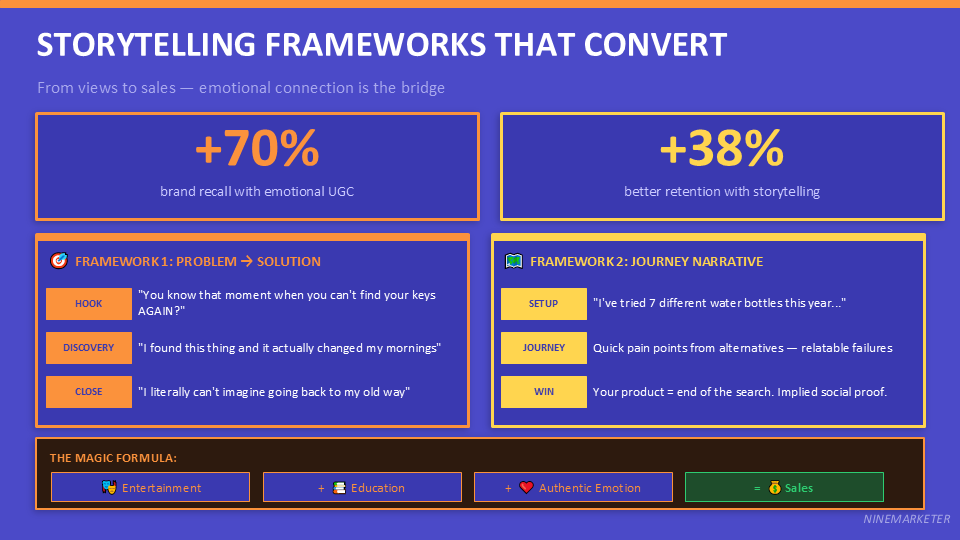
Emotional UGC ads increase brand recall by 70%, which is critical when you’re competing with thousands of other dropshippers selling similar products.
The simplest storytelling framework for product content is the problem-solution narrative, but you need to make the problem feel urgent and personal.
“Tired of X?” isn’t enough.
You need to describe the frustration in a way that makes people nod along.
“You know that moment when you’re rushing out the door and can’t find your keys AGAIN?”
Now you’ve got their attention because you’ve articulated their specific pain point.
The middle of your story – the solution – should feel like a discovery, not a pitch.
“I found this thing and it’s actually changed how I do mornings” lands way better than “This key organizer features five hooks and magnetic backing.”
You’re selling the outcome, the emotional transformation, not the product itself.
Videos with strong storytelling get 38% better retention, and retention is everything on TikTok.
Another framework that works incredibly well is the “journey” narrative.
“I’ve tried seven different water bottles” or “This is my third hair straightener this year.”
People love following someone’s journey to finding the right solution, and when your product is positioned as the end of that journey, it carries implied social proof.
You’ve tested alternatives, and this is the winner.
For maximum impact, end with a future-facing statement that plants a seed about life after purchase.
Not “you should buy this” but rather “I literally can’t imagine going back to my old way.”
That subtle shift from product features to lifestyle transformation is what converts casual viewers into customers.
Before-and-after videos get 45% more engagement than static posts, and that’s because they tell a complete story with emotional payoff.
The best dropshipping content doesn’t feel like content at all.
It feels like someone sharing a genuine discovery with their friends, and viewers get to be part of that discovery.
That’s the magic formula: entertainment plus education plus authentic emotion, all wrapped around a product that actually solves a problem.
Content Creation Tactics That Drive Sales
Here’s the thing nobody tells you about TikTok dropshipping: posting product after product with “link in bio” will kill your account faster than you can say “viral.”
People came to TikTok to be entertained, not to shop.
But when you nail the balance between entertainment and selling, your conversion rates can literally skyrocket compared to traditional advertising.
The secret sauce is what marketers call the 80/20 rule for social media content – and it’s not just some fluffy guideline.
It means 80% of your content should educate, entertain, or solve problems, while only 20% should directly promote your products.
This isn’t guesswork.
According to a report by Global Web Index, people use social media primarily to find “funny and entertaining” content, not to get bombarded with sales pitches.
Why the 80/20 Split Actually Converts
Most dropshippers get this backwards.
They think “I’m here to sell products, so every video should sell products.”
Then they wonder why their engagement tanks and nobody’s clicking through to buy.
The reality?
When you provide value first, people trust you.
And consumers are 131% more likely to buy from a brand immediately after consuming educational content from that brand.
Think about how you scroll through TikTok yourself.
When someone’s obviously trying to sell you something in every video, you keep scrolling.
But when someone teaches you a hack, makes you laugh, or shows you something genuinely interesting, you stick around.
You follow them.
And when they do mention a product, you actually listen because you’ve already decided they’re worth your time.
Companies that use content marketing see a 6X increase in overall conversion rate compared to those relying on traditional marketing alone.
That’s not a typo, six times higher.
The brands winning on TikTok right now understand that their “sales content” needs to be surrounded by content that makes people want to keep watching.
The 80% is your insurance policy.
It keeps followers engaged, prevents them from unfollowing you for being too salesy, and builds the kind of relationship where people actually want to support your brand when you do drop a promotional video.
Educational Content That Positions Products as Solutions
Educational content is where dropshippers can absolutely dominate if they do it right.
This isn’t about making boring tutorial videos that look like instruction manuals came to life.
It’s about showing people something they didn’t know, in a way that makes them think “wait, I need that.”
Let’s say you’re selling a portable smoothie blender.
Bad educational content: “Here are the five features of this blender.”
Good educational content: “Here’s how to make protein shakes in your car during your commute without making a mess.”
You’re teaching them something valuable while naturally demonstrating why your product solves their problem.
Research shows that 68% of consumers prefer content that educates them about a product or service, which makes sense when you think about it.
The key is making sure your educational content directly relates to pain points your product solves.
Don’t just create random “life hack” videos hoping to go viral.
Create content that subtly positions your product as the hero of the story without feeling like an ad.
When someone watches your video about “three mistakes people make with meal prep” and your product solves all three mistakes, that’s educational content done right.
Email campaigns at 87% and educational content at 77% are the top content marketing methods B2B marketers use to nurture audiences, and the same principle applies to dropshipping.
You’re nurturing a relationship that eventually converts into a sale, rather than demanding an immediate purchase from strangers.
Leveraging Pain Points Without Being Annoying
Pain point marketing is powerful, but there’s a fine line between acknowledging someone’s struggle and just being depressing.
The formula that works: identify the problem, amplify the frustration briefly, then immediately show the solution.
You’re not dwelling on negativity, you’re creating a “before and after” journey in 15 seconds.
“You know that moment when you’re trying to open a jar and your hand just keeps slipping?” That’s acknowledgment.
“And you end up using a towel, a rubber band, trying to run it under hot water, and nothing works?” That’s amplification.
“This jar opener grips any size and opens it in one twist.” That’s the solution.
Notice how the pain point makes the product reveal satisfying rather than pushy.
The mistake most dropshippers make is thinking pain points have to be serious.
They don’t.
Some of the best converting content addresses minor annoyances – things people didn’t even realize bothered them until you pointed it out.
“Tired of your phone charger falling behind your nightstand every single night?”
There’s your hook, and suddenly a magnetic cable organizer becomes essential.
When you nail the pain point, people feel seen.
They think “yes, exactly!” and that emotional recognition creates instant connection.
That connection is what turns a scroll into a watch, a watch into a click, and a click into a sale.
The product becomes the answer to a problem they’re actively experiencing, not something you’re trying to convince them they need.
Comparison Videos Done Right
Comparison content is absolutely golden for dropshipping because it does the heavy lifting of convincing people why your product is better.
But – and this is crucial – it has to feel authentic.
The second it feels like a biased sales pitch, you lose all credibility.
Adding video to a landing page can boost conversion rates by up to 80%, and comparison videos are particularly effective at driving those conversions.
Here’s what works: compare your product to the old way of doing things or to a common alternative, not directly to other brands by name.
“I tested three different phone mounts” works way better than “Our phone mount vs. Brand X.”
When you frame it as your genuine testing experience, people trust the outcome.
Even better, film yourself actually using the alternatives first, showing the problems, then revealing your product as the solution.
The best comparison videos show failures. Seriously.
If you’re selling a kitchen gadget, show yourself struggling with the traditional method first.
Let the onion slip, let the can opener fail, let the reality of the problem play out.
Then when your product works smoothly, the contrast sells itself.
Videos with strong storytelling get 38% better retention, and comparison content is inherently a story with a payoff.
People want to make informed decisions.
When you present comparisons transparently, you position yourself as helpful rather than pushy.
Plus, comparison content tends to rank really well algorithmically because people watch it all the way through – they want to see which option “wins.”
That watch time signals to TikTok that your content is engaging, which pushes it to more viewers.
Day in the Life Content That Sells Without Selling
Day-in-the-life content is sneaky genius for dropshipping because you’re not selling anything directly, you’re just showing your routine.
But if your products happen to be part of that routine?
That’s organic product placement that doesn’t feel like an ad at all.
This is UGC (user-generated content) style at its finest, and UGC performs 93% better than traditional branded content across major platforms.
The format is simple: “Day in my life as a [something relatable]” and you just film snippets of your day where your products naturally appear.
Making coffee with your portable espresso maker, using your laptop stand during work, organizing your desk with your cable management system.
You’re not explaining features or giving a sales pitch – you’re just living your life, and your products are part of it.
What makes this work is the authenticity.
People watching day-in-the-life content aren’t in “shopping mode,” they’re in “entertainment mode.”
But when they see something useful in your routine, they get curious.
“Wait, what is that thing she used to organize her cords?”
Boom, that’s engagement.
That’s someone seeking out information about your product because they’re genuinely interested.
People trust UGC 2.4 times more than brand-created content, which is why this style converts so well.
It doesn’t trigger people’s natural resistance to advertising.
Instead of thinking “they’re trying to sell me something,” viewers think “oh that’s smart, I should get one of those.”
That subtle shift in perception changes everything.
The key is keeping it actually realistic.
Don’t make your day look like a perfectly staged commercial.
Let your life be messy, relatable, and human.
That’s what resonates with people scrolling TikTok at 11 PM in their pajamas.
Behind-the-Scenes: Building Trust Through Transparency
Behind-the-scenes content is your credibility builder.
In an era where everyone assumes dropshipping means cheap products shipped from who-knows-where, showing transparency differentiates you from sketchy competitors.
Film your packing process, show how you test products before listing them, talk about why you chose certain items for your store.
Sharing behind-the-scenes content makes your brand feel more real and helps you connect better with your audience.
This isn’t about showing some fancy warehouse or pretending to be bigger than you are.
People actually prefer the honesty.
“Here’s my garage where I pack orders” is way more relatable and trustworthy than trying to fake a big operation.
This content works because it humanizes your business.
You’re not some faceless corporation, you’re a person (or a small team) working hard to get good products to customers.
Share your wins, share your challenges, show the learning process.
“I had to return this entire batch because the quality wasn’t good enough” – that vulnerability builds massive trust.
The behind-the-scenes format also lets you explain your values without being preachy.
Show yourself carefully packing items so they arrive undamaged.
Film the product testing process.
Talk about why you switched suppliers to get better quality.
These aren’t direct sales tactics, but they address the main objections people have about buying from dropshippers: quality concerns and unreliable service.
People buy from brands they trust, and trust comes from transparency.
When someone sees you genuinely care about what you’re selling, they’re way more likely to take a chance on your products.
Plus, this content makes your brand memorable, you’re not just another dropshipping store, you’re that person who actually shows what goes on behind the scenes.
How-To Tutorials That Showcase Versatility
How-to content is evergreen gold for dropshipping because it provides lasting value while demonstrating your products in action.
The magic is showing use-cases people hadn’t thought of.
If you sell a phone tripod, don’t just show “how to use a phone tripod.” Show “how to film professional-looking recipe videos with just your phone” or “how to take family photos without asking strangers to help.”
Now you’re solving real problems.
Video content that provides useful information can drive an 80% increase in conversion rates on websites, and the same principle applies to social content.
When someone learns something valuable from your video, they associate your brand with being helpful.
That’s powerful positioning.
The tutorial itself is the value, and the product is just the tool that makes it possible.
The best how-to content teaches a complete skill or solution, not just how to use the product.
“How to create a home gym in a small apartment” is way more engaging than “how to use resistance bands.”
Your resistance bands become part of a larger transformation.
You’re selling the outcome – a functional workout space – not just the equipment.
This content also has serious longevity.
Unlike trending sounds or challenges that die in a week, tutorial content keeps getting discovered.
Someone searching for “how to organize charging cables” three months from now can still find and engage with your content.
That long-tail value makes tutorials worth the extra effort to create.
Plus, tutorials naturally lead to action.
When someone watches your entire video and learns something useful, they’re in a mindset of “I could do that.”
If doing it requires your product, the path to purchase feels logical rather than forced.
You’re not convincing them to buy, you’re enabling them to achieve something they now want to do.
Riding Seasonal Waves and Trending Topics
Seasonal content and trending topics are your fast lane to massive visibility because you’re tapping into existing interest.
When everyone’s searching for “back to school organization” or “summer travel essentials,” your product content can ride that wave.
Content around fall and winter may perform better as they’re geared towards specific trends like back-to-school, Halloween, and holidays.
The smart move is planning your seasonal content early.
Don’t post about Christmas gifts on December 20th, start in November when people are actually planning their shopping.
Same with summer products, start promoting in late spring when people are thinking ahead.
You want to catch people in the research phase, not when they’ve already made their decisions.
Trending topics are different from seasonal trends because they move fast.
A news event happens, a meme blows up, a celebrity does something unexpected, if you can tie your product to that moment quickly, you can capture huge attention.
But the key word is quickly.
Trending topic content has a shelf life of maybe 48 hours before it’s old news.
The biggest mistake with seasonal content is being too obvious.
Everyone’s posting pumpkin spice content in October.
What about “cozy season essentials you didn’t know you needed” instead?
Same season, less saturated angle.
You’re still tapping into the fall mood, but you’re standing out from the crowd.
By leveraging data-driven insights and maintaining a flexible approach to content planning, you can enhance engagement and strengthen brand credibility.
Seasonal planning also lets you batch-create content efficiently.
Dedicate one day to filming all your fall content, another to winter content, and so on.
Then you’re ready to post at the right moment without scrambling.
This advance preparation means you can focus on trending opportunities as they pop up, rather than being stuck creating basic seasonal content at the last minute.
The combination of planned seasonal content and reactive trending content gives you the best of both worlds.
You have a solid content calendar that capitalizes on predictable interest spikes, plus the flexibility to jump on unexpected opportunities.
That balance keeps your content feed fresh, relevant, and constantly reaching new potential customers.
Mastering TikTok Trends for Organic Reach
You know that sinking feeling when you finally jump on a trend, only to realize everyone and their mom already did it three days ago?
Yeah, that’s the cost of being late to the party on TikTok.
The difference between catching a trend early and riding the wave versus showing up when it’s already crashed can literally mean the difference between 500 views and 500,000 views.
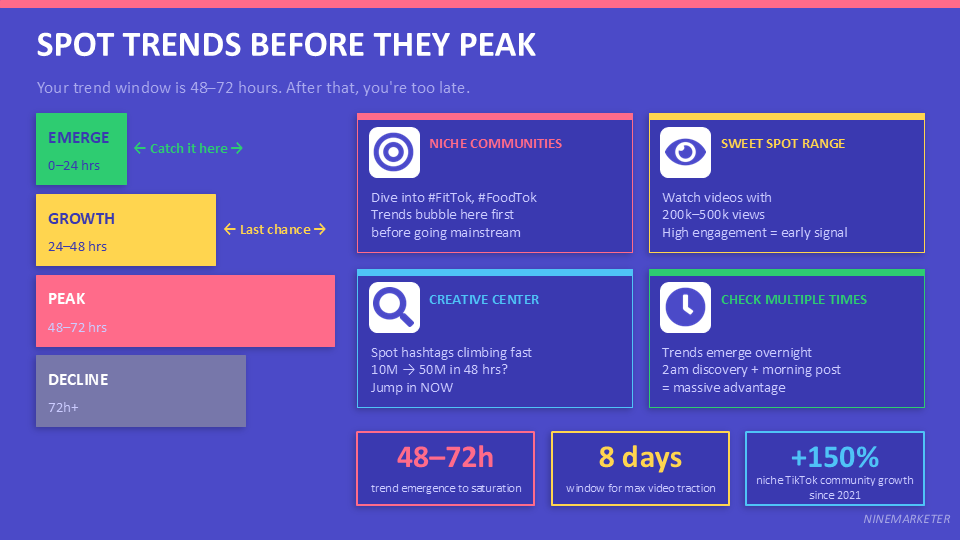
Here’s what most dropshippers don’t get: TikTok videos tend to gain most of their traction within the first 8 days, showing just how fast content moves on this platform.
Trends move even faster, we’re talking 48 to 72 hours from emergence to saturation in most cases.
If you’re not paying attention, you’ll miss your window completely.
Identifying Trends Before Everyone Else Does
The secret to trend spotting isn’t scrolling your For You Page for hours (although that helps).
It’s knowing where to look and what signals to watch for.
Most people see trends when they’re already everywhere, which is way too late.
You need to catch them in the growth phase, not the peak phase.
Start by spending time in niche communities related to your products.
If you’re selling fitness gear, you should be deep in #FitTok. Kitchen gadgets? Live in #FoodTok.
TikTok communities have grown by more than 150% since 2021, and each one has its own mini-trends that bubble up before hitting the mainstream.
A sound or challenge that’s getting traction in BookTok today might explode platform-wide tomorrow.
The “for you page” isn’t just entertainment, it’s your trend radar.
But here’s the trick: watch what’s getting engagement in the low hundreds of thousands, not the millions.
By the time something has 5 million views, it’s already saturated.
Look for videos with 200k-500k views that are getting crazy engagement rates.
That’s your sweet spot for early adoption.
TikTok’s Creative Center is a free tool that shows you trending hashtags, sounds, and creators in real-time.
The catch is that most people use it to see what’s already trending.
Smart creators use it to spot what’s climbing fast, hashtags with momentum but not yet at peak.
If a hashtag went from 10 million to 50 million views in 48 hours, that’s your signal to jump in now.
Check TikTok at different times throughout the day, not just once.
Trends can emerge overnight, literally.
The person who catches a new dance challenge at 2am and posts their version by morning has a massive advantage over someone who discovers it the next afternoon when hundreds of others have already participated.
Adapting Trends Without Looking Forced
Here’s where most dropshippers crash and burn: they see a viral dance and think “how do I awkwardly hold my product while doing this?” Stop. Just stop.
The best trend adaptations feel natural, like your product was made for that trend.
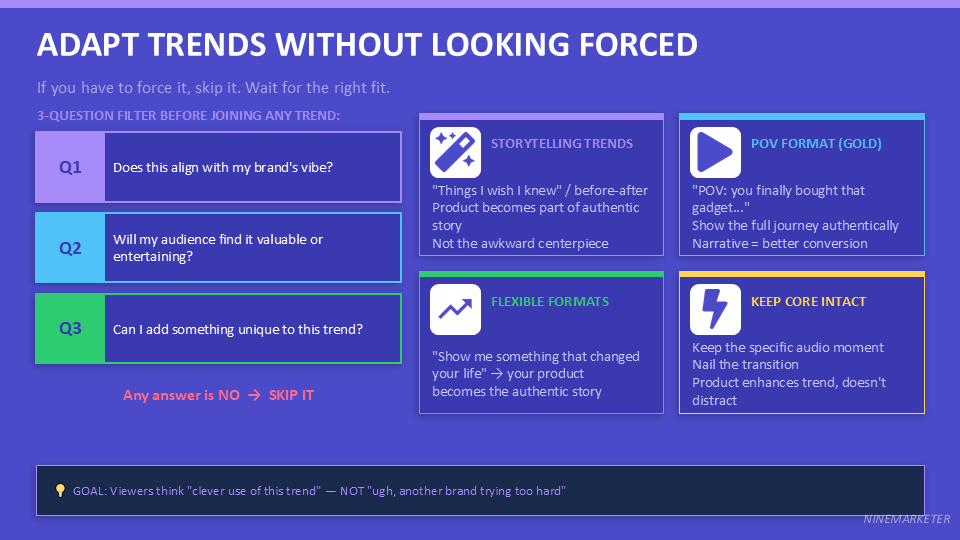
If you have to force it, skip it and wait for a better fit.
The key is asking “does this trend align with my product’s use case or vibe?”
A portable speaker company jumping on a dance trend makes perfect sense, they can show the speaker playing the trending audio while someone dances.
But a phone case company doing the same dance while awkwardly holding their product?
That’s forced and people can smell it from a mile away.
Look for trends with flexible formats.
Storytelling trends, “things I wish I knew” trends, before-and-after trends, these give you natural ways to showcase products without being salesy.
When a trend says “show me something that changed your life,” that’s your opening.
Your product becomes part of an authentic story, not the awkward centerpiece of someone else’s format.
The “POV” (point of view) trend format is gold for dropshipping because it’s inherently about experiences and scenarios.
“POV: you finally bought that kitchen gadget you kept seeing on TikTok”, now you can show the whole journey authentically.
These narrative-driven trends convert way better than straight product demos because viewers are engaged with the story, not just the sell.
Don’t change the core of what makes a trend work.
If it’s a specific audio moment, keep that moment.
If it’s a particular transition, nail that transition.
Then add your product in a way that enhances the trend rather than distracts from it.
You want people to think “oh that’s a clever use of this trend” not “ugh another brand trying too hard.”
Sound Selection That Actually Works
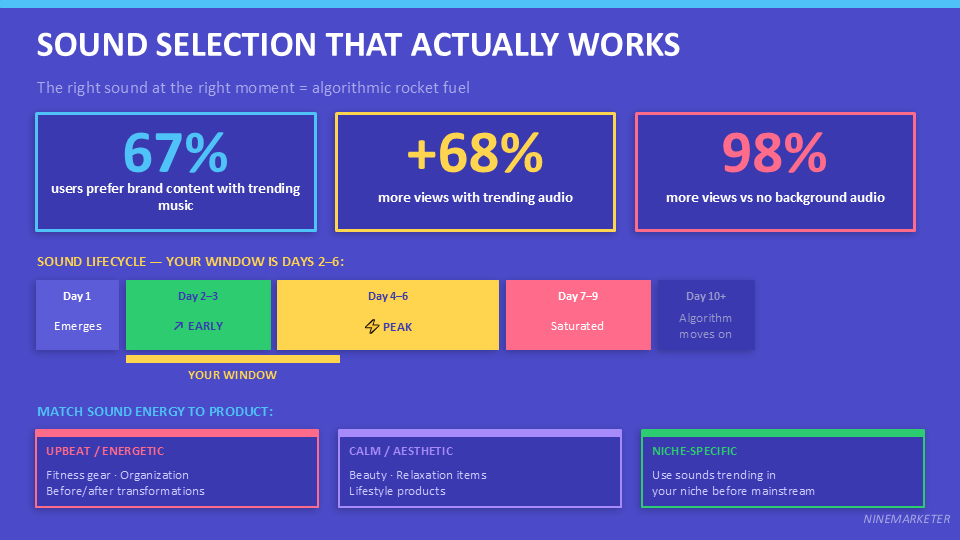
67% of TikTok users prefer brand content that incorporates trending music, which tells you everything about how important audio strategy is.
But here’s the thing, not all trending sounds are created equal, and picking the wrong one can actually hurt your reach.
The trending sounds that work best for dropshipping aren’t always the most popular ones.
In fact, mega-viral sounds can be oversaturated to the point where your video gets lost.
Videos using trending audio get 68% more views compared to those without, but that bump only works if you’re early enough to the sound that there’s still audience appetite for it.
Your sound selection should match your content’s energy and your product’s vibe.
Upbeat, energetic sounds work for fitness products, home organization, anything with before-and-after transformations.
Calm, aesthetic sounds are perfect for beauty products, relaxation items, anything lifestyle-oriented.
When there’s a mismatch, it feels off and people scroll.
Here’s a pro move most people miss: use sounds that are trending in your niche specifically, not just trending platform-wide.
A viral hashtag might face intense competition, but pairing it with niche-specific sounds increases discoverability by helping the algorithm understand your content’s context.
If #FitTok has a sound blowing up but it hasn’t hit mainstream yet, that’s your goldmine.
The timing matters too.
Sounds typically trend for 5-10 days before they peak and then decline.
Your window is days 2-6 of that lifecycle.
By day 7, you’re competing with thousands of other videos using the same sound.
By day 10, the algorithm is already looking for the next thing.
Missing this window means your video won’t get the sound-based algorithmic boost.
Original sounds can work too, but they’re a gamble.
Videos with background music see 98% more views on average, which shows that familiar audio performs better than silence.
If you create an original sound, it better be really good, like catchy jingle or satisfying ASMR level good.
Otherwise, stick with trending audio that’s proven to hold attention.
Hashtag Strategy That Gets You Discovered
Let’s talk hashtags, because this is where a lot of dropshippers waste their efforts.
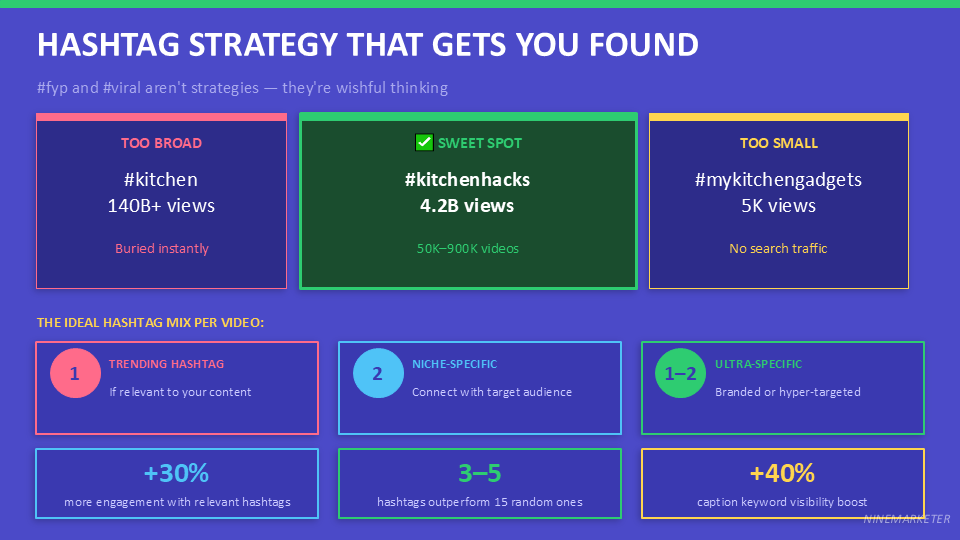
Posts with relevant hashtags experience up to 30% more engagement than those without, but that only works when your hashtag strategy isn’t trash.
Using #fyp and #viral isn’t a strategy, it’s wishful thinking.
The golden rule: the best hashtags for visibility on TikTok have less than a million videos.
Once a hashtag hits the millions, your content gets buried in seconds.
You want hashtags that are popular enough to have search traffic but not so saturated that you’re invisible.
Think 50k-900k videos as your sweet spot.
Your hashtag mix should be strategic: one trending hashtag (if relevant), two niche-specific hashtags, and one to two branded or ultra-specific hashtags.
Using relevant keywords in captions can boost content visibility by 20-40%, and hashtags are part of that keyword strategy.
The algorithm uses them to categorize and serve your content to the right viewers.
Here’s what actually works: instead of #kitchen (140 billion views, completely oversaturated), use #kitchenhacks (4.2 billion views, still searchable).
Instead of #fitness (way too broad), use #homeworkouttips (much more targeted).
Niche-specific hashtags often perform better than broad ones, improving discoverability because they connect you with viewers who are actually interested in your specific content.
Don’t use the same hashtag set on every video.
The algorithm can detect repetitive patterns and may see it as spammy behavior.
Rotate your hashtags based on the specific content of each video.
If one video is about organization and another is about cleaning, those need different hashtag strategies even if you’re selling the same product category.
Avoid hashtag stuffing, quality over quantity always.
Three to five relevant hashtags typically outperform fifteen random ones.
TikTok recommends using 3-5 relevant hashtags so you still have space to write engaging captions that capture attention.
The caption is where you hook people emotionally, the hashtags are how you get discovered initially.
Joining Trends Without Looking Desperate
You’ve seen them, brands that jump on every single trend, regardless of relevance, and it just feels desperate.
Like watching your parents try to be cool.
The secret to participating in trends authentically is selectivity.
Not every trend is for you, and that’s okay.
In fact, it’s better.
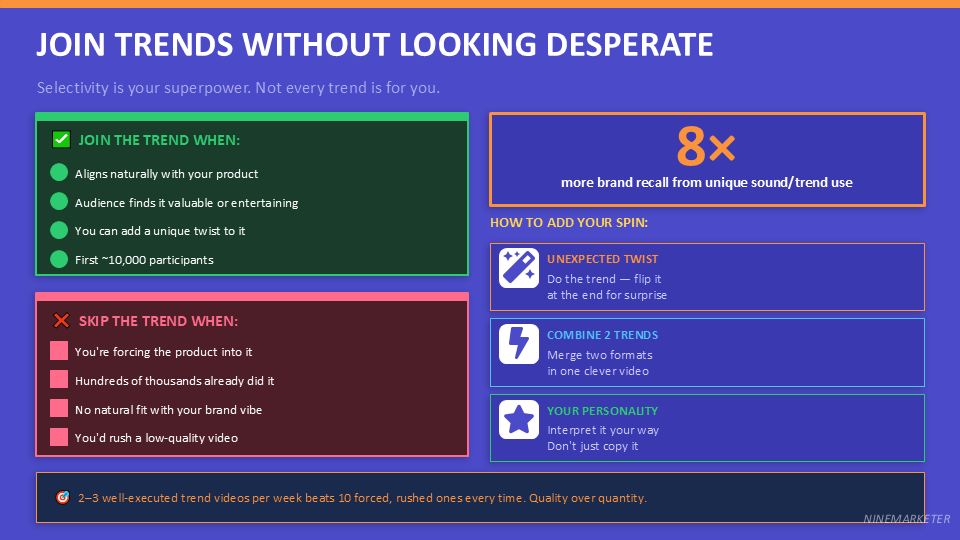
Ask yourself three questions before jumping on a trend: Does this align with my brand?
Will my audience find this valuable or entertaining?
Can I add something unique to this trend?
If the answer to any of these is “not really,” skip it.
TikTok users are 8 times more likely to remember a brand because of the unique way it uses sounds and trends, not because it does every trend mediocrely.
The brands that win on TikTok pick 2-3 trends per week that genuinely fit, rather than forcing 10 trends per day.
Quality and authenticity beat quantity every single time.
When you’re selective, each trend video you create can actually be good instead of rushed and awkward.
That quality shows, and viewers respond to it.
Timing your trend participation matters too.
If you’re first or second hundred to a trend, that’s great.
If you’re in the first ten thousand, that’s still workable.
If you’re arriving after hundreds of thousands of people already did it?
You missed the boat.
Trends peak and fade quickly, with some lasting just a few days.
The “fast cycle” means new trends emerge every few days, so missing one isn’t the end of the world, just catch the next one.
Add your own spin when you can.
The trend provides the framework, but your execution should have personality.
Maybe you do the trend but with a unexpected twist at the end.
Maybe you combine two trends in a clever way.
Originality within a trend helps your content stand out while still riding the wave of existing interest.
You’re not recreating the trend perfectly, you’re interpreting it.
Creating Branded Challenges That Actually Take Off
Let’s be real about branded challenges: they’re expensive if you go the official route through TikTok’s ad platform, but there’s a scrappy, organic version that dropshippers can do.
It won’t get you 4 billion views like the #EyesLipsFace challenge, but it can build community and generate UGC for free.
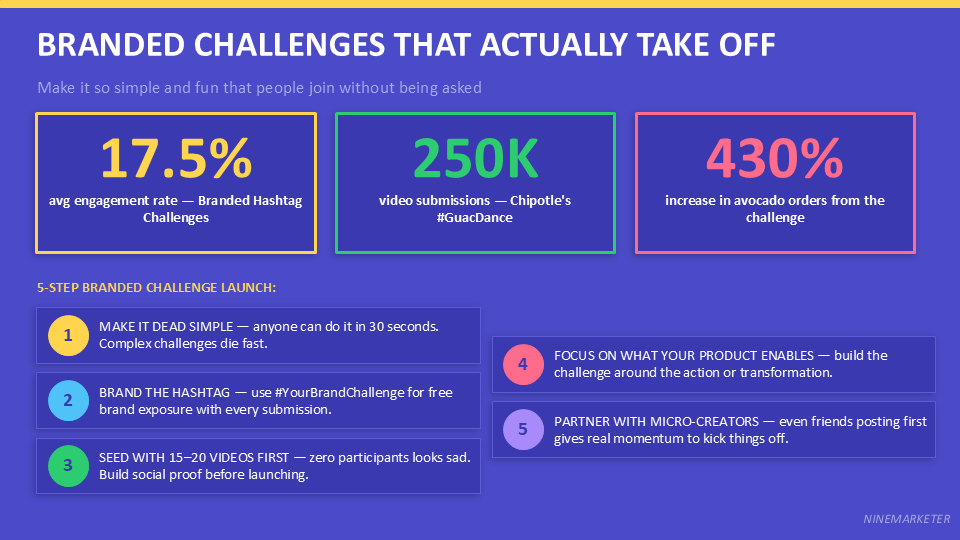
Branded Hashtag Challenges generate an average engagement rate of 17.5%, making them one of the most effective formats on TikTok.
But that stat applies to paid challenges.
For organic challenges, you need a different approach, make it so simple and fun that people want to participate without any incentive.
The challenge needs to be dead simple.
Complex challenges die fast.
Look at #GuacDance by Chipotle it was literally just dancing with the guac song.
That simplicity led to 250,000 video submissions and a 430% increase in avocado orders.
Your challenge doesn’t need fancy choreography or complicated rules.
It needs to be something anyone can do in 30 seconds.
Include your brand name in the hashtag for recognition.
Instead of #CookingChallenge, make it #CookWith[YourBrand]Challenge.
Every time users participate, they reinforce your brand name across TikTok’s ecosystem.
It’s free brand exposure with every single video created, which compounds as more people participate.
Seed your challenge with a few creator partnerships or even just friends who will post first.
A branded challenge with zero participants looks sad and won’t attract organic participation.
But a challenge with 15-20 initial videos gives social proof that this is actually happening.
People are way more likely to join something that already has momentum than to be first.
The challenge should showcase your product’s benefit, not just the product itself.
A successful TikTok challenge aligns with the brand’s identity while being entertaining and relatable.
Think about what your product enables people to do, and build the challenge around that action or transformation.
A water bottle brand’s challenge could be about staying hydrated during a specific activity, making the product part of a lifestyle rather than the entire focus.
Timing Your Trend Content for Maximum Impact
Posting a trend video at 3am when your audience is asleep is like throwing a party that no one can attend.
Timing matters, maybe even more than you think.
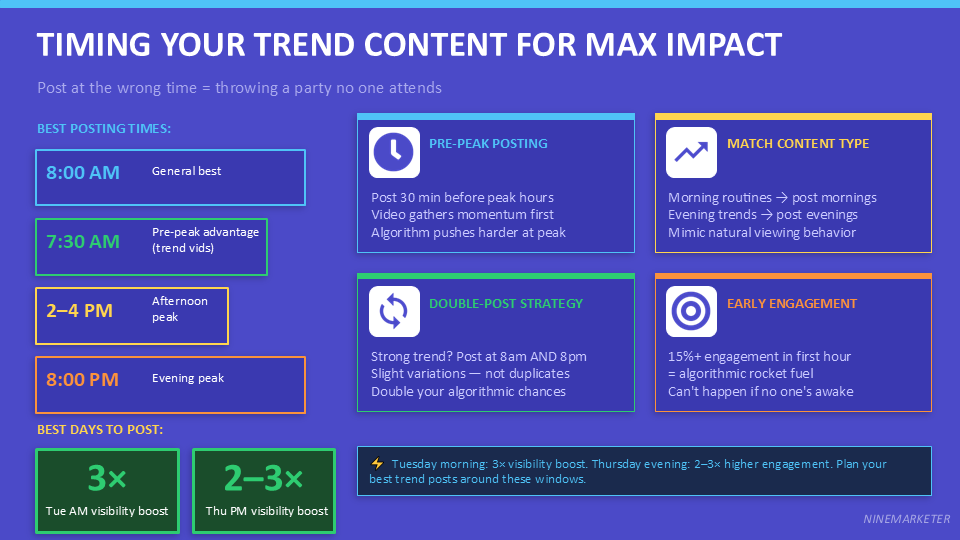
Videos with strong early engagement around 15%+ in the first hour typically explode in reach, and you can’t get that early engagement if nobody’s awake to see your video.
General data shows the best times to post on TikTok are 8 a.m. and 8 p.m., with early afternoon around 2–4 p.m. coming in right after.
But here’s the catch: if you’re posting trend content, you might need to adjust these times.
Trends move fastest during peak TikTok hours, which means competition is also highest then.
For trend videos specifically, posting slightly before peak hours can give you an advantage.
If peak engagement is 8pm, posting at 7:30pm means your video has 30 minutes to gather some initial engagement before the rush.
Then when peak hours hit, the algorithm sees your video already has momentum and pushes it harder.
It’s a small window but it matters.
Different trends perform better at different times too.
Morning trends (like “morning routine” content) obviously should post in the morning when people are looking for that content.
Evening trends, weekend trends, workday trends, they all have optimal timing.
Match your posting time to when people would naturally be interested in that type of content.
Tuesday through Thursday consistently show the highest engagement, with Tuesday mornings seeing a clear 3x boost in visibility and Thursday evenings producing 2x to 3x higher engagement.
If you’re going to jump on a trend, aim for these high-performing days.
Posting the same trend content on a Saturday versus a Tuesday can result in dramatically different outcomes.
Don’t just post once and forget it.
Some creators post trend videos multiple times at different hours to catch different audience segments.
If a trend is strong enough and you have a good take on it, posting one version at 8am and another at 8pm (with slight variations) can double your chances of catching the algorithm’s attention.
Just make sure they’re different enough that they don’t look like duplicate content.
Knowing When to Ditch Trends and Go Original
Here’s the harsh truth: constantly chasing trends can actually hurt your brand in the long run.
You become that account that just copies whatever’s viral instead of having its own identity or point of view.
Some sounds or memes peak in just a few days, and if you’re always showing up late to trends, you’re training the algorithm (and your audience) that your content isn’t timely or original.
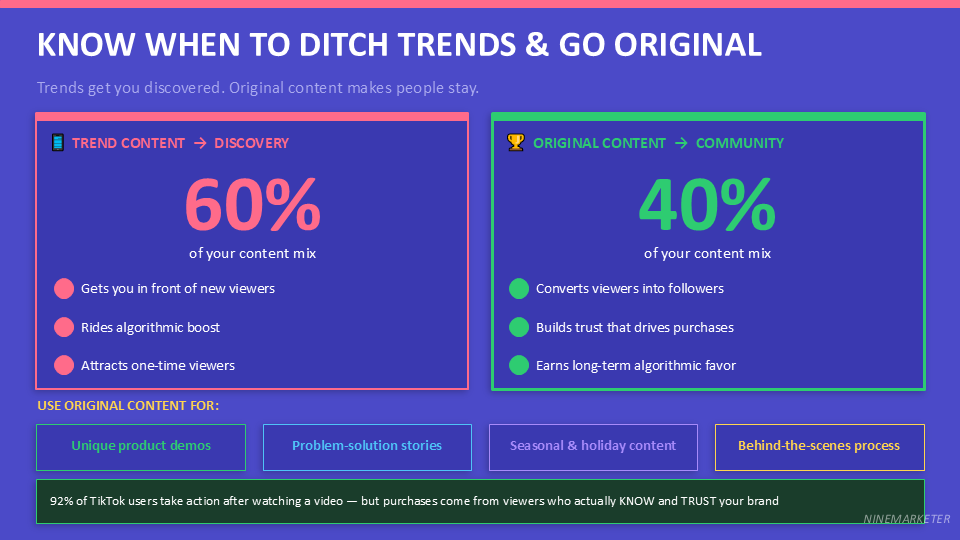
The brands that blow up on TikTok have a mix: maybe 60% trend-based content, 40% original content.
That original content is what builds your actual audience, the people who follow you for you, not just because you did a trending dance.
92% of TikTok users take some action after watching a video, but that action is more likely to be a purchase if they actually know and trust your brand.
Create original content when you have something genuinely valuable to share.
A unique product demonstration, a problem-solution story, a behind-the-scenes look at your process, these don’t need trends to perform well.
In fact, some of the most successful dropshipping videos are just authentic, helpful content with no trend in sight.
They work because they provide value, not because they’re riding a wave.
Seasonal content and evergreen content should always be original.
If you’re making a holiday gift guide or a “best uses for this product” video, that’s where your creativity shines without needing a trending sound or format.
Content around fall and winter may perform better as they’re geared towards specific trends like back-to-school and holidays, and these work best with original concepts tied to the season.
Use trends to get discovered, use original content to build community.
When a trend video goes viral, you’ll get a flood of new viewers.
Those viewers will click on your profile to see what else you post.
If everything is just more trends, they won’t follow.
But if they see original, valuable content that speaks to their needs?
That’s when you convert viewers into followers and followers into customers.
The algorithm actually rewards accounts that create original viral content more than accounts that only participate in existing trends.
TikTok wants to surface fresh, unique content that keeps the platform interesting.
So when you post original content that performs well, the algorithm sees you as a creator worth promoting rather than just another trend-hopper.
That builds long-term algorithmic favor that benefits all your content.
Balance is everything.
Trends get you in the door, original content makes people want to stay.
Master both, and you’ll build an audience that actually converts instead of just scrolls past to the next viral video.
Building an Engaged TikTok Community
There’s this weird obsession with follower count on TikTok, and honestly, it’s costing dropshippers thousands of dollars in lost sales.
You’ve probably seen accounts with 100k followers that barely get any comments or purchases, while someone with 5,000 followers is making bank.
The difference?
Engagement rate.
And it’s not even close.
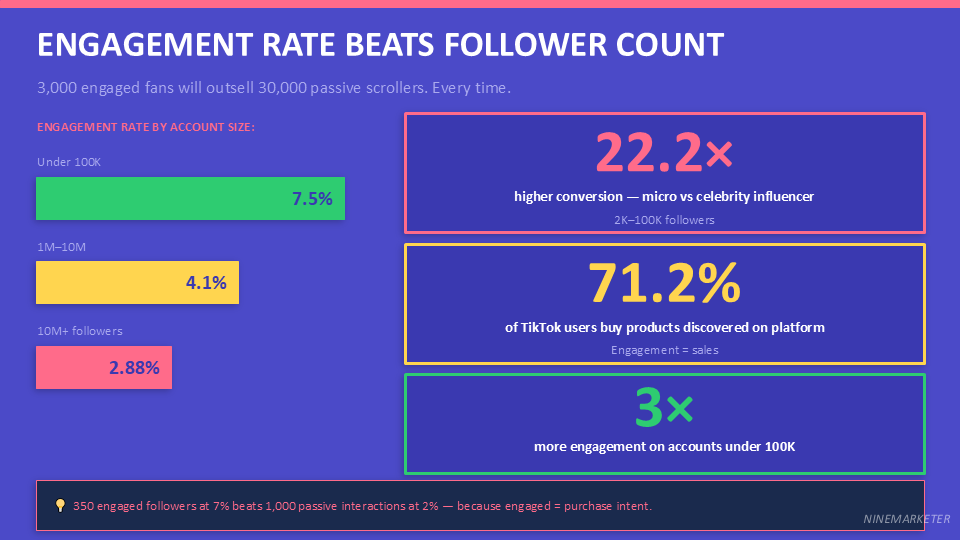
Here’s the reality: smaller accounts under 100k followers achieve engagement rates of 7.50%, while mega-accounts with over 10 million followers see rates drop to 2.88%.
That’s not a typo, smaller accounts get almost three times more engagement.
For dropshipping, this means a tight-knit community of 3,000 engaged followers will outperform 30,000 passive scrollers every single time.
Why Engagement Rate Crushes Follower Count
Let’s talk money.
Micro-influencers with 2,000 to 100,000 followers have conversion rates that are 22.2 times higher than traditional celebrities.
Twenty-two times.
That stat alone should change how you think about building your TikTok presence.
You don’t need millions of followers, you need people who actually give a damn about what you’re selling.
The math makes sense when you think about it.
An engagement rate of 7% on 5,000 followers means 350 people actively interacting with your content.
An engagement rate of 2% on 50,000 followers is only 1,000 interactions.
Sure, that’s more total interactions, but those 5,000 followers are way more likely to convert to customers because they’re actually paying attention.
With 71.2% of TikTok users buying products discovered on the platform, engagement directly translates to sales.
But here’s the kicker: those purchases happen because of trust and connection, not because someone saw your product once and forgot about it.
A highly engaged community knows your brand, trusts your recommendations, and feels connected to your story.
For dropshipping specifically, engagement rate tells you who’s actually considering buying versus who’s just scrolling.
When someone takes the time to comment, save your video, or share it with friends, they’re signaling purchase intent.
The algorithm recognizes this too, which is why high-engagement accounts get pushed harder on the FYP even with smaller followings.
Strategic Comment Responses That Boost Reach
Most dropshippers treat comments like an afterthought.
They’ll respond with a quick “thanks!” and call it a day.
Big mistake.
Comments are a key signal that tells the algorithm a post is engaging, and the more comments you get, the more likely you’ll land on For You pages.
But it goes deeper than that.
Responding to comments doesn’t just make your audience feel heard, it literally tells TikTok your content is worth pushing to more people.
When you reply, it creates additional engagement on that video, which signals continued interest.
The algorithm loves when creators engage with their audience, treating it as proof that your content sparks genuine conversations.
The strategy isn’t just replying to every comment with emojis.
You want to create conversations that keep people coming back.
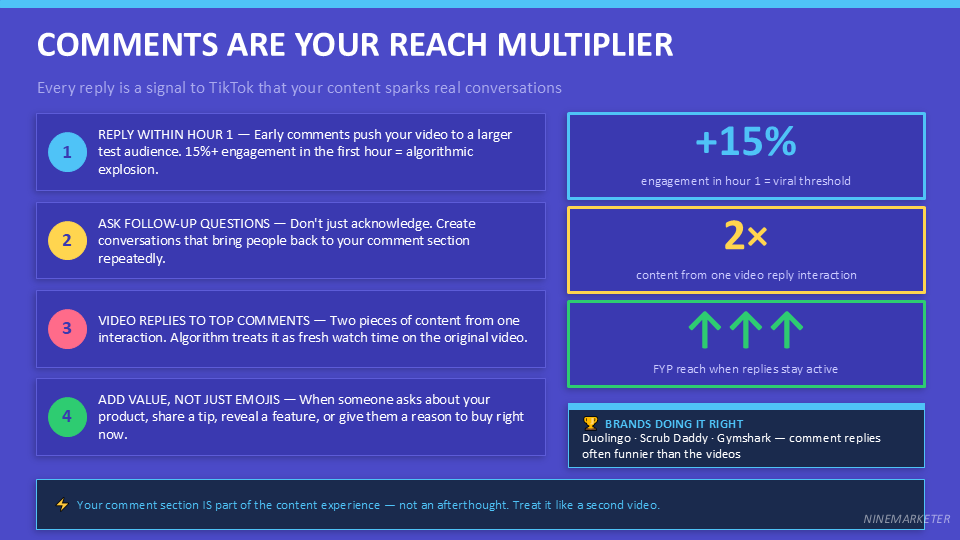
Ask follow-up questions, provide additional value, or respond with humor that matches your brand personality.
When someone asks about your product, don’t just say “link in bio” give them a reason why they need it, share a tip for using it, or tell them about a feature they might not know.
Video replies to comments are absolute gold.
When you create a video responding to someone’s comment, you’re essentially getting two pieces of content from one interaction.
Video replies = more views because the algorithm treats it as fresh watch time while also keeping the original video active.
It’s like compound interest for engagement.
Here’s a tactic that works crazy well: respond to your top comments within the first hour of posting.
Early engagement signals to TikTok that your video is performing, which increases the chances of it getting pushed to a larger test audience.
Videos with strong early engagement around 15%+ in the first hour typically explode in reach, and comment responses contribute directly to that early spike.
The brands killing it on TikTok understand that their comment section is part of the content experience.
Duolingo, Scrub Daddy, Gymshark they all have distinct comment strategies where their responses are often funnier or more engaging than the original video.
That’s not an accident. It’s a deliberate strategy to build community and keep engagement high.
Duet and Stitch: Creating Interactive Connections
If you’re not using Duet and Stitch features, you’re missing out on some of the most powerful community-building tools TikTok offers.
These features aren’t just gimmicks, they’re designed to create conversations and collaborative content that the algorithm absolutely loves.
Incorporating Duet and Stitch videos can significantly increase engagement, especially when used with content from well-known creators.
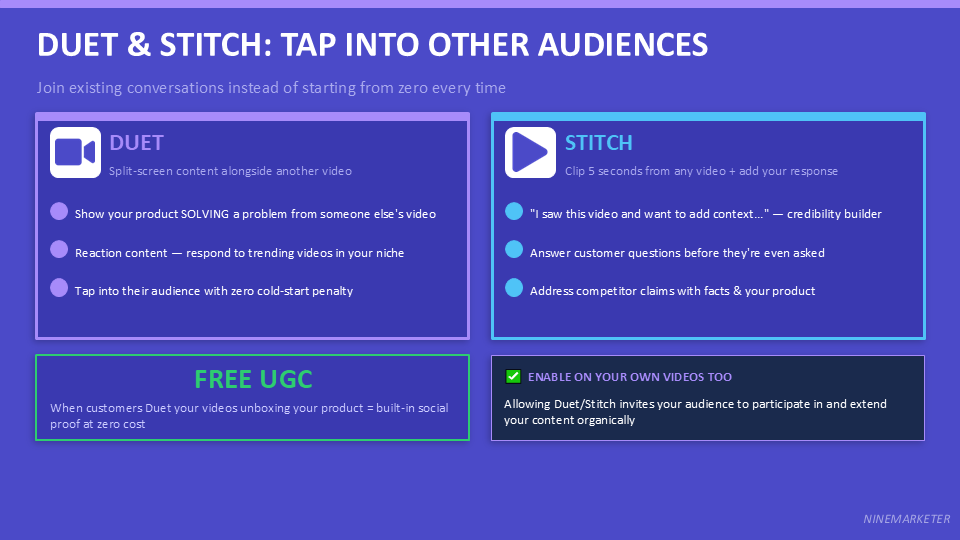
Duet lets you create split-screen content alongside someone else’s video, which is perfect for reaction content, demonstrations, or showing your product in action while someone uses a similar (inferior) product.
The genius of Duets is that they feel collaborative even when the original creator didn’t plan for it.
You’re joining a conversation rather than starting one from scratch.
Stitch allows you to clip up to 5 seconds from another video and then add your own response.
This format works beautifully for dropshipping because you can take a customer question, a product review, or even a competitor’s content and add your unique perspective.
Stitches are excellent for storytelling, tutorials, or discussions because they encourage deeper interaction with the original content.
The strategic advantage?
When you Duet or Stitch someone else’s content, you’re tapping into their audience.
If their video already has traction, your version can ride that wave and get discovered by people who would never have found your account otherwise.
Using these features helps brands reach new audiences through shared experiences.
For dropshipping products, Duets work great when someone posts a problem your product solves.
You can Duet their video showing the struggle with your video showing the solution.
Stitches are perfect for answering common questions or addressing misconceptions about products in your category.
“I saw this video about X and wanted to add some context”, now you’re positioned as helpful rather than salesy.
Enable Duet and Stitch on your own videos too.
Allowing Duet and Stitch increases your potential for engagement because it invites your audience to participate in your content.
When customers create Duets showing themselves unboxing your product or using it, that’s free user-generated content that comes with built-in social proof.
The key is making sure your Duets and Stitches add value, not just piggyback.
The algorithm (and users) can tell when you’re forcing it.
Pick content that genuinely relates to your niche, and make your addition valuable enough that people watch it all the way through.
Encouraging Organic User-Generated Content
User-generated content is the holy grail of dropshipping marketing, and for good reason.
UGC-style content sees 60% of TikTok brand engagement, and it performs dramatically better than anything you create yourself.
The challenge is getting customers to create content without paying them or making it feel forced.
The secret?
Make sharing easy and rewarding.
Not with discounts or incentives, but with recognition and community.
When someone comments about buying your product or mentions using it, respond publicly and enthusiastically.
Feature their experience in your own content.
Ask if you can Duet or Stitch their video.
People love being acknowledged by brands they support.
Create a branded hashtag that’s simple and memorable, then actually use it in your own content.
When customers see you consistently using #YourBrandLife or #SolvedWith[YourProduct], they’re more likely to use it too.
Hashtag challenges can generate massive engagement, with successful campaigns generating 17.5% engagement rates on average.
Make your products inherently shareable.
Think about the unboxing experience, the way the product looks on camera, whether it creates a “wow” moment that people want to capture.
The portable blender that makes perfect smoothies in your car? That’s shareable.
The phone case that… holds your phone? Not so much.
If your product doesn’t create natural content opportunities, you’re swimming upstream.
Comment section prompts work better than you’d think.
End your videos with “show me how you’d use this” or “Duet this if you’ve tried it.”
Not as a call-to-action overlay, but as a natural conversation starter.
When you position your Stitch or Duet as an invitation, you’re tapping into the conversational instinct that makes TikTok so engaging.
The authenticity matters more than production quality.
When real customers post shaky, poorly lit videos showing how much they love your product, that resonates way more than your perfectly staged content.
About 82% of customers trust brands more when they include UGC, and that trust directly translates to conversion rates that blow away traditional advertising.
Building Anticipation With Consistent Posting
Consistency isn’t just about keeping the algorithm happy, it’s about training your audience to expect and look forward to your content.
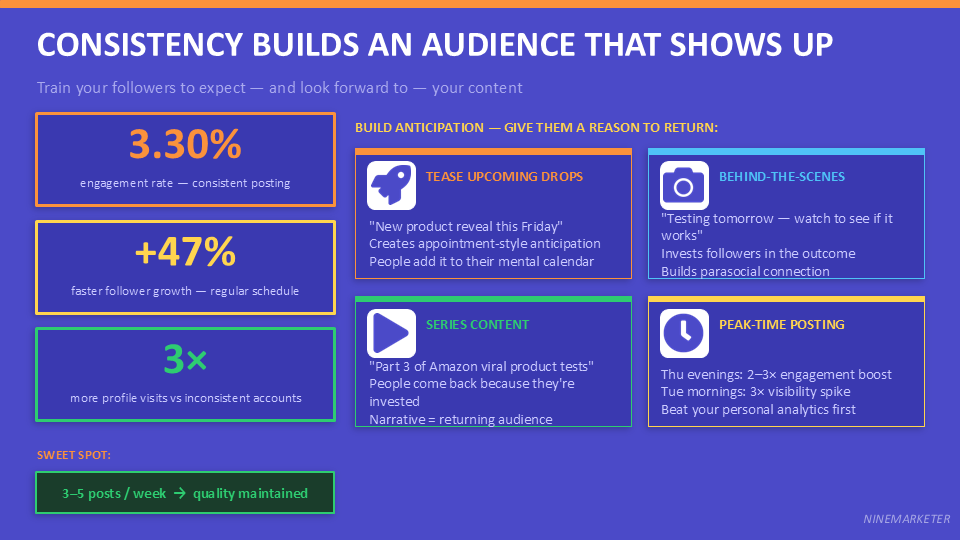
When people know you post every Tuesday and Thursday at 8pm, they start checking for your videos.
That habitual engagement is way more valuable than sporadic viral hits.
Regular posting achieves an engagement rate of 3.30%, while inconsistent posting can’t match this performance.
The data on posting frequency is pretty clear: TikTok recommends posting 1-4 times per day, and accounts that maintain this schedule see dramatically better results.
But here’s the thing, that recommendation assumes you can maintain quality at that volume.
For most dropshippers managing content themselves, 3-5 posts per week is the sweet spot.
Business accounts maintaining regular posting schedules achieve 47% faster follower growth and 3x more profile visits than inconsistent posters.
That’s because the algorithm treats consistent accounts as reliable content sources worth promoting.
Every time you post, TikTok gets another data point to understand your niche and find your ideal audience.
Timing matters too, but not as much as people think.
Thursday evenings consistently produce 2x to 3x higher engagement, with Tuesday mornings seeing similar spikes. But posting at 2pm when your audience is active beats posting at the “optimal” 8pm when they’re not.
Use your analytics to figure out when your specific followers are online.
The mistake most dropshippers make is treating posting like a chore.
They batch-create content, schedule it, and forget about it.
That’s fine for maintaining presence, but it doesn’t build community.
The accounts with the most engaged followers mix scheduled content with real-time responses to trends, customer questions, and cultural moments.
Think about anticipation as part of your strategy.
“New product reveal this Friday” creates expectations.
“Behind the scenes testing tomorrow” gives people a reason to check back.
Series content – “Part 3 of testing Amazon’s viral products” – keeps people coming back because they’re invested in the narrative.
Consistency isn’t just frequency; it’s creating reliable touchpoints with your audience.
The Power of Going Live for Real-Time Sales
TikTok Live is probably the most underutilized feature for dropshipping, and that’s wild considering the conversion potential.
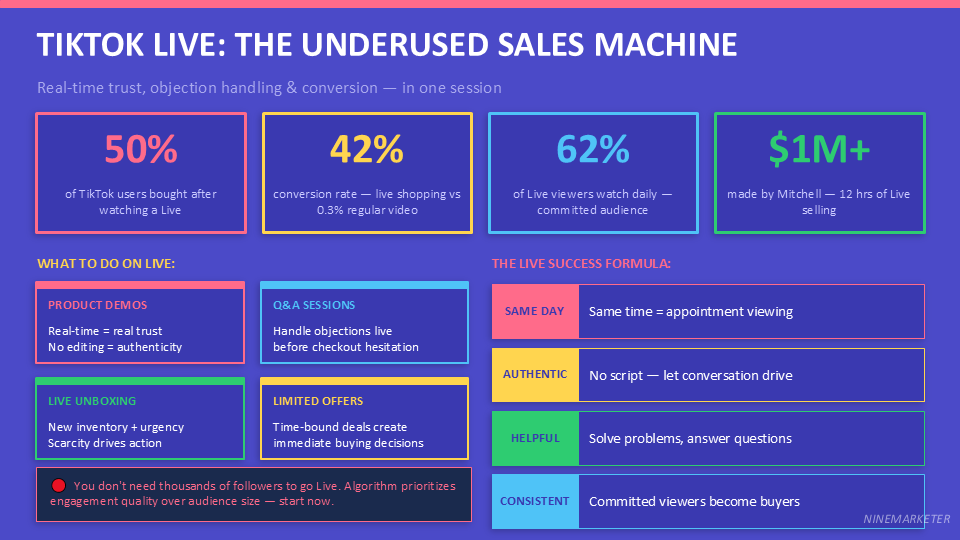
Half of TikTok users have made purchases after watching a live video, and those aren’t just impulse buys.
Live creates urgency, builds trust, and allows real-time objection handling that pre-recorded content can’t match.
The numbers on Live are honestly crazy.
Made by Mitchell earned over $1,000,000 in sales over 12 hours thanks to innovative live-selling events.
That’s not a big brand with massive reach, that’s strategic use of TikTok’s Live Shopping features combined with authentic audience connection.
Livestreaming accounted for 10% of TikTok Shop sales in 2024, which might seem small, but those are highly qualified, high-intent purchases.
Going Live isn’t about having a fancy setup or a script.
It’s about showing up authentically and giving people a reason to stick around.
Product demonstrations, Q&A sessions, limited-time offers, unboxing new inventory, these all work because they create real-time interaction that viewers value.
The algorithm tracks how viewers interact with product tags during Live sessions, and high engagement signals that your content is effective.
The conversion rate difference is stark. While regular videos might convert at 0.3-0.6%, live shopping sessions with creators can see conversion rates above 42%.
That’s because Live removes friction, people can ask questions, see the product in action, and buy immediately without leaving the stream.
It’s QVC for the TikTok generation.
Consistency matters with Live too.
TikTok has described LIVE viewers as a ‘committed’ user base, with 62% watching it daily.
When you go Live regularly, same day, same time, you build an audience that shows up expecting to engage and potentially buy.
The brands crushing it on Live treat it like appointment viewing, not a sporadic experiment.
You don’t need thousands of followers to benefit from Live.
The algorithm prioritizes engagement quality over audience size, meaning even new accounts can reach viewers if their Live sessions generate strong interaction.
Start small, focus on being helpful and authentic, and let the conversation drive the content.
Organic Micro-Influencer Collaborations
Forget paying mega-influencers for shoutouts that go nowhere.
The real opportunity is in organic collaborations with micro-influencers who actually care about products in your niche.
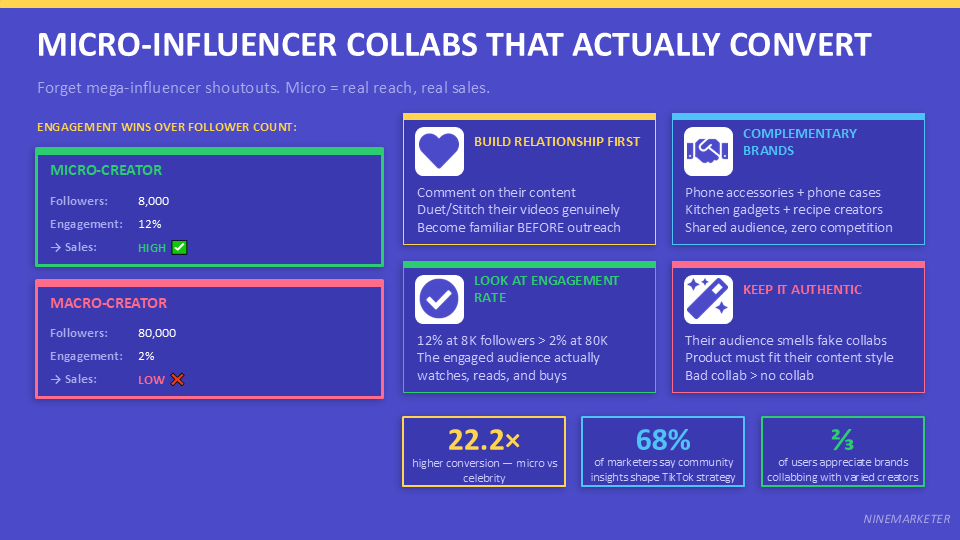
Micro-influencers with 2,000 to 100,000 followers boast conversion rates 22.2 times higher than traditional celebrities, and many of them are open to product collaborations without demanding huge paychecks.
The approach here isn’t transactional.
Don’t slide into DMs with “we’ll give you a free product for a post.”
Instead, engage genuinely with creators in your space.
Comment on their content, Duet or Stitch their videos in valuable ways, build an actual relationship.
When they notice you’re not just another brand trying to use them, real collaboration becomes possible.
Complementary brand partnerships work even better because there’s no competitive tension.
If you sell phone accessories, partnering with someone who sells phone cases makes sense.
If you sell kitchen gadgets, collaborating with recipe creators is natural.
These partnerships expose both brands to new audiences that are already interested in the general category.
Two-thirds of TikTok users appreciate when brands collaborate with a variety of creators, so mixing up your collaborations keeps content fresh.
Look for creators whose engagement rate is strong, not just follower count.
An influencer with 8,000 followers and a 12% engagement rate will drive more sales than someone with 80,000 followers and a 2% engagement rate.
The highly engaged audience actually watches content, reads captions, and takes action.
About 68% of marketers consider community insights critical for shaping TikTok strategies, and micro-influencer audiences are communities, not just numbers.
Authenticity kills forced partnerships.
If the creator doesn’t genuinely like your product or it doesn’t fit their content style, the collaboration will flop.
Their audience can smell inauthenticity instantly, and it damages both your credibility and theirs.
Better to have no collaboration than one that feels like a desperate ad placement.
The best collaborations create content that’s valuable regardless of the product placement.
Tutorial videos, challenge collaborations, “day in the life” content that naturally features your product, these feel organic because they are.
The product is part of the story, not the entire reason for the content existing.
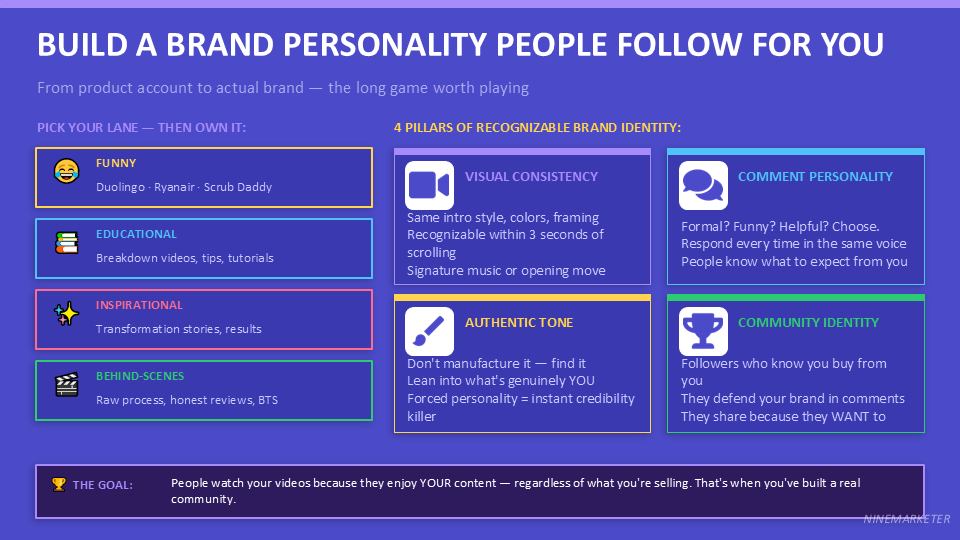
Creating a Recognizable Brand Personality
Your TikTok account needs a personality that’s instantly recognizable, even before people see your username.
Duolingo’s unhinged owl mascot, Scrub Daddy’s dad-joke energy, Ryanair’s chaotic Twitter-energy-on-TikTok, these brands are identifiable within three seconds of scrolling.
That recognition builds familiarity, and familiarity builds trust.
The mistake most dropshippers make is trying to be everything to everyone.
Generic, safe, forgettable.
But TikTok rewards distinctive voices.
Pick a lane, are you funny? Educational? Inspirational? Behind-the-scenes transparent?
You can be multiple things, but you need a core personality that threads through all your content.
Brands are known for responding to comments with unique content and distinct brand voices.
Consistency in style matters as much as posting frequency.
Some creators start most videos the same way, like showing their laptop and then opening it, all in signature colors.
That visual consistency makes their content instantly identifiable, even in the scroll.
For dropshipping, this could be your intro music, the way you frame products, a catchphrase you use, or even just the energy you bring to every video.
Your comment section is an extension of your brand personality.
The way you respond to questions, handle complaints, or joke with followers tells people who you are as a brand.
Formal responses? Casual and funny? Helpful and educational? Whatever you choose, keep it consistent.
People should know what to expect when they engage with you.
Don’t try to manufacture personality, find the authentic angle that works for you or your brand.
If you’re naturally funny, lean into that.
If you’re more informative, own the expert educator role.
If you’re genuinely excited about products, let that enthusiasm show.
Forced personality is worse than no personality because it comes across as dishonest.
The long game with brand personality is building an audience that follows you for you, not just for your products.
When someone watches your videos because they enjoy your content regardless of what you’re selling, you’ve created real community.
Those are the followers who buy, who defend your brand in comments, who share your content because they genuinely want others to discover you.
That’s when you know you’ve moved from dropshipping account to actual brand.
Your Path to TikTok Dropshipping Domination
The dropshipping landscape has fundamentally changed, and TikTok organic marketing is no longer optional, it’s essential.
While your competitors are still figuring out basic hashtag strategies, you now have the blueprint to create content that the algorithm loves and audiences can’t resist sharing.
Remember, TikTok success isn’t about going viral once.
It’s about showing up consistently with valuable, entertaining content that naturally showcases what you’re selling!
The beauty of organic marketing is that every video is a new opportunity to reach thousands of potential customers without spending a cent on advertising.
Start implementing these strategies today.
Create your first piece of content using the frameworks we’ve covered, post it, analyze the results, and iterate.
Your next viral video, and the flood of orders that come with it, could be just one upload away.
The TikTok organic goldmine is waiting for you!