


You’ve done everything right.
Product research?
Check.
Stunning store design?
Check.
Ad campaigns launched with high hopes?
Check.
But three months in, you’re barely breaking even while watching your profit margins evaporate with every competing ad that pops up in your feed.
Sound familiar?
Here’s what nobody tells you when you’re starting out: niche saturation can kill a dropshipping business faster than a bad supplier ever could.
I’ve watched countless entrepreneurs pour thousands into niches that were already oversaturated, convinced they could “just market better” than everyone else.
The reality?
Sometimes the battlefield is so crowded that even the best generals can’t win.
In this guide, you’ll learn how to spot the telltale signs that your niche has hit critical mass, understand why saturation happens faster than ever in 2025, and most importantly, discover actionable strategies to either revive your current niche or pivot to greener pastures.
Let’s dive into the signs that should make you pause and reconsider your approach.
Understanding Dropshipping Niche Saturation
Look, here’s something most dropshipping “gurus” won’t tell you straight: market saturation isn’t just some abstract concept you can ignore.
It’s the silent killer that’s been bleeding stores dry since 2024, and if you don’t understand how it works, you’re basically lighting your ad budget on fire.
So what exactly is market saturation in dropshipping terms?
It’s when there’s way more supply than actual demand, basically, too many sellers chasing the same customers with identical products.
When a global dropshipping market valued at $365.7 billion has thousands of stores selling the exact same phone cases from the exact same suppliers, that’s saturation at work.
The thing is, saturation hits different than just “having competition.”
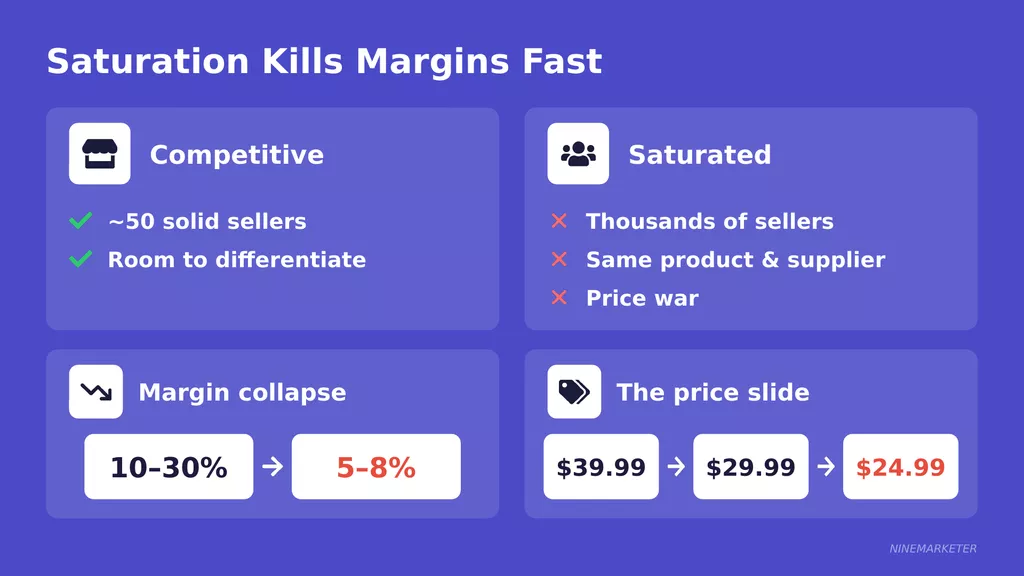
A competitive niche might have 50 solid stores.
A saturated niche?
You’re competing with thousands of sellers who are all desperately racing to the bottom on price.
The Brutal Economics Behind Compressed Margins
Here’s where it gets painful.
When saturation kicks in, profit margins don’t just shrink, they collapse faster than you’d believe.
The standard dropshipping profit margin sits somewhere between 10-30% after all costs, but that’s in a normal market.
Once saturation hits, you’re lucky to keep 5-8%.
Think about it this way.
You find a product with a decent 25% margin. Great, right?
But then fifty other dropshippers discover the same product.
Suddenly everyone’s undercutting each other to win the buy box or get clicks.
That $39.99 product?
Now it’s $29.99.
Then $24.99.
Before you know it, you’re selling at cost just to move inventory and justify your ad spend.
The worst part is how fast this happens.
Products that were printing money in early 2024, those trendy LED moon lamps, the phone grips everyone was pushing,
eneric pet products with cartoon faces went from 40% margins to barely profitable within months.
Not years. Months.
How Platform Algorithms Punish Oversaturated Markets
Now let’s talk about something that’ll really mess with your business: how Facebook, TikTok, and Google respond when they smell saturation.
These platforms aren’t stupid.
They know when a thousand advertisers are pushing identical products, and they make you pay through the nose for it.
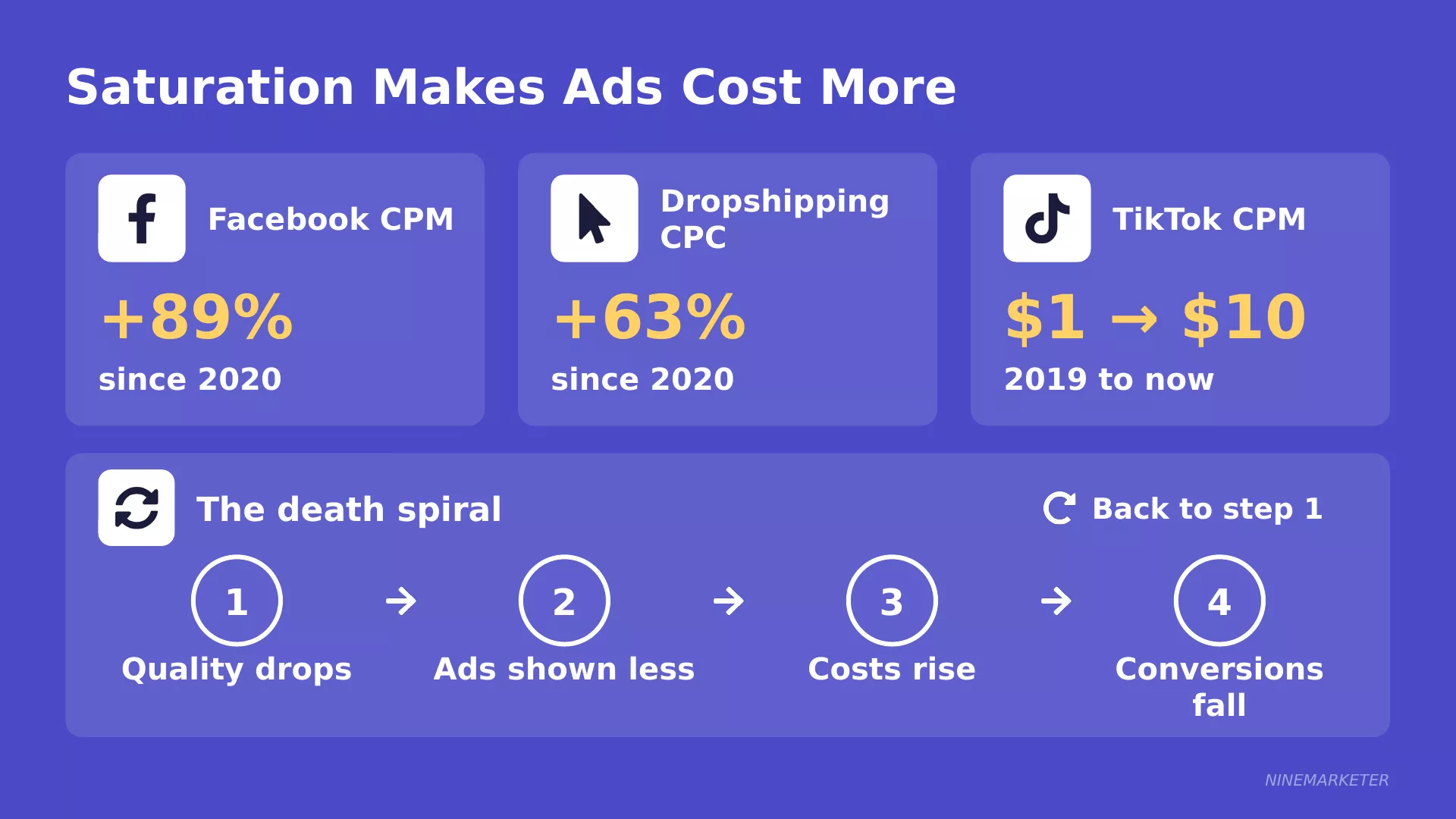
Facebook’s CPM has literally increased 89% since 2020. That’s not a typo.
The average cost per click for dropshipping ads jumped 63% since 2020, pricing out most beginners completely.
When you’re in an oversaturated niche, you’re in a bidding war with established players who have way deeper pockets.
TikTok’s not much better anymore.
Sure, it started cheap with $1 CPMs back in 2019, but those days are gone.
Now you’re looking at $10 average CPMs, and that’s if you’re lucky.
In saturated niches, costs spike even higher as the algorithm realizes your ad is competing with hundreds of similar products.
The algorithms basically punish saturation by making visibility more expensive.
They want diverse, fresh content, not the thousandth store selling the same fidget spinner.
Google’s Quality Score drops. Facebook’s relevance score tanks.
Your ads get shown less, cost more, and convert worse. It’s a death spiral.
Temporary Pressure vs. True Market Death
Here’s something crucial that trips people up: not every competitive situation means your niche is dead.
There’s a massive difference between temporary competitive pressure and actual market saturation.
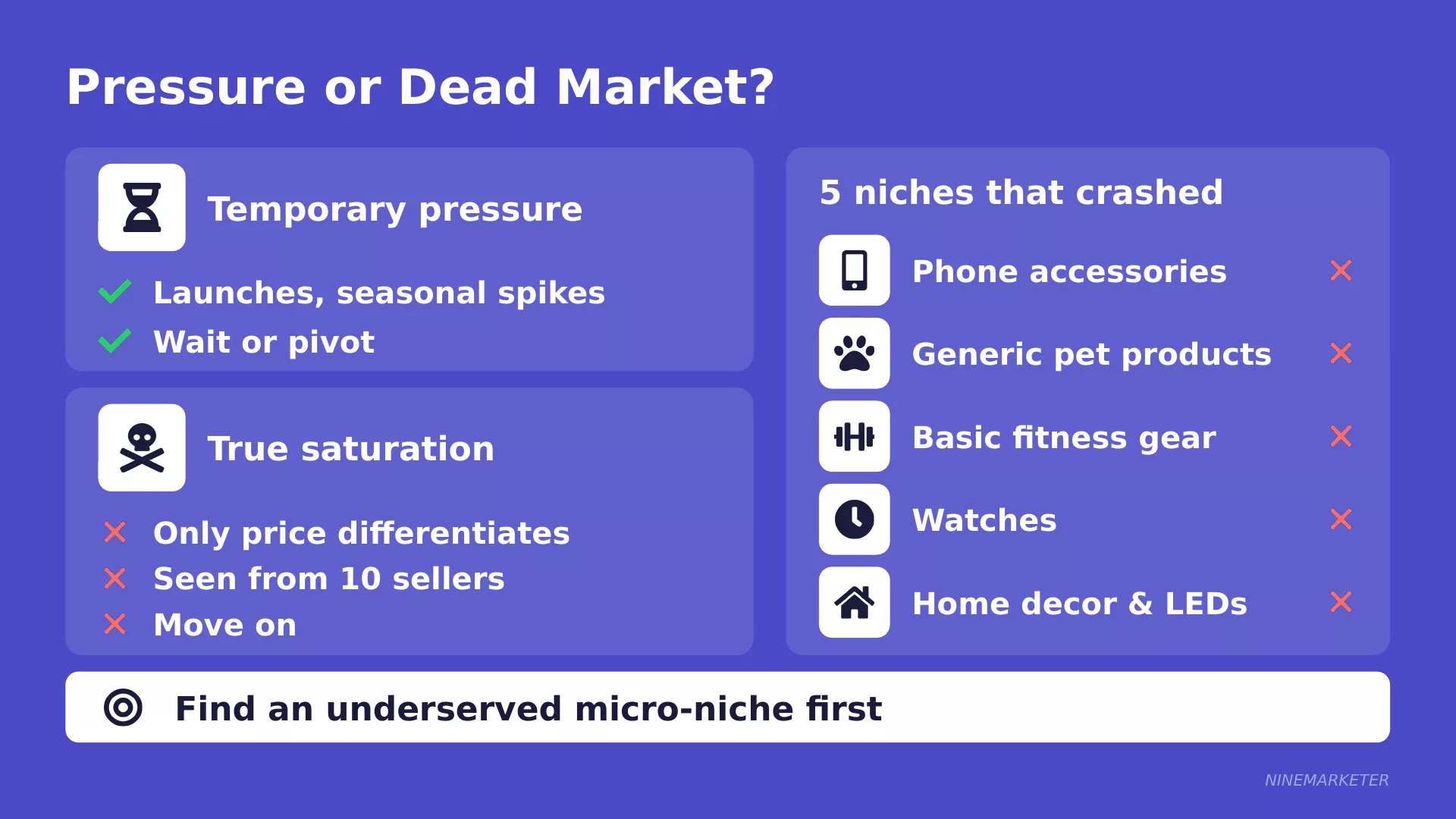
Temporary pressure happens during product launches or seasonal spikes.
Say a new iPhone drops and suddenly everyone’s selling compatible cases.
Yeah, it’s crowded for a few weeks.
But that pressure eases as some sellers move on, demand normalizes, and you can carve out space with better branding or faster shipping.
True saturation?
That’s when the fundamental economics don’t work anymore.
When fidget toys became oversaturated, a trend that peaked and crashed, it wasn’t just crowded.
The entire demand curve collapsed. People stopped searching for them.
The product became associated with “dropshipping junk.” No amount of marketing could save it.
Here’s a test: if you can’t find a way to differentiate your product beyond price, and your target audience has seen the exact same item from ten different sellers in the past month, you’re probably looking at true saturation. Temporary pressure?
You can wait it out or pivot slightly. True saturation means it’s time to move on entirely.
Real Examples That Went From Gold to Garbage
Let me give you some specific examples of niches that absolutely tanked between 2024-2025.
These are cautionary tales, and if you’re in any of these, it might be time to reassess.
Phone accessories were the first domino to fall. By mid-2024, this niche was so oversaturated it became almost impossible for new stores to break even.
Pop sockets, phone cases, charging cables, everyone and their cousin was selling them.
The market became flooded with identical products, and consumers got wise to the fact they could buy the same thing for less directly.
Generic pet products followed the same path. Not specialized pet items, we’re talking about the basic toys, bowls, and generic accessories that became oversaturated as thousands of stores jumped in trying to capitalize on pet owners’ spending habits.
The problem was that big players like Amazon and Chewy had better prices, faster shipping, and actual customer service.
Fitness equipment hit oversaturation during the 2020-2022 home workout boom and never recovered. By 2024, the market was absolutely wrecked.
Resistance bands, yoga mats, basic dumbbells, all being sold at near-cost by desperate dropshippers trying to recoup their inventory costs.
High competition made it nearly impossible to achieve decent visibility without burning through thousands in ad spend.
The watch niche also became brutally saturated, with the market expected to hit $117.8 billion by 2025 but absolutely packed with sellers.
Luxury replicas, fashion watches, fitness trackers, all competing in the same overcrowded space with razor-thin margins.
And let’s not forget the absolute disaster that was the home decor wave of 2024-2025.
Those trendy minimalist prints, LED strip lights, and aesthetic room decorations?
Completely oversaturated.
Instagram and TikTok were plastered with sponsored posts selling the exact same items, and consumers started tuning them out entirely.
The pattern across all these examples is the same: a profitable opportunity attracts too many sellers too quickly, margins compress, ad costs skyrocket, and suddenly what was a goldmine becomes a money pit.
By the time most people jump on these trends, they’re already on the downslope to saturation.
If you’re looking at entering dropshipping in 2025, learn from these failures. Don’t chase what’s already crowded.
Find those underserved micro-niches where you can actually build a brand and establish yourself before the masses show up.
Because once saturation hits, it’s basically game over unless you’ve got something truly unique to offer.
Warning Sign #1: Skyrocketing Advertising Costs
You know that sinking feeling when you check your ad dashboard and your costs have doubled overnight?
Yeah, that’s not always just bad luck or a crappy campaign.
Sometimes those skyrocketing ad costs are screaming at you that your niche is hitting saturation, and most dropshippers completely miss the warning signs until it’s too late.
The thing is, rising ad costs can mean different things.
Sometimes it’s just Q4 craziness. Other times?
It’s your niche drowning in competition, and you need to get out fast.
Let’s break down how to tell the difference.
When Your CPM and CPC Numbers Start Telling a Story
Here’s the deal with identifying saturation through your ad costs: you need to know what “normal” looks like first.
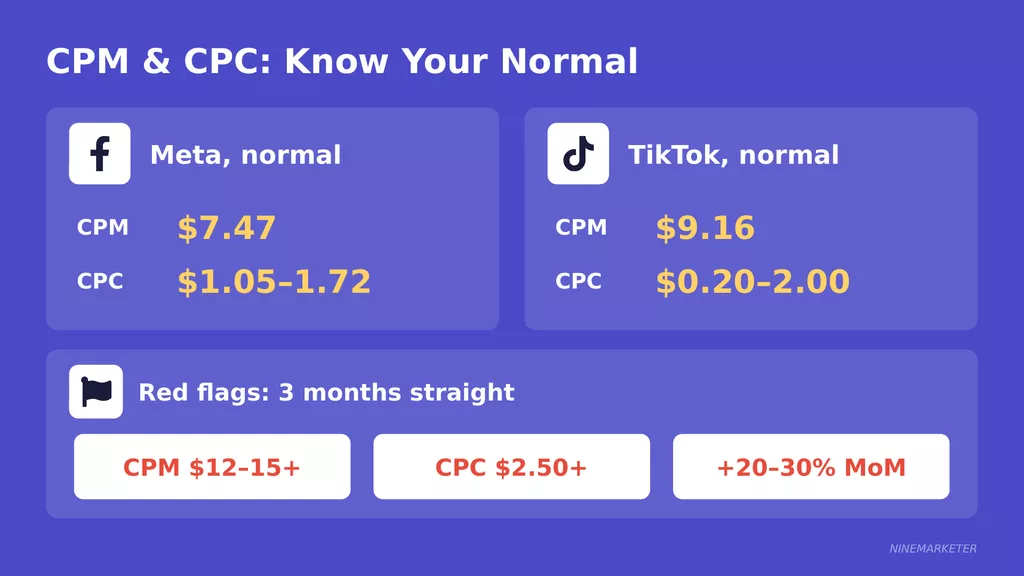
If you’re running Facebook ads with a CPM around $7.47, that’s pretty standard across industries in 2025.
Your CPC sitting at $1.05 to $1.72? That’s within normal range too.
But when those numbers start climbing week after week without any seasonal reason, pay attention.
We’re talking CPMs hitting $12, $15, or higher consistently.
That’s when you need to ask yourself if you’re in an overcrowded market where everyone’s fighting for the same eyeballs.
On TikTok, the story’s similar but with different numbers. Average CPMs hover around $9.16 with CPC between $0.20 to $2.00.
When you start seeing CPMs consistently above $12-15 for weeks on end, and your CPC creeps past $2.50 with no improvement in conversion rates, that’s a red flag waving at you.
The critical thing to understand is this: it’s not about hitting these numbers once.
It’s about the trend. If your costs are climbing 20-30% month over month for three straight months, and your targeting hasn’t changed, you’re probably looking at market saturation rather than just having a bad campaign.
Benchmarking Against Your Niche’s Reality
Generic industry averages only tell you so much.
What you really need to understand is how your specific niche stacks up, and this is where most people get tripped up.
Let’s say you’re in the phone accessories space.
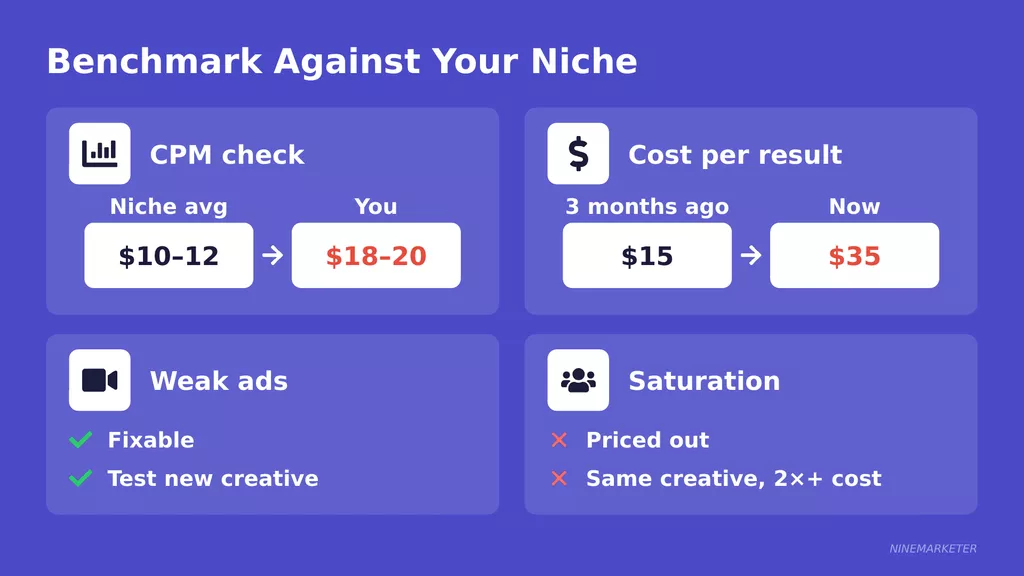
If everyone else selling phone cases is paying $10-12 CPMs on Meta and you’re suddenly paying $18-20, one of two things is happening:
Either your ads suck (which is fixable), or the market is so saturated that you’re getting priced out by established players with deeper pockets.
Here’s a practical way to benchmark: look at your cost per result over time.
If you were getting conversions at $15 three months ago and now you’re at $35 for the exact same product with similar creative quality, that’s not normal fluctuation.
That’s saturation pushing your acquisition costs through the roof.
The brutal truth is that when a niche gets saturated, profit margins compress down to 5-8% while your ad costs keep climbing.
You end up spending more to make less, which is a recipe for bleeding money slowly.
Instagram’s particularly tricky because CPCs are naturally higher, averaging $3.35 for Feed and $1.83 for Stories.
But even within that premium pricing, you should see consistency.
When your Instagram CPC suddenly jumps from $3 to $6 and stays there, while your competitors’ ads are getting more frequent and aggressive, you’re witnessing saturation in real-time.
How Competition Warps Ad Auction Dynamics
This is where things get technical, but stick with me because understanding this will save you thousands of dollars.
Facebook and Meta don’t just award ad placements to the highest bidder.
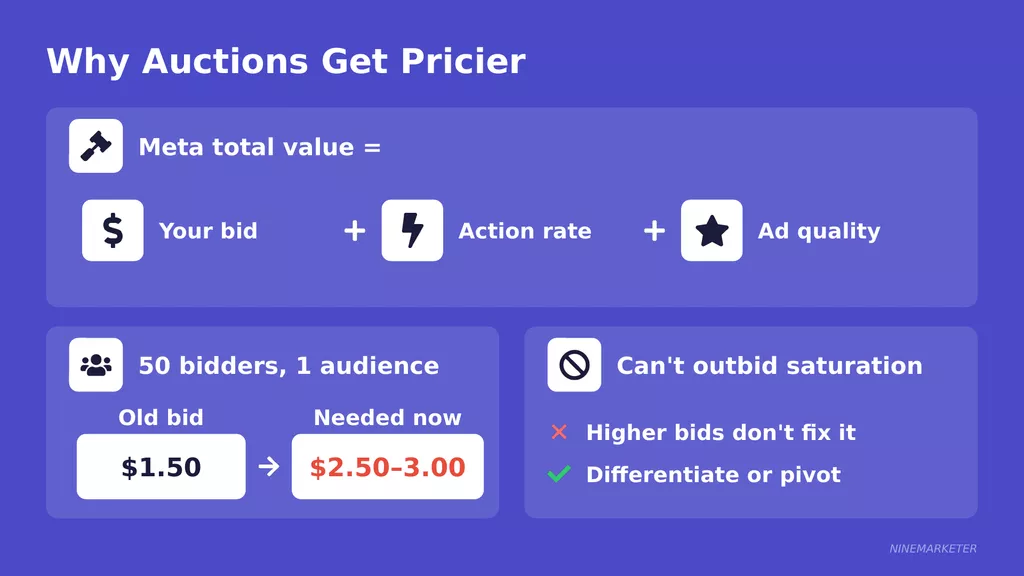
They use what’s called a total value equation: your bid plus your estimated action rate plus your ad quality.
When saturation hits, here’s what happens: hundreds of advertisers are bidding on the same audience with similar products.
Even if your ad quality is decent, the sheer volume of competition drives up the price you need to pay to win the auction.
It’s pure supply and demand, and demand is crushing supply.
Think about it this way.
When fifty advertisers are all targeting women aged 25-40 interested in home decor, Meta’s algorithm sees high competition for limited ad inventory.
The auction gets more expensive for everyone.
Your $1.50 bid that used to win placements? Now you need $2.50 or $3.00 just to get in the game.
Google Ads operates differently with their generalized second-price auction, but the saturation effect is the same.
When competition increases, your Quality Score matters more than ever, and if you’re selling the same product as everyone else with similar landing pages, you’re going to pay premium prices.
The worst part?
In saturated markets, even aggressive bidding strategies don’t always help because you’re just throwing more money at a fundamentally oversaturated problem.
You can’t outbid your way out of true market saturation.
Platform-Specific Red Flags in Your Dashboard
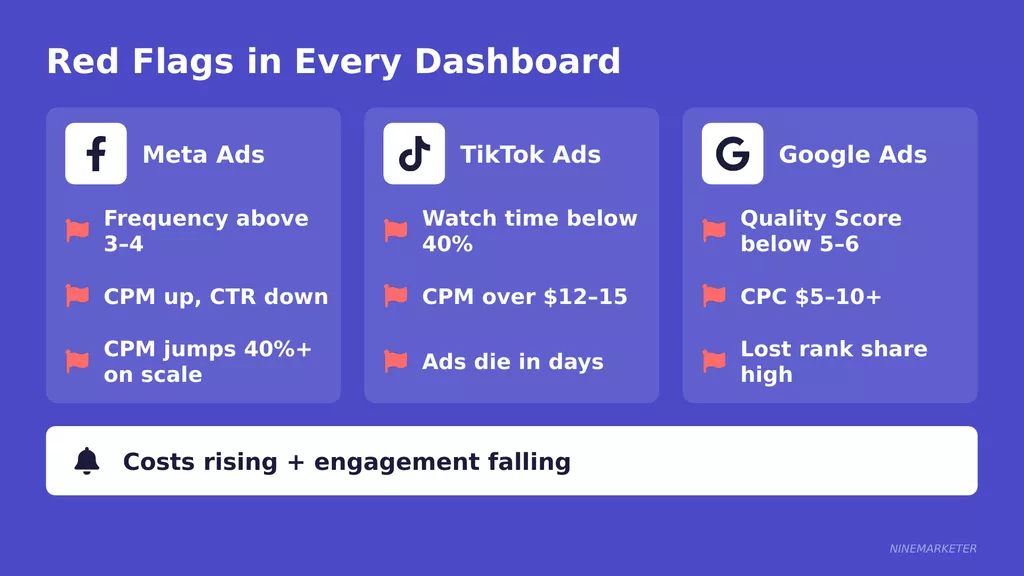
Each advertising platform shows saturation differently, and knowing what to look for can help you catch it early.
Let’s break down what warning signs look like in each major platform’s dashboard.
Meta Ads Manager: Watch your frequency metric like a hawk.
When your frequency consistently climbs above 3-4 and your CPM keeps rising while your CTR drops, that’s saturation.
You’re showing the same ad to the same people repeatedly because the audience is tapped out.
Also check your auction overlap, if Meta’s showing you significant overlap with other advertisers in your audience definition, you’re in a crowded space.
Another telltale sign in Meta: when you try to scale and your CPM jumps disproportionately.
Normal scaling might increase CPM by 10-15%. Saturation scaling?
You’ll see 40-50% jumps or higher because there simply aren’t enough qualified people left to target at reasonable prices.
TikTok Ads Manager: The platform’s still relatively efficient compared to Facebook, but saturation is creeping in.
If your average watch time drops below 40% consistently and your CPM keeps climbing past $12-15, people are seeing too many similar ads and tuning out.
TikTok’s CPMs have been rising, from cheap entry points to competitive rates, as more advertisers flood the platform.
Look at your TikTok creative fatigue indicators too.
When ads that used to run for weeks start dying after just days, and you’re constantly needing fresh creative just to maintain performance, that’s market saturation making users blind to your niche.
Google Ads: Your Quality Score is the canary in the coal mine.
When you start seeing Quality Scores consistently dropping below 5-6 despite having decent landing pages and relevant keywords, it means Google sees your niche as overcrowded with similar advertisers.
Your CPC might range from $0.10 to $2.00 normally, but in saturated niches, you could be paying $5-10+ per click for competitive keywords.
Check your impression share too.
If your lost impression share due to budget is low but your lost share due to rank is high, you’re getting priced out by competitors in a saturated auction environment.
Seasonal Spikes Versus the Real Deal
Okay, this is probably the most important section because confusing seasonal costs with saturation will make you panic-quit a profitable niche or, worse, stay too long in a dying one.
Seasonal fluctuations are predictable and temporary.
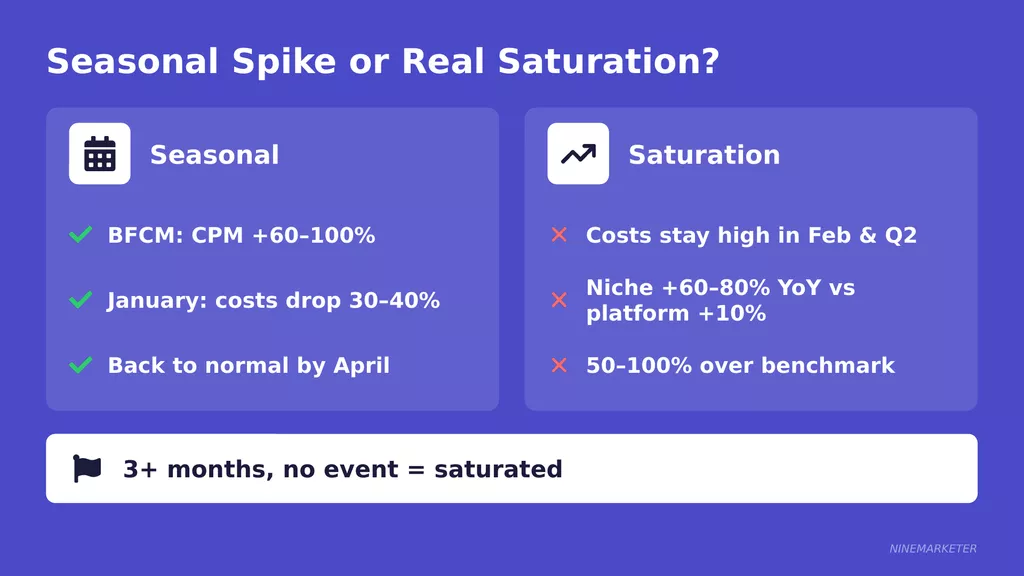
During Q4, specifically around Black Friday and Cyber Monday, CPMs can spike 60-100% across all platforms.
On Meta, Cyber Monday 2024 saw CPMs hit $17.70 and 138% higher than the annual average.
But here’s the thing: everyone sees this. It’s market-wide, and it goes away in January.
The “January slump” is the flip side. CPMs typically drop 30-40% in Q1 as advertisers reset budgets and consumer spending cools after the holidays.
If your costs tank in January but recover by March-April, that’s just seasonality.
Normal. Expected. Don’t freak out.
True saturation looks different.
It’s when your costs stay elevated even during typically cheap months.
When February rolls around and your CPMs are still at November levels, or when Q2 arrives and costs that should be recovering just keep climbing, that’s saturation talking.
Here’s another tell: look at year-over-year trends. Snapchat CPMs jumped 27.6% year-over-year in 2024, that’s platform-wide saturation as more advertisers pile on.
But if your specific niche costs increased 60-80% year-over-year while the platform average only went up 10%, you’ve got a niche saturation problem.
Seasonal content strategies matter too.
If you’re in fitness equipment, you expect higher costs in January (New Year’s resolutions) and September (back to school).
Those are temporary.
But when fitness costs stay high in March, April, May and never come back down, your niche has probably hit permanent saturation.
The election year factor in 2024 also threw things off, driving up costs across the board as political advertisers consumed inventory.
That’s temporary saturation that clears once elections end.
Real market saturation persists across seasons, doesn’t respond to creative refresh, and gets worse month over month regardless of external factors.
When you’re consistently paying 50-100% more than benchmarks for your niche for three+ months straight, and it’s not Q4, and there’s no major event explanation, you need to seriously consider that your niche is saturated.
The bottom line?
If your ads dashboard is showing consistently high CPMs, low CTRs, increasing CPCs, and declining ROAS for months without seasonal explanation, you’re not experiencing temporary competitive pressure.
You’re watching market saturation happen in real-time, and it’s time to pivot before you burn through your entire ad budget trying to fight an unwinnable battle.
Warning Sign #2: Declining Conversion Rates Despite Optimization
Here’s something that’ll keep you up at night: you’ve optimized everything.
Your product pages look great, checkout is smooth, you’ve A/B tested until you’re blue in the face.
And yet, your conversion rates keep sliding.
Month after month, they just keep dropping.
That’s not a funnel problem.
That’s your niche telling you it’s saturated and your customers have seen it all before.
What Normal Conversion Rates Look Like (And When to Panic)
Let’s get real about benchmarks.
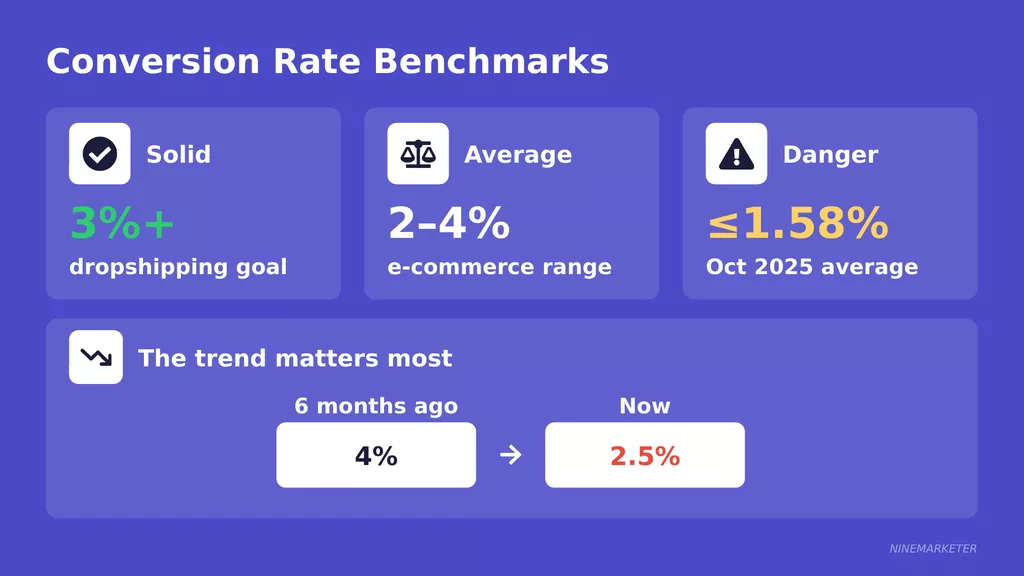
If you’re running a dropshipping store, a conversion rate around 3% or higher is considered solid.
The global average e-commerce conversion rate hovers between 2-4%, but that varies wildly depending on what you’re selling.
Some niches naturally convert better.
Arts and crafts hit 5.2%, kitchen appliances around 3.57%, while more saturated markets struggle to break 2%.
If your store is sitting at 1.58% or below, the October 2025 e-commerce average, you’re in dangerous territory.
But here’s what really matters: the trend.
A store converting at 4% six months ago that’s now down to 2.5% despite constant optimization? That’s a massive red flag.
When you’re doing everything right technically but your conversions keep falling, saturation is probably eating your lunch.
The tricky part is knowing when to worry. Seasonal dips happen. Q1 is always slower.
But when conversion rates drop from 2.27% in November 2023 to 1.58% by September 2024, that’s not seasonal, that’s structural decline.
Why Customer “Ad Blindness” Destroys Saturated Niches
Here’s where things get psychological.
You know how you completely ignore banner ads when you’re browsing?
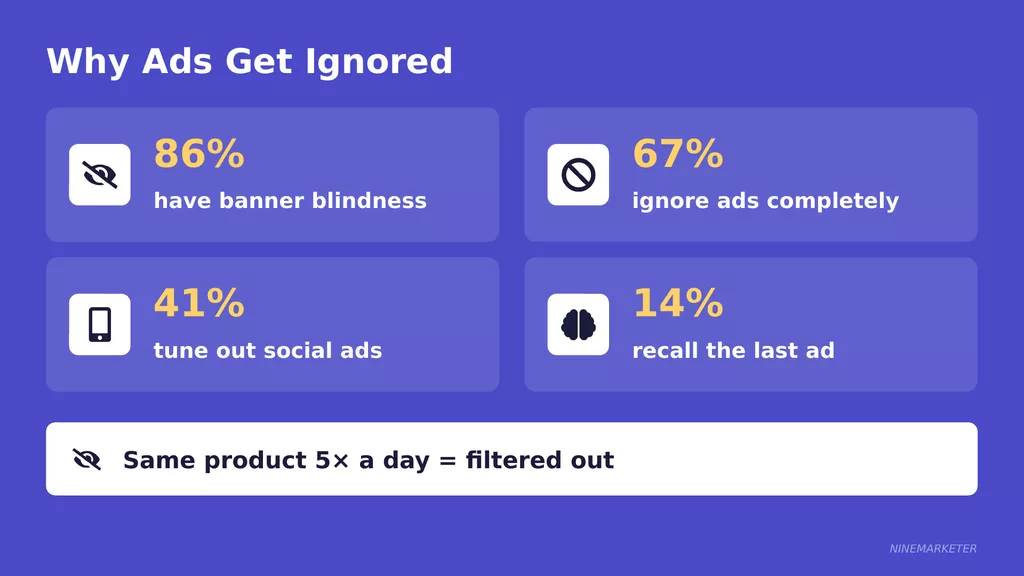
That’s called banner blindness, and 86% of consumers experience it. But it gets worse in saturated niches.
When customers see the same product advertised by twenty different dropshippers, their brains literally tune it out.
The average click-through rate for banner ads is a pathetic 0.06%, that’s 6 clicks out of every 10,000 views.
And in oversaturated markets, it’s even lower because people have developed immunity to your entire product category.
Think about it.
Someone scrolling through Facebook or TikTok sees the same LED face mask five times a day from five different stores.
After a while, their brain just filters it out completely.
67% of users admit to having “banner blindness” where they completely ignore ads, and 41% actively tune out ads on social media.
Even worse?
Only 14% of people can recall the last display ad they saw and what product it promoted.
Your potential customers aren’t ignoring your ad because it’s bad.
They’re ignoring it because they’ve already ignored fifty identical ads this week.
This is why saturated niches see conversion rates crater even with good ads.
The audience has developed selective attention, they’ve learned to identify and skip anything that looks like “another one of those” dropshipping products.
Market Sophistication: The Silent Conversion Killer
Now we need to talk about market sophistication, which is probably the most important concept you’ll learn today.
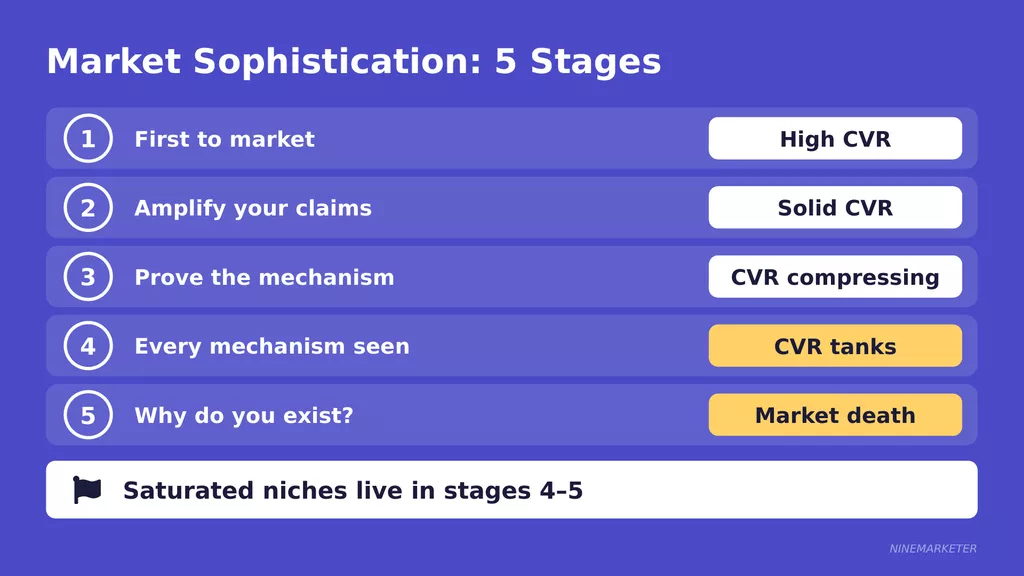
Back in 1966, marketing legend Eugene Schwartz outlined five stages of market sophistication, and understanding where your niche sits changes everything.
Stage 1 is the blue ocean. You’re first to market. Just telling people “this product solves your problem” is enough. Conversion rates are high because customers have never seen anything like it. Easy money.
Stage 2 means competition exists but you can still win by amplifying your claims. “Our version is twice as effective!” Conversion rates are solid if you can differentiate even slightly.
Stage 3 is where most dropshippers live and die. This is when customers know the claims but need to understand the mechanism. You can’t just say “lose weight fast” anymore. Everyone’s saying that. You need unique selling points, special ingredients, proprietary methods. Conversion rates start compressing here.
Stage 4 hits when even mechanisms don’t work. Customers have seen every variation. They’ve heard about Amazonian bark, arctic berries, nano-technology, whatever. Your conversions tank because nothing feels new or different anymore.
Stage 5 is market death for most dropshippers. Customers are looking for reasons to count you OUT. They’re not buying based on features, they want to know WHY you exist and what makes your brand different beyond the product. This is where only established brands with real differentiation survive.
Most dropshipping niches that hit saturation are stuck between stages 4 and 5.
Your conversion rates aren’t dropping because your funnel sucks.
They’re dropping because your market has evolved past the stage where your offering matters.
When you see conversion rates declining despite optimization, ask yourself: has my market become too sophisticated for what I’m selling?
Because if customers have heard your claims a thousand times before, no amount of A/B testing will save you.
Testing Your Way to the Truth
Okay, so your conversion rates are dropping.
How do you know if it’s market saturation versus just having a crappy funnel?
Here’s how to isolate the real problem through systematic testing.
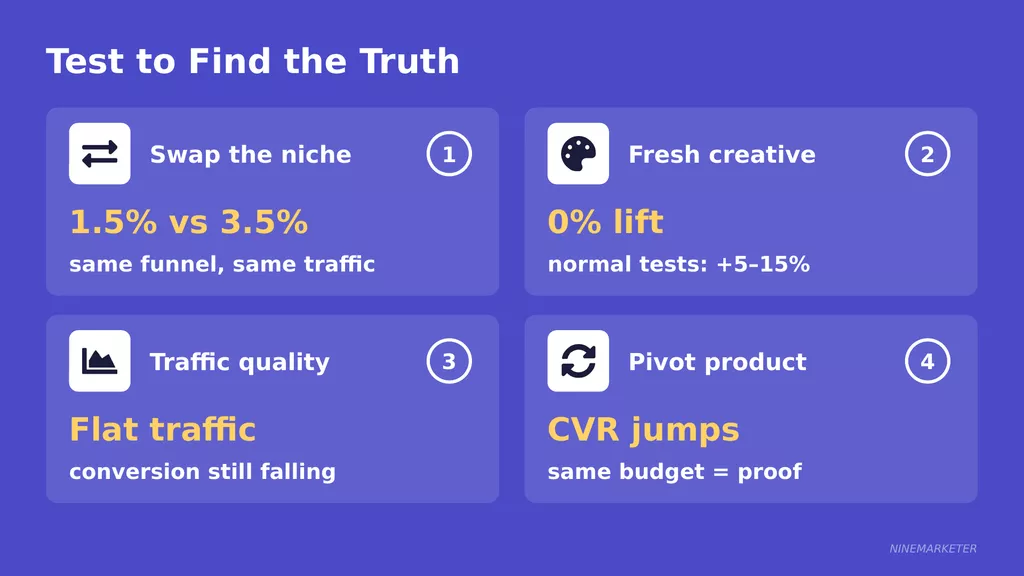
First, run a controlled A/B test comparing completely different product categories on your site.
If your saturated niche products are converting at 1.5% but a test product in a different niche converts at 3.5% with identical funnel and traffic source, that’s market saturation talking.
Second, test your ads against fresh creative angles. Not just different images, I mean completely different hooks, benefits, and messaging.
If typical tests show 5-15% improvement but you’re seeing zero lift no matter what you try, your market is probably tapped out.
When even radical creative changes don’t move the needle, customers aren’t responding to the product category anymore.
Third, analyze your traffic quality over time.
Pull your analytics and compare add-to-cart rates, bounce rates, and time on site from six months ago versus today.
If traffic quality is the same but conversion keeps dropping, it’s not your visitors, it’s your offer’s relevance in a saturated market.
Here’s a specific test that works: temporarily pivot to a different product entirely and see what happens.
Keep everything else identical, same ad budget, same targeting, same funnel.
If conversion rates suddenly jump, you’ve just proven your original niche is saturated.
Also, test social proof elements prominently.
In early-stage markets, conversion rates improve dramatically when you add reviews and testimonials.
In saturated markets?
Barely moves the needle because customers are skeptical of everything, they’ve been burned before by similar products.
The ICE framework (Impact × Confidence × Ease) helps prioritize which tests to run.
But if you’ve systematically tested high-impact elements and nothing works, stop wasting time optimizing.
Your problem isn’t technical.
Funnel Problems vs. Market Exhaustion: How to Tell the Difference
This is crucial because fixing a funnel problem is easy.
Accepting market saturation means pivot or die.
So how do you tell them apart?
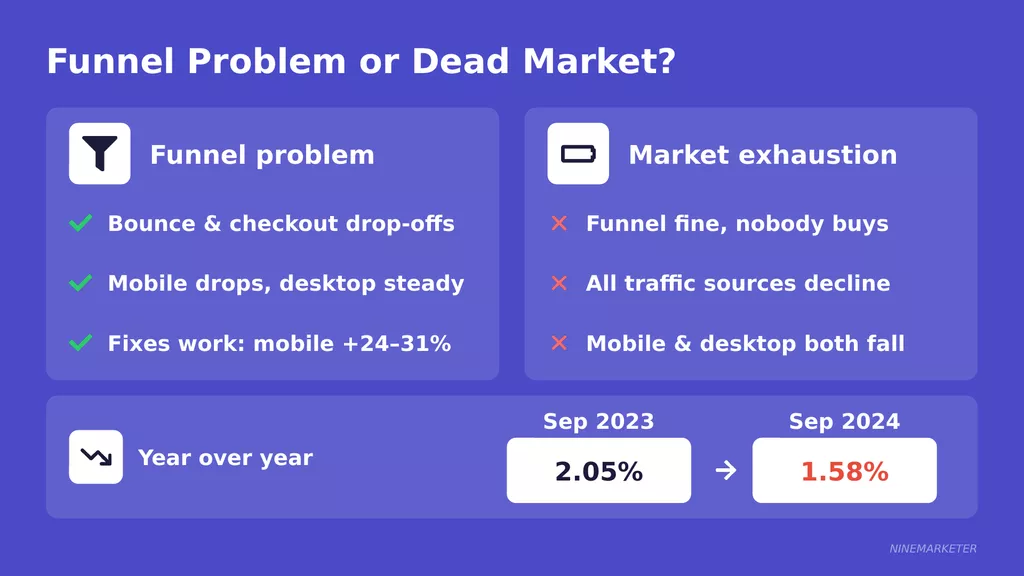
Funnel problems have specific symptoms.
High bounce rates on landing pages.
Drop-offs at specific checkout steps.
Poor mobile performance.
Traffic that engages but doesn’t convert.
These issues show up in heat maps and session recordings as clear friction points.
When you have a funnel problem, fixing it produces results.
Optimize your checkout and cart abandonment drops 15-23%.
Improve mobile UX and conversion jumps 24-31%.
Add payment options and checkout completion increases 8-19%.
Funnel problems respond to optimization.
Market exhaustion looks completely different.
Your funnel metrics might actually be fine, low bounce rates, good time on site, people viewing multiple products.
But nobody’s buying.
They’re browsing without intent because they’ve seen it all before and aren’t excited.
Here’s another tell: look at your return customer rate.
Funnel problems affect new visitors more than returning customers.
Market saturation affects everyone equally because the product itself has lost appeal.
Check your traffic sources too.
If organic traffic converts at roughly 4% but paid ads only hit 2-3%, that’s normal.
But if ALL traffic sources show declining conversions over time regardless of quality, it’s probably not your funnel.
Desktop versus mobile splits also reveal problems.
Desktop naturally converts 1.7X better than mobile, with mobile at 1.8% and desktop at 3.9%. If your mobile conversion drops but desktop stays steady, that’s a technical problem.
If both decline together, market issue.
The ultimate test?
Compare year-over-year performance.
Funnel problems show up as inconsistent, fixable issues.
Market saturation shows up as steady, irreversible decline over months, like going from 2.05% in September 2023 down to 1.58% by September 2024.
When you’ve A/B tested everything, tried new creative, optimized checkout, improved site speed, added social proof, simplified forms, and your conversion rate STILL keeps dropping month after month?
Stop blaming your funnel.
Your market is cooked.
The hard truth is this: if you’re pulling 1.5% conversions in a niche that should hit 3%, and you’ve already optimized everything multiple times with zero improvement, you’re not facing a technical problem.
You’re facing market reality.
Your customers are saturated, your niche is overcrowded, and no amount of CRO wizardry will fix a fundamental demand problem.
Time to pivot, not polish.
Warning Sign #3: Your Competitors Are Everywhere
Remember when you first found your “winning product” and felt like you had discovered gold?
Then two weeks later, you started seeing the exact same thing advertised by twenty different stores.
Yeah, that’s market saturation smacking you in the face.
When your competitors are everywhere, and I mean everywhere, it’s not just annoying.
It’s a clear warning that your niche is drowning in oversupply, and you need to make some hard decisions fast.
Using Competitive Intelligence Tools to See the Bigger Picture
Here’s the thing most dropshippers miss: you can’t just eyeball competition anymore.
You need actual data to understand how saturated your niche really is.
That’s where competitive analysis tools come in, and trust me, they’ll show you things that’ll make your stomach drop.
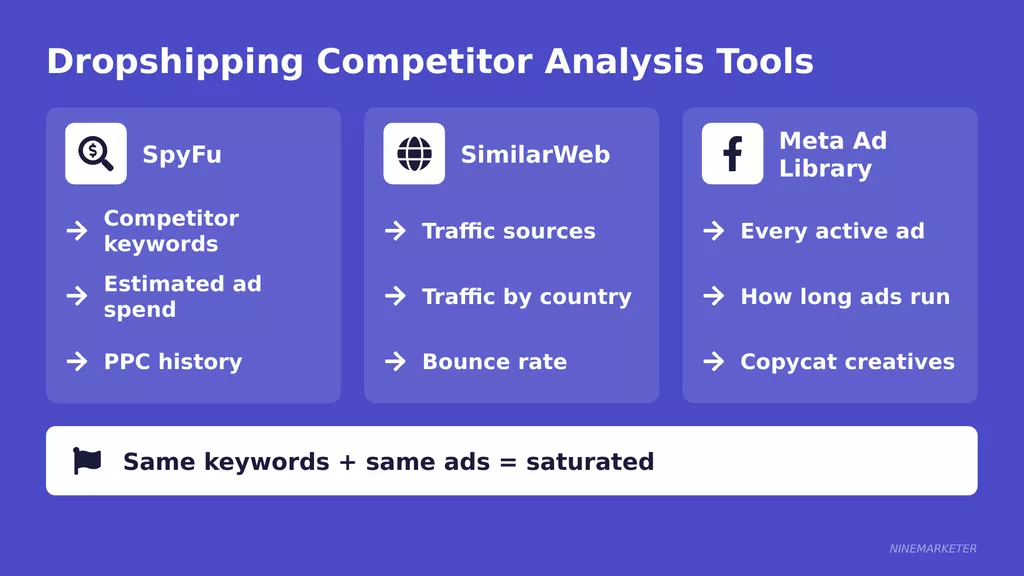
SpyFu is your first stop for understanding Google Ads competition.
This tool lets you plug in any competitor’s domain and see exactly which keywords they’re bidding on, how much they’re estimated to spend, and their complete PPC history.
When you start seeing dozens of competitors all bidding on the exact same product keywords with estimated monthly spends climbing into thousands, you’re looking at saturation.
The beauty of SpyFu is it shows you organic keywords too.
So if every competitor in your niche is ranking for the same 50 product terms, and you’re all fighting over scraps of traffic, that’s your red flag.
Use it to track competitors‘ backlinks, keyword rankings, and ad strategies all in one place.
SimilarWeb gives you a different angle, traffic analytics.
You can see where competitors’ visitors are coming from (organic, paid, social, referrals) and how engaged those visitors are.
When you notice that top competitors in your niche are seeing traffic stagnate or decline despite heavy ad spend, that’s market saturation killing growth potential.
SimilarWeb also breaks down traffic by geography, which is crucial.
You might think you’re competing globally, but then realize 80% of traffic concentrates in the same three countries where everyone’s already saturated.
The tool provides monthly traffic volume, bounce rates, and pages per visit, all indicators of how healthy (or dying) a niche really is.
And don’t sleep on Meta’s Ad Library.
This free tool is a goldmine for seeing exactly what your competitors are running on Facebook and Instagram.
Search your product or niche, and you’ll get every active ad from every advertiser targeting that space.
When you scroll through and see the same product advertised by 50+ different stores all using nearly identical creative and copy, congratulations, you’ve just confirmed you’re in a red ocean.
The Ad Library also shows you how long ads have been running.
If everyone’s ads are new (less than a week old) and constantly churning, it means people are burning through budgets trying to make dead niches work.
Use it to identify which competitors are using branded content and influencer partnerships too, which tells you how aggressive the competition really is.
When Competitor Volume Crosses Into Dangerous Territory
So how many competitors is too many?
There’s no magic number, but there are patterns that scream “get out now.”
If you’re seeing 100+ stores selling the exact same product from the same suppliers on Meta’s Ad Library, you’re way past competitive and deep into saturated.
When SpyFu shows 50+ advertisers all bidding on your main product keywords simultaneously, the auction costs alone will kill your margins.
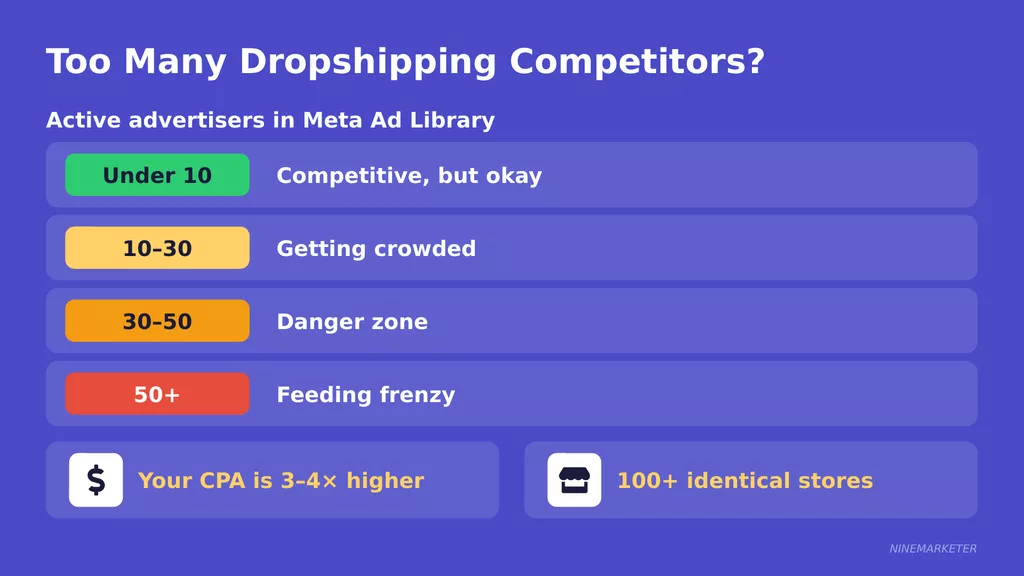
Here’s a practical test: go to Facebook Ad Library and search for your product.
Count how many different advertisers are actively running ads for it right now.
Under 10?
You’re competitive but okay.
10-30?
Getting crowded, watch closely. 30-50?
Danger zone.
Over 50?
You’re in a feeding frenzy, and only the strongest (biggest budgets) will survive.
Same thing with Google.
Use SpyFu to check keyword competition for your main product terms.
If you’re seeing “Very High” competition ratings on every single keyword related to your product, and 40+ advertisers fighting for the same terms, you’re swimming in oversaturation.
Another indicator: when you start seeing multiple competitor stores with identical product descriptions, images, and prices, everyone’s just copying everyone else in a desperate race to the bottom.
That’s not competition, that’s market collapse.
The crossover point happens when new entrants can’t get traction anymore.
When you launch a new product and your Cost Per Acquisition is 3-4X what established players are paying, saturation has already locked you out.
The winners got in early, the rest are just donating money to Zuckerberg.
The Red Ocean Phenomenon: Swimming in Blood
Let’s talk about red ocean strategy, because understanding this concept will fundamentally change how you look at dropshipping niches.
The term comes from the book “Blue Ocean Strategy” by W. Chan Kim and Renée Mauborgne, and it perfectly describes what happens in saturated markets.
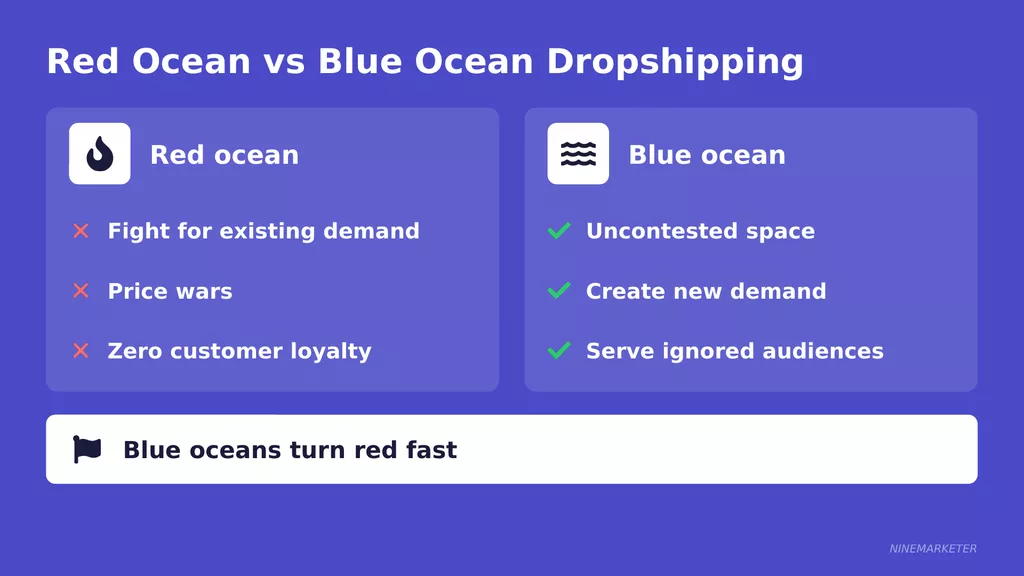
A red ocean is a market characterized by cutthroat competition where companies fight over existing demand rather than creating new demand.
Think of sharks in a feeding frenzy, the water turns red from all the blood.
That’s your saturated dropshipping niche.
In red oceans, growth and profitability decline as the market becomes more dispersed among too many players.
Everyone’s competing on price because there’s no other way to differentiate.
You’ve got the same product, same suppliers, same shipping times, same everything.
So what’s left? Price wars.
The red ocean operates within known market boundaries, which means customers know exactly what’s available and from how many sources.
When phone accessories hit saturation in 2024, it became a perfect red ocean, hundreds of sellers offering identical products to an audience that knew they could buy the same thing cheaper elsewhere.
Here’s what makes red oceans so brutal for dropshipping: market saturation limits growth opportunities, forcing you to steal customers from competitors rather than finding new ones.
And in a market where everyone’s selling the same LED face mask or posture corrector, customers have zero loyalty.
They’ll jump ship for a 10% discount in a heartbeat.
The traditional approach in red oceans is competing to be the best, better prices, better ads, better customer service.
But in dropshipping, where you don’t control the product or fulfillment, “better” is nearly impossible.
You can’t differentiate on quality when everyone’s sourcing from the same factory.
You can’t win on shipping when everyone’s using the same logistics.
That’s why so many dropshippers fail.
They enter red oceans thinking they can outcompete through hustle or better marketing, when the fundamental economics make profitable operation impossible.
Zero-sum game dynamics mean your gain is literally someone else’s loss, and with dozens or hundreds of competitors, everyone’s fighting over crumbs.
Blue oceans, uncontested market space, are where dropshipping gold exists.
Finding products nobody else is selling yet, or serving audiences everyone else ignores.
But once the masses discover your blue ocean, it rapidly turns red.
And when it does, no amount of optimization will save you.
Geographic Saturation: It’s Not Just About Volume
Here’s something most people overlook: saturation doesn’t happen uniformly across regions.
You might have a product that’s dying in the US market but still fresh in European or Latin American markets.
Understanding geographic patterns can buy you time.
The US and UK markets are typically first to saturate because they’re dropshipping’s most lucrative markets with high purchasing power.
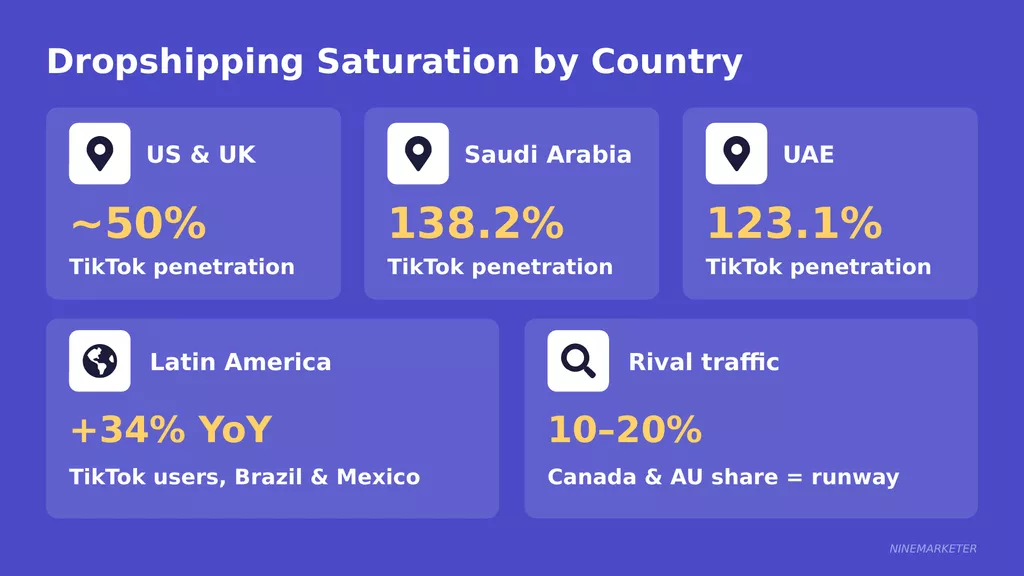
When TikTok shows 138.2% penetration rate in Saudi Arabia and 123.1% in the UAE versus only 50% in the US and UK, it actually indicates the US/UK markets might be approaching saturation while Middle Eastern markets still have room.
Latin America is currently showing 34% year-over-year growth in TikTok users, with Brazil and Mexico leading the charge.
That’s where smart dropshippers are pivoting when US markets saturate, finding geographic arbitrage opportunities before everyone else floods in.
Southeast Asia is interesting because while it has massive TikTok engagement and time spent on platform, purchasing power is lower.
So you see high engagement but conversion rates might not justify the effort.
That’s a different kind of challenge than pure saturation.
Use SimilarWeb to check where your competitors’ traffic is concentrated.
If 90% of everyone’s traffic comes from the US, and your product appeals to US buyers specifically, you’re fighting over a saturated geographic market.
But if you find that only 10-20% of competitor traffic comes from Canada or Australia, you might have runway there.
The pattern you want to avoid: everyone targeting the same countries with the same products at the same time.
When you see that happening, geographic saturation is adding another layer of difficulty to an already saturated niche.
Social Media Red Flags: When Hashtags and Influencers Tell the Story
Social media gives you real-time saturation indicators if you know what to look for.
Hashtag saturation and influencer overlap are two massive warning signs most dropshippers completely ignore.
Let’s start with hashtags.
On TikTok, the most popular hashtag #fyp has 100 trillion views, while #foryou has 50.9 trillion.
These mega-hashtags are basically worthless for discovery now, they’re oversaturated to the point of being invisible.
But here’s what you need to watch: product-specific hashtags.
When a niche hashtag goes from 10 million views to 500 million views in a few months, that’s your saturation indicator.
The sweet spot for TikTok hashtags is under 1 million videos for actual discoverability.
Anything above that and you’re drowning in noise.
Check Instagram too.
When a product-specific hashtag has 10,000+ posts and generic oversaturated tags like #ExplorePage or #InstaBest dominate your competitor’s strategies, the market’s cooked.
Everyone’s fighting for the same algorithmic scraps.
The bigger warning sign is how fast hashtag volume accelerates.
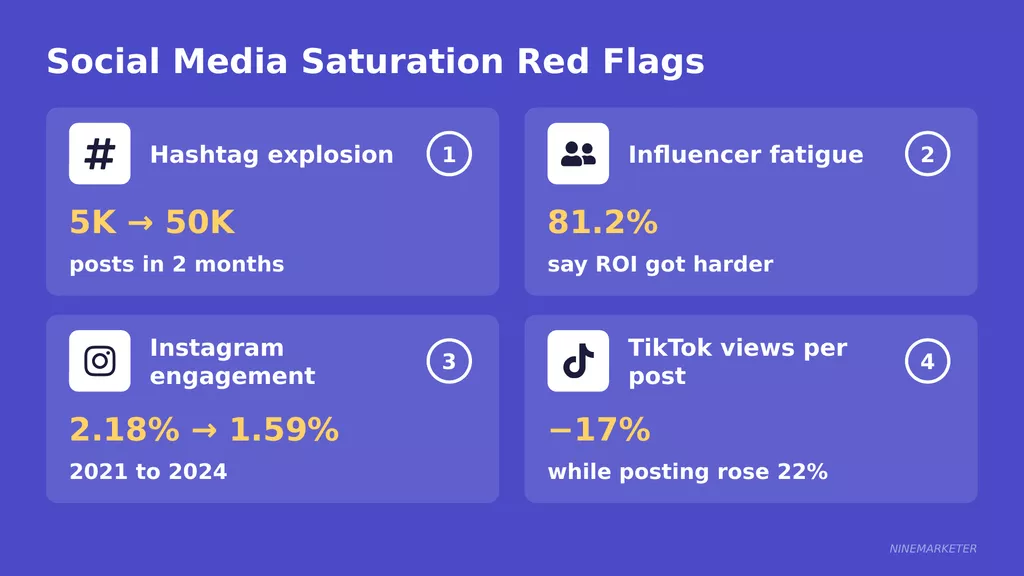
If your product hashtag jumped from 5,000 posts to 50,000 posts in two months, that’s not organic growth, that’s a gold rush.
And in dropshipping, when gold rushes happen, the market saturates within weeks, not months.
Now let’s talk influencer overlap, which is honestly one of the sneakiest saturation indicators.
When you start seeing the same influencers promoting five different competing stores selling your product, you’ve got a problem.
81.2% of marketers said it was harder to get the same ROI from influencer collaborations in 2024, largely due to audience fatigue.
Here’s how this plays out: An influencer with 100K followers promotes Product X for Store A.
Their audience sees it, some people buy.
Two weeks later, same influencer promotes the same product for Store B.
Their audience is like “didn’t we just see this?” Engagement drops.
Then Store C, D, and E all approach the same influencer because they’re targeting the same niche.
Pretty soon, over half of marketers are concerned about market saturation because they’re running out of unique influencer partners.
Everyone you find has recently worked with a competitor.
Your “ideal” influencers are all taken or demanding exclusivity contracts that price you out.
The data backs this up: Instagram engagement rates dropped from 2.18% in 2021 to 1.59% in 2024 partially due to platform saturation.
Average views per TikTok post fell 17% from 2024 to 2025 while posting frequency jumped 22%. More content, less engagement, that’s saturation killing reach.
When you see micro-influencers with 10K-100K followers getting better engagement than macro-influencers specifically in your niche, it often means the bigger influencers are oversaturated with sponsored posts.
Their audiences have developed ad blindness to anything that looks like another dropshipping promo.
Here’s your practical check: Go through competitor ads and note which influencers they’re using.
Make a spreadsheet.
If you see the same 20-30 influencers working with multiple competing stores in your niche, and their engagement rates on sponsored posts are declining, you’re looking at influencer saturation reflecting broader market saturation.
The average consumer follows fewer influencers than they did a few years ago, 65% follow fewer fashion influencers specifically, because they’re tired of constant sponsored content.
When influencer fatigue sets in at the consumer level, that niche is done.
Social media saturation also shows up in content formats.
When brands posted an average of 10 posts per day across networks in 2023 and everyone in your niche is maxing out daily posting limits, you’re competing in a content volume war you can’t win as a small dropshipper.
The final nail: when you look at your niche on TikTok or Instagram and see that organic reach has declined dramatically despite increased posting frequency, saturation has fundamentally changed the game.
Small accounts that saw TikTok reach decline 32% despite 16% more posting weren’t doing anything wrong, the platform’s just oversaturated with their type of content.
Bottom line?
When your competitors are everywhere, in search results, in ad libraries, on the same influencers’ feeds, using the same hashtags, you’re not in a competitive market.
You’re in a saturated bloodbath.
And unless you’ve got a massive budget and unique angle, it’s time to pivot before you become another statistic of failed dropshipping stores.
Warning Sign #4: Customer Acquisition Cost Exceeds Lifetime Value
Here’s the brutal truth about dropshipping in 2025: most e-commerce businesses lose $29 on average per new customer acquired after accounting for marketing costs and product returns.
That’s up from just $9 in 2013, a 222% increase that’s killing stores left and right.
When your Customer Acquisition Cost starts creeping up toward (or God forbid, exceeding) your Customer Lifetime Value, you’re not running a business anymore.
You’re running a very expensive hobby that bleeds money with every sale.
Calculating Your True CAC: It’s More Than Just Ad Spend
Most dropshippers screw this up from day one.
They look at their Facebook ads dashboard, see they spent $500 to get 25 customers, and think “Great, my CAC is $20!”
Wrong. Dead wrong.
The actual CAC formula is simple: Total Marketing & Sales Spend divided by Number of New Customers Acquired.
But the devil’s in what you include in that “total spend” number.
Your true CAC includes way more than just ad clicks.
You need to account for marketing team salaries (or your own time), software tools, content creation costs, agency fees if you’re using them, discounts and promotions for new customers, payment processing fees, and even the cost of buying stock or samples.
Here’s a real example.
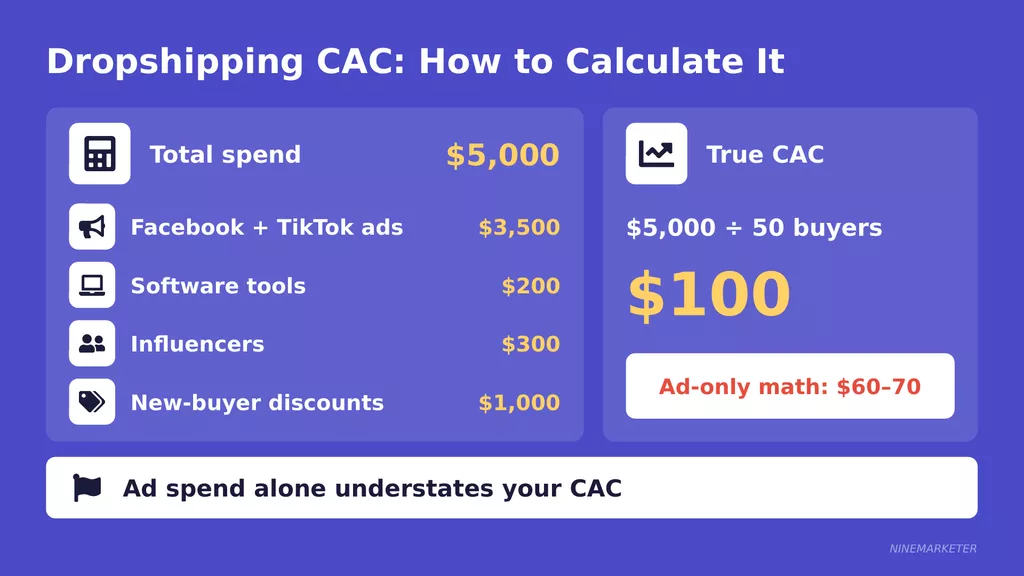
Say you’re running a dropshipping store and in one quarter you spent $3,000 on Facebook ads, $500 on TikTok ads, $200 on various software subscriptions (Shopify, email marketing, analytics tools), $300 on influencer partnerships, and $1,000 in discounts for first-time buyers.
That’s $5,000 total.
If you acquired 50 new customers, your actual CAC is $100, not the $60-70 you’d calculate if you only counted ad spend.
The average CAC for e-commerce sits somewhere between $50-$130 depending on your niche, but Shopify’s data shows many stores hitting $68-$78 range.
If you’re significantly above that and operating on typical dropshipping margins of 15-20%, you’re probably underwater and don’t even realize it.
And here’s the kicker: CAC has risen approximately 40% between 2023 and 2025 thanks to increased platform competition, privacy regulations limiting targeting precision, and straight-up market saturation.
That phone accessories niche that cost you $45 per customer in 2023?
Now it’s $65-70, and climbing.
Understanding LTV in the Dropshipping Reality
Lifetime Value in dropshipping is… not great.
Let’s be real about this.
Unlike subscription businesses or brands with high repeat purchase rates, most dropshipping stores struggle with customer retention.
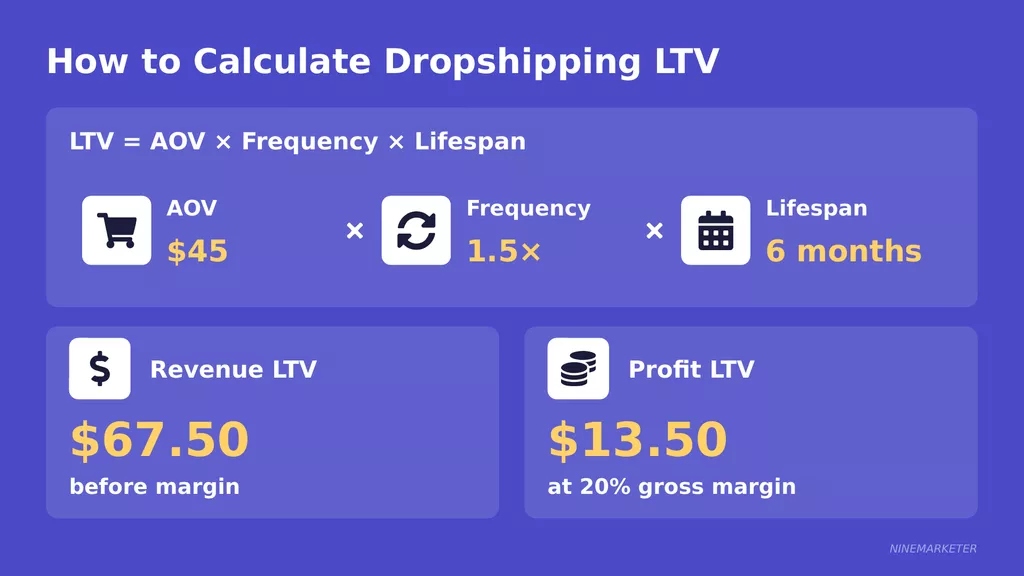
The basic LTV formula multiplies Average Order Value by Purchase Frequency by Customer Lifespan.
Sounds simple.
But in dropshipping, those numbers are typically depressing.
Let’s break it down with realistic numbers.
Say your average order value is $45.
Your purchase frequency is maybe 1.5 times (because let’s face it, most dropshipping customers buy once and never return).
Customer lifespan is maybe 6 months.
That gives you an LTV of roughly $67.50.
Now compare that to your CAC.
If you’re paying $50-60 to acquire each customer and they’re only worth $67.50 over their entire “lifetime,” you’re operating on razor-thin margins that can’t absorb any fluctuations in ad costs or other expenses.
For a more accurate picture, you should calculate LTV with gross margin factored in: AOV × Purchase Frequency × Customer Lifespan × Gross Margin%.
If your gross margin is 20% (typical for dropshipping), that $67.50 LTV becomes just $13.50 in actual profit.
Suddenly that $50 CAC looks catastrophic.
Shopify’s research shows that customer acquisition costs average between $127-$462 depending on industry.
In mature, saturated markets, dropshippers are often hitting the higher end of that range while their LTV stays stubbornly low because they can’t build real customer loyalty.
The 3:1 Ratio That Separates Winners From Losers
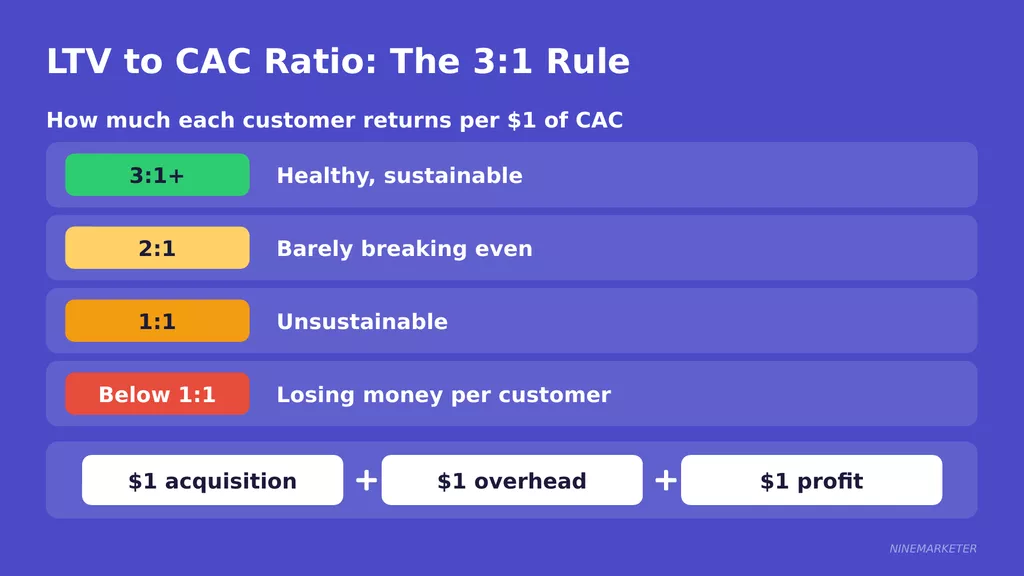
Here’s the magic number you need burned into your brain: 3:1. Your LTV should be at least three times your CAC. Ideally, you want 4:1, but 3:1 is the absolute minimum for sustainable growth.
This ratio tells you whether your acquisition strategy actually works or if you’re just lighting money on fire.
A 3:1 LTV: CAC ratio means for every dollar you spend acquiring a customer, you should earn at least three dollars back over their lifetime.
Why 3:1?
Because that one dollar goes to acquisition, one dollar covers your other operating costs (fulfillment, support, returns, overhead), and one dollar is actual profit.
Simple economics.
When your ratio drops below 3:1, you’re in dangerous territory.
At 2:1, you’re barely breaking even after all costs.
At 1:1? You’re spending as much to acquire customers as they ever spend with you, totally unsustainable.
Below 1:1 means you’re literally losing money on every single customer.
The harsh reality for dropshippers in saturated niches is that maintaining a 3:1 ratio has become nearly impossible.
When your LTV is $70 and your CAC is climbing to $50-60, you’re operating at maybe 1.2:1 or 1.4:1.
That’s not a business model, that’s a slow-motion bankruptcy.
Here’s how it plays out in real life.
If your LTV is $200 and your CAC is $100, you’ve got a healthy 2:1 ratio, not great, but workable.
But then market saturation hits.
Ad costs spike, your CAC climbs to $140.
Suddenly you’re at 1.4:1.
Your margins evaporate.
You can’t scale because every new customer acquisition digs your hole deeper.
And the worst part?
Most dropshippers don’t even calculate this ratio.
They just keep spending on ads wondering why they’re not profitable despite “good revenue.”
Revenue means nothing if your unit economics are broken.
How Saturation Sends CAC Into a Death Spiral
Market saturation doesn’t just hurt your conversions, it absolutely destroys your Customer Acquisition Cost.
And once that CAC escalation cycle starts, it’s brutally hard to stop.
Here’s the mechanism: As more competitors flood into your niche, ad costs rise because everyone’s bidding for the same audience.
The more competitors bidding for the same audience, the higher the cost to acquire each customer.
In a crowded niche, you’ll pay more for visibility.
The data backs this up.
Digital advertising in e-commerce has become a particularly saturated market, with barriers to entry lower than ever.
New competitors launch campaigns constantly, driving up costs.
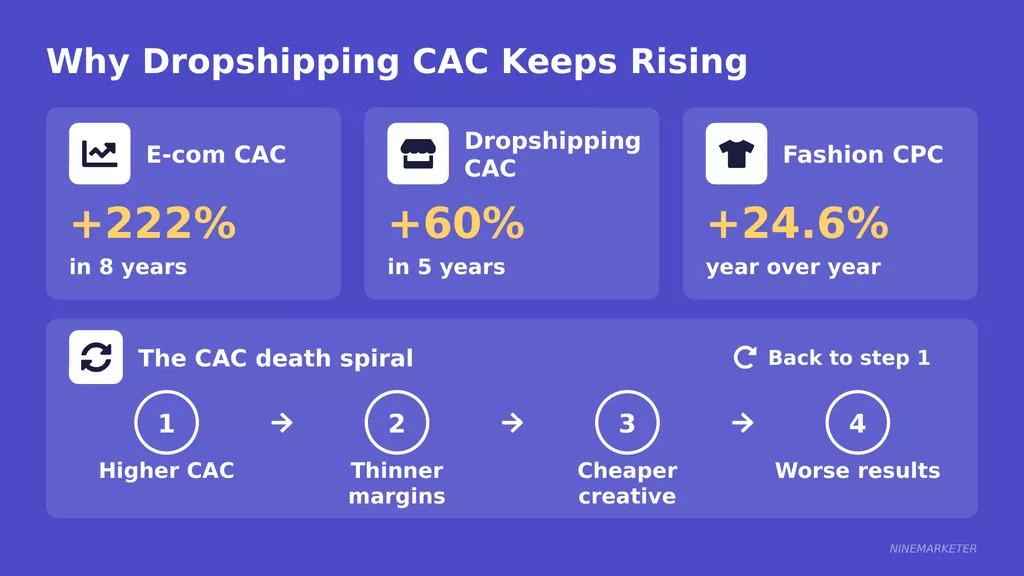
CAC has surged 222% over eight years, reflecting market saturation and rising ad costs.
But it gets worse through a feedback loop.
Higher CAC means lower margins.
Lower margins mean less budget for quality creative and testing.
Cheaper creative performs worse, which… increases your CAC even more.
It’s a death spiral.
Google’s average CPC increased 10% from 2023 to 2024, a huge jump compared to the 2% rise from 2022 to 2023.
Industries like apparel, fashion, and jewelry saw CPCs rise by 24.6% year-over-year.
If you’re in a saturated niche within these verticals, you’re getting absolutely hammered.
Rising customer acquisition costs are up 60% in five years for dropshipping specifically.
That’s not gradual inflation, that’s acceleration driven by too many sellers chasing too few customers.
The geographic factor makes it worse.
US ecommerce brands often face above-average CAC, especially in highly competitive markets.
West Coast brands pay 15-25% higher CAC than average, while Midwest sees costs 10-20% lower.
But as saturation spreads geographically, even previously cheap markets get expensive.
And don’t forget the regulatory angle.
Privacy changes like iOS updates and GDPR have reduced targeting precision, forcing broader (and more expensive) audience approaches.
You’re paying more to reach less qualified audiences.
Less precision means more waste, which means higher effective CAC.
The retention crisis compounds everything.
In 2024, 75% of software companies saw declining retention rates despite increased spending.
When retention drops, you need to spend more on acquisition to replace churned customers, which drives CAC up further.
It’s an expensive treadmill you can’t get off.
Here’s the thing about saturation-driven CAC escalation: it doesn’t reverse.
Once ad costs spike in a saturated market, they don’t magically come back down.
You either accept permanently higher CAC (and lower margins) or you pivot to a new niche.
Those are your only options.
Tools and Metrics for Tracking CAC and LTV Accurately
You can’t fix what you don’t measure, and most dropshippers are flying blind because they’re not using the right tools to track their unit economics.
First, stop relying solely on native Shopify analytics.
Shopify Analytics gives you a decent starting point, but it doesn’t automatically calculate blended CAC across all your marketing channels or give you cohort-based LTV analysis.
You need better tools.
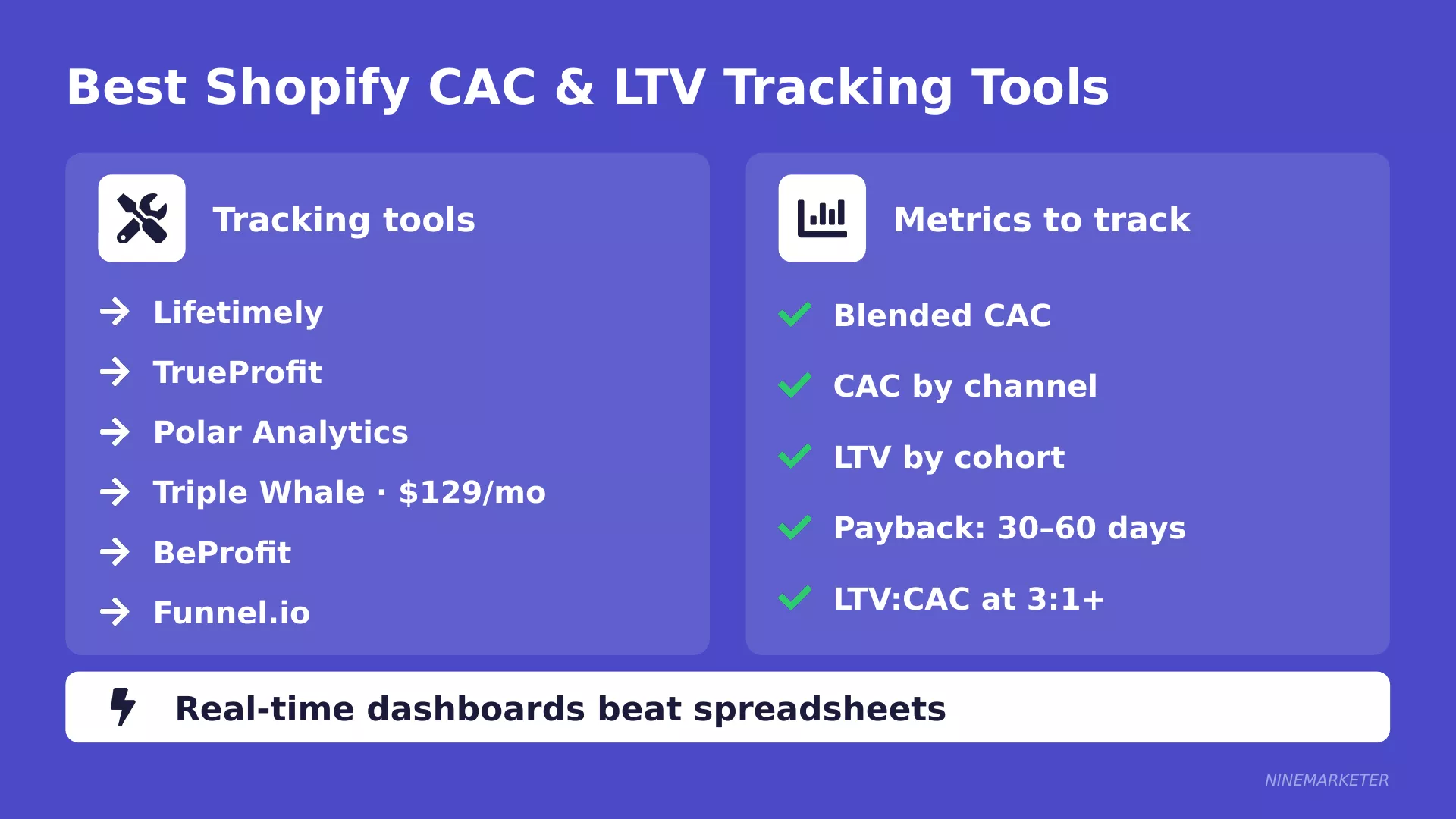
Lifetimely is one of the best Shopify apps for this.
It provides automated Profit & Loss reports, CAC tracking, and LTV insights segmented by customer cohorts.
Plans start at varying levels based on your monthly revenue.
The cohort analysis alone is worth it, you can see exactly which customer groups are profitable and which aren’t.
TrueProfit displays your store’s actual profit in real-time and automatically tracks earnings, ad spend, shipping expenses, transaction fees, LTV, and CAC in one location.
No more manual spreadsheet hell.
Polar Analytics is a higher-end option that centralizes 45+ data sources in one dashboard.
You can track profit and loss, blended CAC, ROAS, MER, LTV, and cohorts with out-of-the-box dashboards.
It’s particularly good if you’re running multi-channel campaigns and need to see the full picture.
Triple Whale starts at $129/month and is specifically designed for customer acquisition and LTV tracking.
It combines Shopify data with ad platform spend to give you unified ROAS, CAC, and LTV metrics.
BeProfit offers accurate profit tracking with CAC, ROAS, and LTV monitoring.
It integrates with major ad channels and provides real-time P&L updates so you always know where you stand.
For more advanced setups, consider Funnel.io, which combines Shopify data and ad platform spend to give you unified ROAS, CAC, and LTV metrics.
It automates reporting across all channels and exports clean, normalized data for deeper analysis.
The key metrics these tools should help you track:
Blended CAC – Not just Facebook CAC or Google CAC, but your true cost across all channels divided by all new customers. This gives you the real picture.
CAC by Channel – Which platforms are giving you efficient acquisition? If TikTok brings cheaper traffic but lower conversion rates, you need to know that to adjust strategy.
LTV by Cohort – Customers acquired in January might behave differently than those acquired in June. Cohort analysis shows you which acquisition periods or channels bring the most valuable customers.
CAC Payback Period – How long does it take to recover acquisition costs? For private SaaS companies, average payback is 23 months. For dropshipping, you need it much faster – ideally 30-60 days max.
LTV:CAC Ratio – Track this monthly. If it drops below 3:1, you need immediate intervention.
AOV, Purchase Frequency, Customer Lifespan – These are the three components that make up LTV. Track each independently so you know which lever to pull to improve your ratio.
The truth is, if you’re not tracking these metrics with dedicated tools, you’re almost certainly miscalculating your profitability.
42% of marketing budgets are wasted on customer acquisition, and most of that waste comes from not understanding true CAC and LTV.
Don’t make the mistake of thinking you can track this in spreadsheets.
By the time you’ve manually calculated your blended CAC across six different ad accounts, factored in all your costs, and built cohort tables for LTV, the data’s already outdated.
You need real-time dashboards that update automatically.
The bottom line is this: when your CAC exceeds your LTV, or even when your LTV:CAC ratio drops below 3:1, you’re in a crisis whether you realize it or not.
In saturated markets, this metric deteriorates faster than you can fix it through optimization alone.
You’re either pivoting to a new niche, dramatically changing your business model (hello, subscription model or private label), or slowly going broke one “profitable” sale at a time.
If you’re sitting at a 1.5:1 or 2:1 ratio right now, thinking “it’s fine, I’m still making some profit,” understand that market saturation only pushes in one direction: higher CAC and stagnant or declining LTV.
Every month you wait to address this, your situation gets worse.
That’s not pessimism; that’s math.
Warning Sign #5: Product Pricing Wars and Race to the Bottom
There’s this moment that happens in every saturated niche, and it’s ugly.
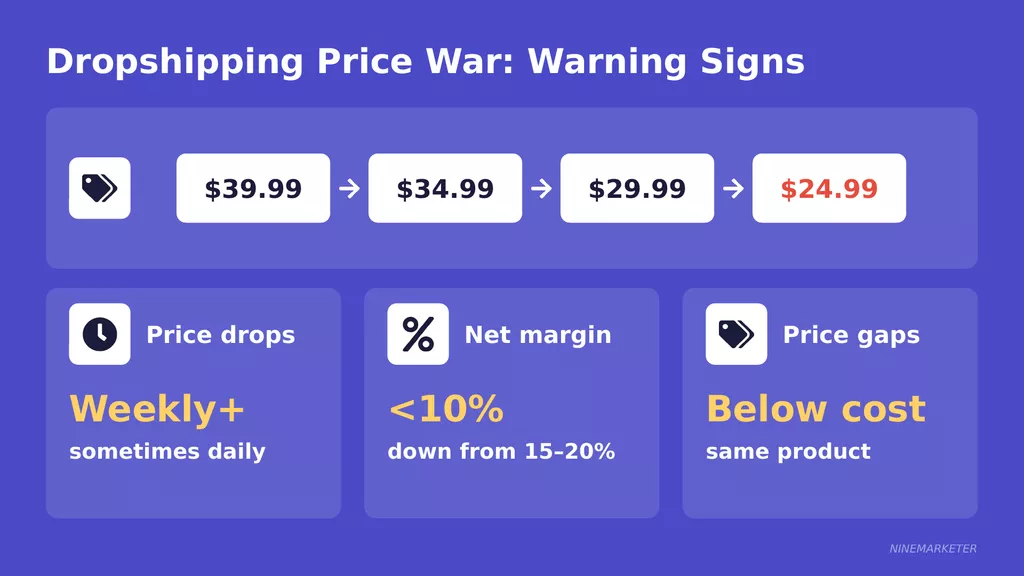
You price your product at a healthy $39.99 with decent margins.
A week later, a competitor drops to $34.99.
Then another goes $29.99.
Before you know it, you’re staring at a market where everyone’s selling at $24.99 or lower, and nobody’s making any real money anymore.
Welcome to the race to the bottom, where dropshipping often becomes a battle where margins get hurt because everyone’s competing solely on price.
And once it starts, it’s almost impossible to stop.
When Your Niche Enters Destructive Price Competition
Here’s how you know you’ve crossed from healthy competition into destructive territory: when price becomes the only differentiator.
Not quality, not service, not brand, just who can go lowest without going bankrupt.
The warning signs are pretty clear.
First, you’ll notice competitors dropping prices weekly or even daily.
In highly competitive niches, dropshippers race each other to the bottom on pricing, sacrificing quality just to maintain some semblance of market share.
Second, your own margins are compressing so fast you can barely keep up.
Most dropshippers operate with net profit margins of 15-20%, but when saturation hits, those margins can plummet below 10%, making profitability nearly impossible to sustain.
Third, and this is the killer, you start seeing the exact same product listed at wildly different prices, with the lowest prices clearly unsustainable.
Someone’s selling at a loss just to move volume or drive competitors out.
That’s not competition, that’s market carnage.
The intense competition and saturation in dropshipping leads to identical stores offering similar products, which forces price wars and margin shrinkage.
When you can’t differentiate on anything else, price becomes the nuclear option everyone uses simultaneously.
And here’s what makes it so brutal: consumers in highly competitive markets can compare prices with just a few clicks.
They know when they’re being overcharged because ten other stores are offering the same thing cheaper.
Your perceived value evaporates instantly.
How Saturation Forces Aggressive Discounting
Market saturation doesn’t just encourage discounting, it practically mandates it.
Here’s the mechanism that drives this destructive cycle.
When too many sellers flood a niche, each store’s traffic and conversion rates naturally decline.
You’re splitting a finite customer base among hundreds or thousands of competitors.
To maintain sales volume, stores start offering discounts.
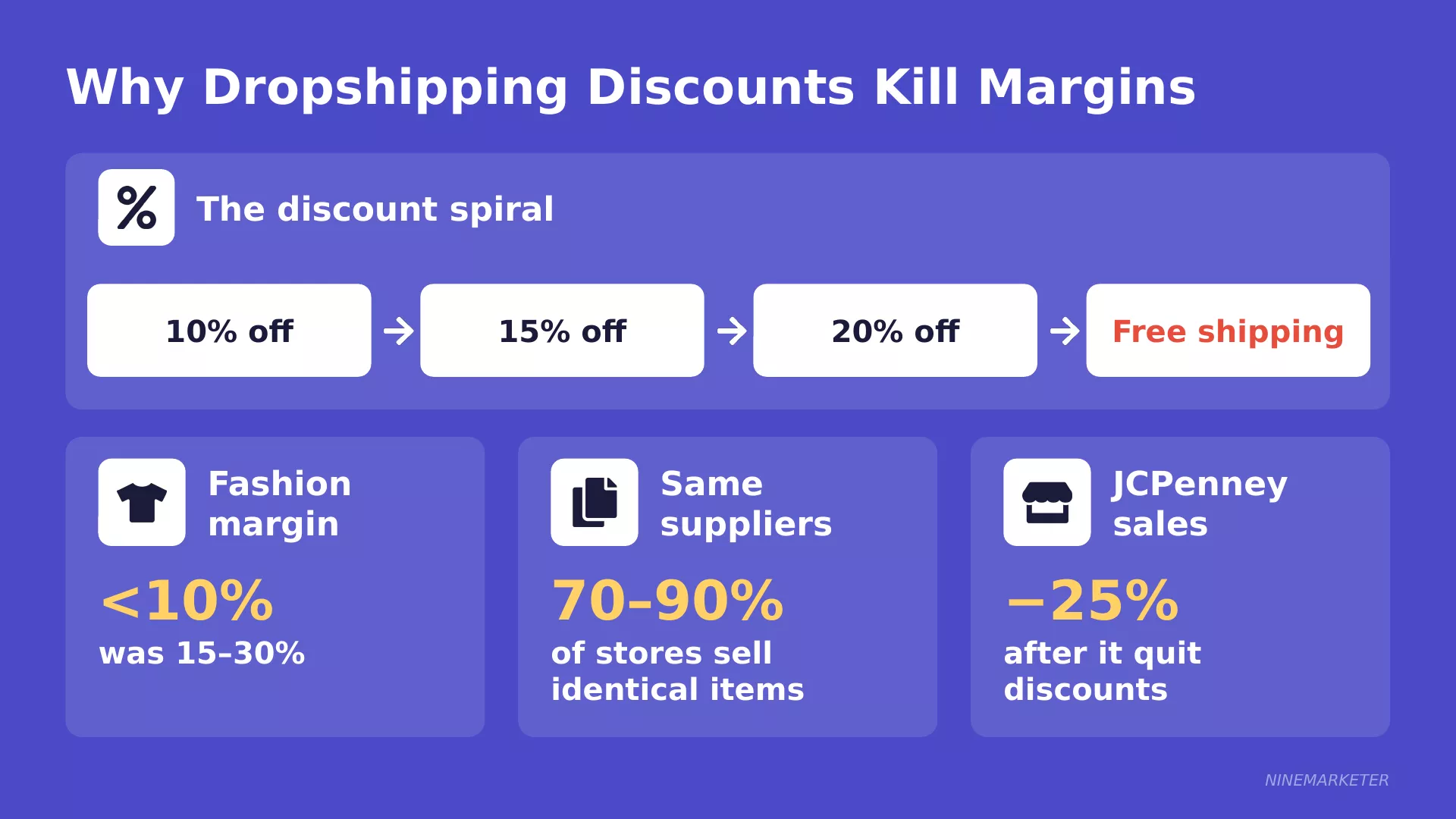
First it’s 10% off to attract buyers.
Then a competitor does 15%.
Then 20%.
Then someone throws in free shipping on top.
The problem with aggressive discounting is that it leads to a race where prices continue dropping until profit margins become unsustainable.
Nobody wins this game.
Everyone just loses slower.
Data backs this up.
Dropshippers in saturated markets like fashion are seeing margins closer to 10% or less, down from the 15-30% range in healthier markets.
Those economics don’t work long-term, especially when tariffs and rising operational costs are squeezing profits even further in 2025.
The discount spiral also creates psychological dependency.
Customers in saturated niches become trained to expect sales, coupons, and deals.
They literally wait for discounts before buying anything.
This is why retailers that tried eliminating frequent sales saw catastrophic results, like JCPenney’s 25% sales plummet in 2012 when they dropped their discount-driven strategy.
Here’s what actually happens in saturated niches: 70-90% of stores offering the same products from the same suppliers means price becomes the only variable shoppers care about.
When everyone sells identical items, you literally can’t compete on anything else.
So you cut prices.
And then everyone else cuts deeper.
And round and round it goes.
The worst part?
Even stores that don’t want to participate get dragged in.
If you try maintaining your $39.99 price while everyone else is at $29.99, your sales disappear.
You’re forced to match the market or die.
That’s not a choice, that’s capitulation.
The Psychology Behind “Pennies on the Dollar” Dynamics
There’s some fascinating (and depressing) psychology behind why pricing wars escalate so quickly in saturated markets.
Understanding this helps explain why the race to the bottom feels so inevitable.
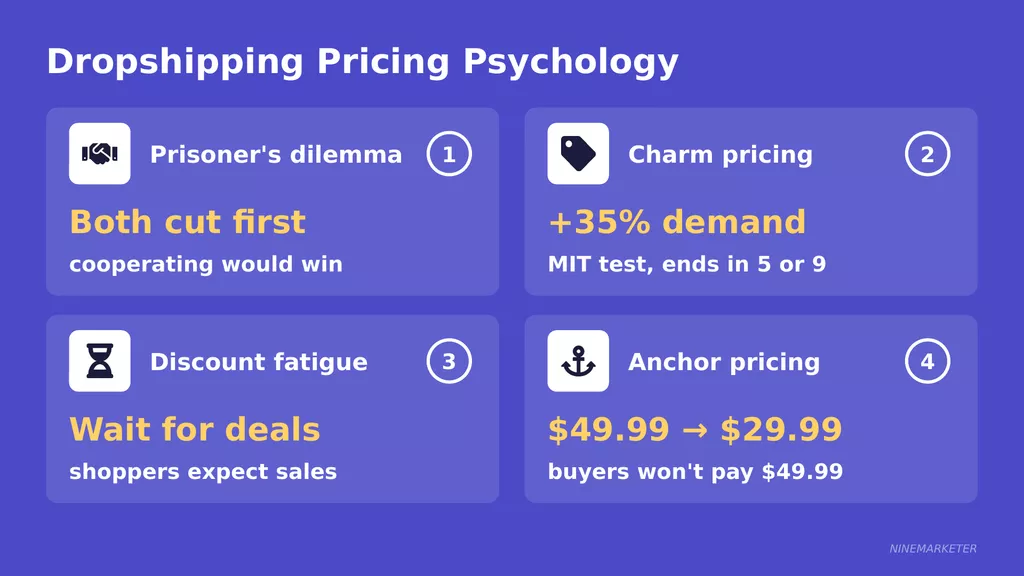
First is the prisoner’s dilemma from game theory. Two rational competitors could cooperate and maintain higher prices, which benefits both.
But if one defects and lowers prices to steal market share, the other gets crushed.
So both lower prices preemptively, even though cooperation would have been better for everyone.
It’s rational irrationality.
Then there’s charm pricing psychology.
Studies show charm pricing increased consumer demand by 35% in one MIT experiment, which is why almost 90% of retail prices end in 5 or 9. Specifically, 60.7% end in 9 and 28.6% end in 5.
In saturated markets, this psychology gets weaponized.
A product at $39.99 becomes $29.99, then $24.99, then $19.99. Each drop triggers the left-digit bias where $19.99 seems closer to $10 than $20 in consumers’ minds, creating perceived value that doesn’t reflect actual value.
But here’s the kicker: consumers have become savvy enough to identify psychological pricing tactics.
They know they’re being manipulated with these techniques.
In saturated niches, shoppers develop “discount fatigue” where they assume all prices are inflated and wait for better deals.
This forces sellers to discount even deeper just to trigger purchasing action.
There’s also the price contamination effect.
When competitors quickly match your pricing moves and consumers switch providers instantly for lower prices, you’re in a contaminated market.
Every price change gets copied within hours, nullifying any advantage and ratcheting the entire market downward.
In highly competitive eCommerce spaces, consumers expect to find the best prices with minimal effort, and price transparency makes this trivial.
They’ll literally open three tabs, compare identical products, and buy from whoever’s cheapest.
No brand loyalty, no appreciation for service quality,+ just pure price optimization.
The psychology works against sellers in another way too: anchor pricing.
When your product was $49.99 originally, and now it’s “on sale” for $29.99, that anchors customer expectations.
They won’t pay $49.99 ever again.
You’ve permanently devalued your own product.
In saturated markets where everyone’s constantly “on sale,” nothing has real value anymore, just discount expectations.
Monitoring Competitor Pricing Using Automated Tools
If you’re going to survive in a pricing war (or better yet, recognize when to get out), you need intelligence on what competitors are doing.
Manual price checking is useless when you have fifty competitors changing prices daily.
That’s where automated price monitoring tools come in.
These platforms scrape competitor websites and give you real-time data on how your pricing stacks up.
With almost 90% of online shoppers making buying decisions based on price and over 85% comparing prices before purchase, you can’t afford to be the expensive outlier.
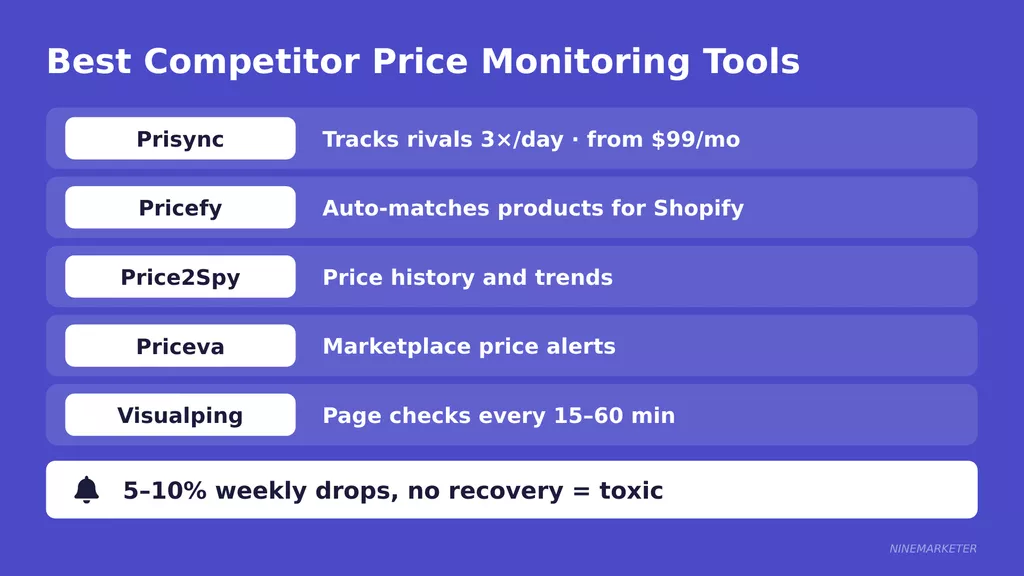
Prisync is one of the most popular options, offering robust competitor price tracking with dynamic pricing suggestions. It provides price updates three times daily and can track competitor stock levels too. Starting at $99/month, it’s positioned for mid-market retailers. The beauty of Prisync is you can track prices from unlimited competitors, making it ideal for saturated niches where everyone needs monitoring.
Pricefy automatically matches your products to competitors’ offerings and compares prices across any currency, country, or marketplace. It’s designed specifically for Shopify dropshippers and provides dynamic repricing that adjusts automatically based on market trends. Once you upload your catalog, Pricefy handles the product matching so you don’t manually track every competitor.
Price2Spy excels at historical pricing analysis. It tracks pricing changes over time, showing you seasonal patterns and long-term trends. This is crucial for understanding whether you’re seeing temporary discounting or permanent market compression. Price2Spy also includes dynamic repricing modules and daily alerts on price and stock changes.
Priceva focuses on comprehensive competitor insights, providing real-time price tracking across channels with alerts when prices change. It’s particularly strong at monitoring marketplace pricing – crucial since many dropshippers sell across multiple platforms simultaneously. Their software helps teams make smarter pricing decisions by automating the competitive intelligence gathering.
Visualping takes a different approach by monitoring exact on-page price elements and sending AI-readable summaries of what changed. You can set monitoring frequency from 15-60 minutes for volatile SKUs to daily checks for stable products. It’s trusted by 85% of Fortune 500 companies for competitive intelligence.
The Shopify App Store also offers integrated solutions like PriceMole that work directly within your store dashboard, eliminating the need to jump between platforms.
Here’s what matters about these tools: they show you when your niche is entering a pricing death spiral. If you’re checking competitor prices daily and seeing them drop 5-10% week after week with no recovery, that’s your cue that saturation has turned your market toxic. The tools don’t just track prices, they reveal market health.
Some advanced platforms like Competera and Omnia offer demand modeling and automated repricing based on elasticity rules. But honestly, if your niche is so saturated that you need AI-driven repricing just to stay competitive, you’re probably in a market you should exit rather than optimize within.
The key insight these tools provide: when price becomes the only differentiator and consumers can compare instantly, you’re in a commoditized market.
No amount of monitoring changes that fundamental reality.
When Pricing Pressure Reveals Deeper Saturation Issues
This is the most important section, so pay attention.
Pricing wars aren’t the disease, they’re the symptom.
When you see sustained, aggressive price competition in your niche, it’s signaling something much deeper than just aggressive competitors.
Here’s how to tell if pricing pressure indicates true market saturation versus temporary competitive dynamics:
Temporary competitive pressure looks like this: seasonal price drops (Black Friday, back-to-school), new entrant trying to grab market share with aggressive pricing, promotional campaigns that last days or weeks.
These situations are finite. Prices recover after the event or campaign ends. The market returns to equilibrium.
True saturation-driven pricing collapse is different.
Prices drop and never recover. Week after week, month after month, prices just keep compressing with no floor in sight. When the market enters a race to the bottom where prices continue dropping until profit margins become unsustainable, that’s structural, not cyclical.
Let’s look at specific indicators.
If your profit margin was 20-30% a year ago and is now below 10%, and your competitors are in the same situation, that’s saturation.
The entire market has compressed, not just your store.
If you’re seeing dozens of competitors on Meta’s Ad Library selling the same product at prices that obviously can’t be profitable, like selling $15 items for $19.99 with free shipping,
someone’s either losing money or operating on impossibly thin margins. That’s market death, not market competition.
When stores are forced into economy pricing models where they sell at the lowest possible price, even sacrificing quality, you’re watching a niche collapse in real-time.
This becomes common in hyper-competitive niches where dropshippers fight for any sales they can get.
Geographic patterns matter too.
If pricing pressure is isolated to one country or region, that’s local saturation, potentially solvable by expanding elsewhere.
But when global pricing compression happens simultaneously across all major markets, you’re dealing with fundamental oversupply that can’t be arbitraged away.
The tariff situation in 2025 adds another layer.
With tariffs driving up COGS for many dropshippers, the only way to maintain competitive pricing is to completely eliminate profit margins.
If you’re operating in a saturated niche facing 17%+ average tariff rates, pricing wars become mathematically unwinnable.
Here’s the brutal reality check: when you find yourself using price monitoring tools to track fifty competitors who are all within $2-3 of each other’s pricing, and everyone’s running constant “limited time” discounts that never actually end, your niche isn’t competitive, it’s commoditized.
The race to the bottom isn’t sustainable, and emphasizing quality over price becomes impossible when customers have dozens of identical alternatives.
CEO Pieter Zwart of Coolblue summed it up perfectly: “In the end only one thing remains with which you can distinguish yourself online and that is the price.
Since I have 60,000 competitors… you understand that this is just a race to the bottom.” His solution?
Don’t compete on price alone, compete on the complete customer journey.
But that only works if you have the resources and brand strength to deliver premium service. Most dropshippers don’t.
So when does pricing pressure signal it’s time to pivot?
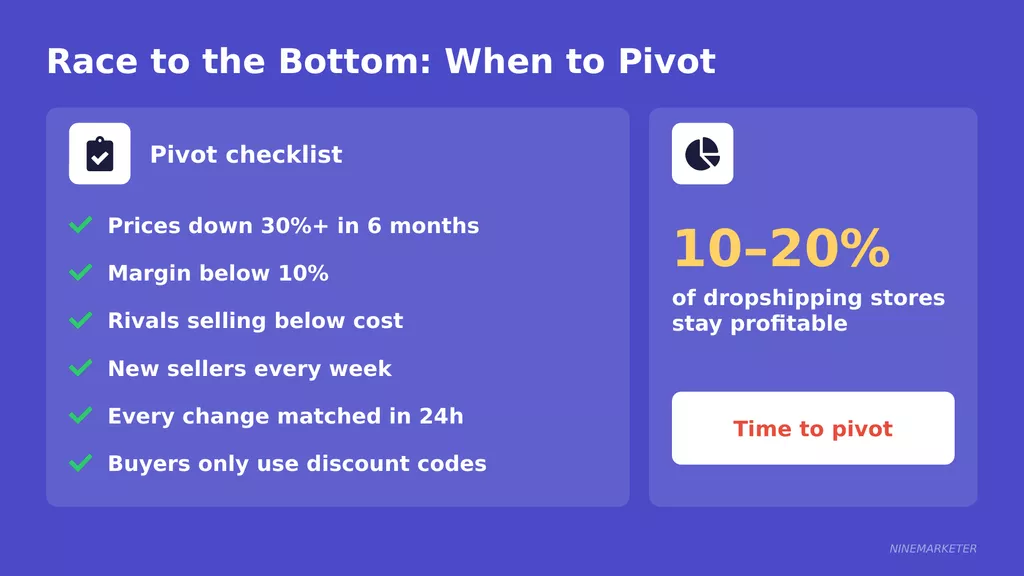
When you can answer “yes” to most of these:
- Prices have dropped 30%+ in six months with no recovery
- Your profit margin is consistently below 10%
- Competitors are clearly selling at unsustainable prices
- New competitors enter weekly, all pricing aggressively
- Every pricing change you make is matched within 24 hours
- Customers only buy on sale or with discount codes
- You’re considering matching prices that you know lose money
If that describes your situation, you’re not in a “challenging” market.
You’re in a dying niche.
Only 10-20% of dropshipping stores manage to stay profitable long-term, and most failures happen because sellers stay too long in saturated markets, burning through capital in unwinnable pricing wars.
The smart play isn’t optimizing your pricing strategy or finding better monitoring tools.
It’s recognizing that when thousands of nearly identical stores flood every niche and price becomes the only differentiator, the dropshipping model itself is broken in that market.
Time to find a blue ocean, not a bloodier red one.
Final Thoughts: Staying Ahead of Saturation
The dropshipping landscape changes faster than ever.
What’s profitable today might be oversaturated tomorrow, and that’s just the nature of the business.
But here’s the silver lining: entrepreneurs who develop the skills to recognize saturation early and adapt quickly are the ones who build sustainable, long-term businesses.
Don’t view niche saturation as failure, view it as market feedback.
The strategies I’ve shared aren’t just reactive measures, they’re proactive frameworks for building antifragile dropshipping businesses that can weather competitive storms.
Whether you choose to double down with differentiation, pivot to greener pastures, or develop a hybrid approach, the key is taking action before your margins disappear completely.
Remember, the most successful dropshippers aren’t the ones who found a magical unsaturated niche and rode it forever.
They’re the ones who built systems for continuous market evaluation, rapid testing, and strategic pivoting.
Start implementing these strategies today, and you’ll be positioned to thrive regardless of how saturated your current niche becomes.