


Picture this: You launch your dropshipping store with a product you think will be a hit.
You invest in ads, build beautiful product pages, and wait for the sales to roll in.
Nothing. Crickets. Sound familiar?
Here’s what the most successful dropshippers know that struggling store owners don’t: they let data choose their products, not gut feelings.
And the best part?
One of the most powerful product research tools available is completely free and sitting right in front of you
Google Trends!
I remember when I first discovered Google Trends for my dropshipping business.
It was like someone turned on the lights in a dark room!
Suddenly, I could see exactly what people were searching for, when they were searching for it, and whether interest was growing or dying.
No more guessing games.
No more launching products that nobody wants.
Just real, actionable data that points you directly toward winning products.
In this guide,
I’m going to show you exactly how to harness Google Trends to identify profitable dropshipping products before your competitors even know they exist.
We’ll cover everything from reading trend patterns and spotting seasonal opportunities to avoiding costly mistakes that drain your budget.
Whether you’re just starting out or looking to scale your existing store, mastering Google Trends will give you the competitive edge you need in 2025’s crowded e-commerce landscape.
Let’s get started!
What is Google Trends and Why It Matters for Dropshipping
Listen, dropshipping has a brutal failure rate that most people don’t talk about.
We’re talking 80-90% of stores shutting down within their first year.
The difference between those who make it and those who don’t?
Data. Real, actual data instead of just hoping your product idea is gonna work.
Google Trends is a free market research tool that shows you exactly what people are searching for over time.
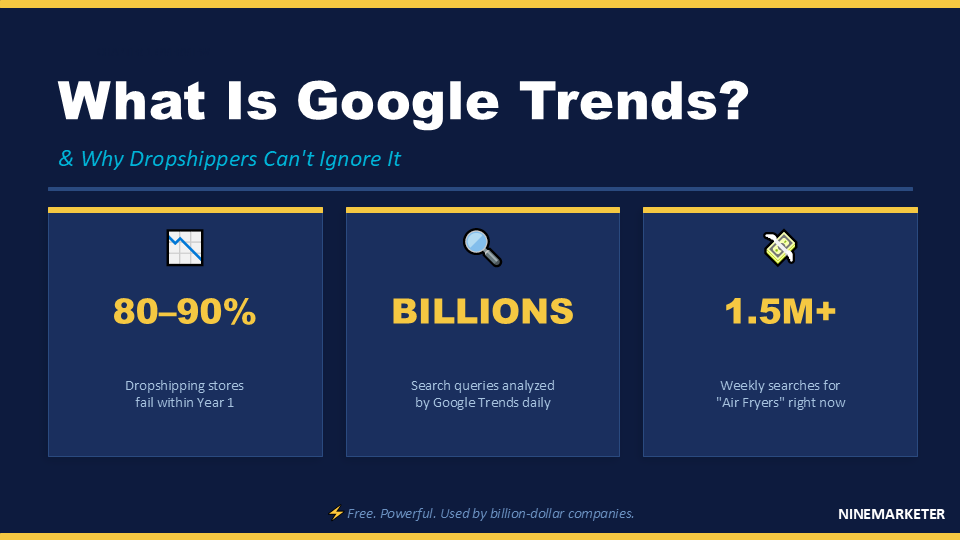
Think of it like having a crystal ball, except it’s backed by billions of actual search queries from real shoppers.
You can see if interest in “fidget rings” is spiking or if “air fryers” are still hot
(spoiler: they are, with almost 1.5 million weekly searches).
Here’s the thing that blows most people’s minds: search volume actually predicts purchasing behavior.
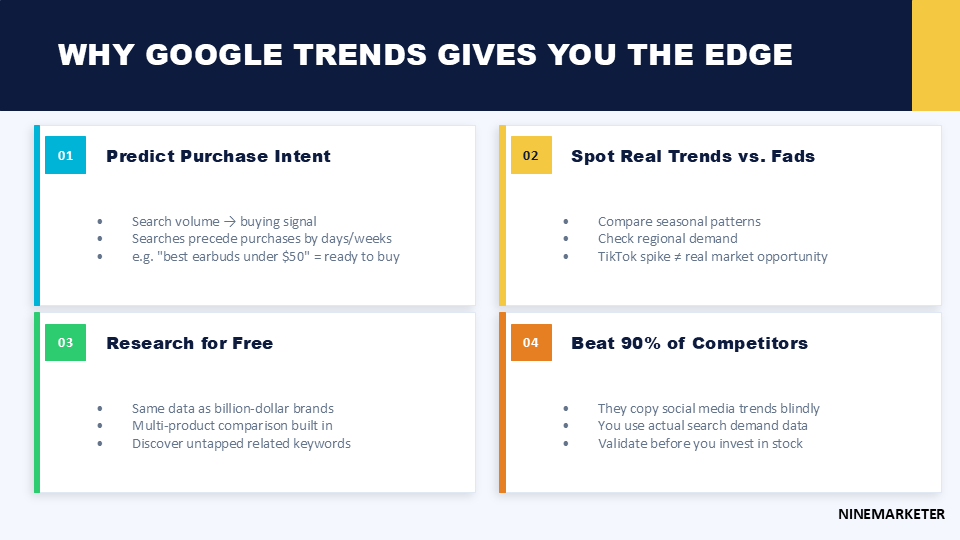
Studies have shown that what consumers search for online can forecast their buying decisions days or even weeks in advance.
When someone’s googling “best wireless earbuds under $50,” they’re not just browsing, they’re getting ready to buy.
The real advantage?
You’re getting real-time insights while your competitors are still guessing.
Most dropshippers make the mistake of thinking any upward trend means instant profit.
Wrong.
You’ve gotta dig deeper and look at seasonal patterns, regional interest, and whether that spike is from actual buyers or just people being curious about some viral TikTok moment.
Google Trends shows you the difference between a fad that’ll die in two weeks and a genuine market opportunity.
Another misconception is that you need fancy paid tools to do product research.
While premium software has its place, Google Trends gives you access to the same search data that billion-dollar companies use, for free.
You can compare multiple products, see which regions are most interested, and even discover related search terms you hadn’t thought about.
The competitive edge comes down to this:
When you base your product selection on actual search demand rather than gut feelings,
You’re already ahead of 90% of dropshippers who are just copying whatever’s trending on their social media feed.
You’re making decisions based on what thousands of potential customers are actively looking for right now.
Smart dropshippers check Google Trends before adding any product to their store.
They validate demand, identify the best time to launch, and avoid saturated markets.
That’s the difference between building a business and hoping for luck.
Setting Up Google Trends for Dropshipping Product Research
Getting started with Google Trends is stupid simple.
You literally just head to trends.google.com and boom
The interface loads instantly. No signup, no credit card, nothing.
But here’s where most dropshippers mess up: they don’t take five minutes to actually understand what they’re looking at.
The homepage shows you three main sections.
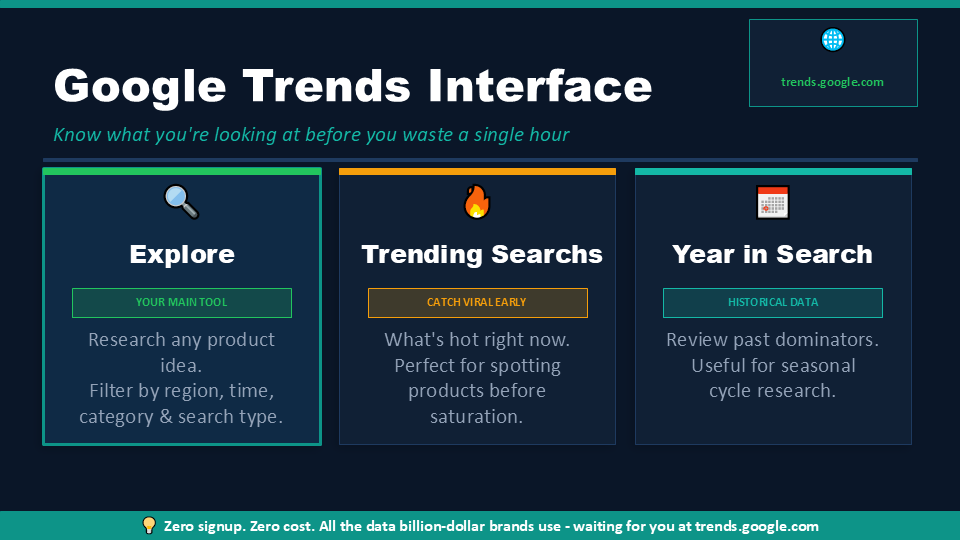
First up is Explore, that’s your workhorse for product research.
Then you’ve got Trending Searches showing what’s hot right now (perfect for catching viral products early).
Year in Search is more for looking back at what dominated in past years.
For dropshipping, you’re gonna live in that Explore section.
Type in your product idea and pay attention, when the dropdown appears, you’ll see “Search term” at the top and “Topic” below it.
Always choose the topic option when available.
Topics pull in misspellings, acronyms, and different languages automatically, giving you way more accurate data.
Now here’s what separates amateurs from people who actually make money: customizing your filters.
See those dropdown menus at the top?
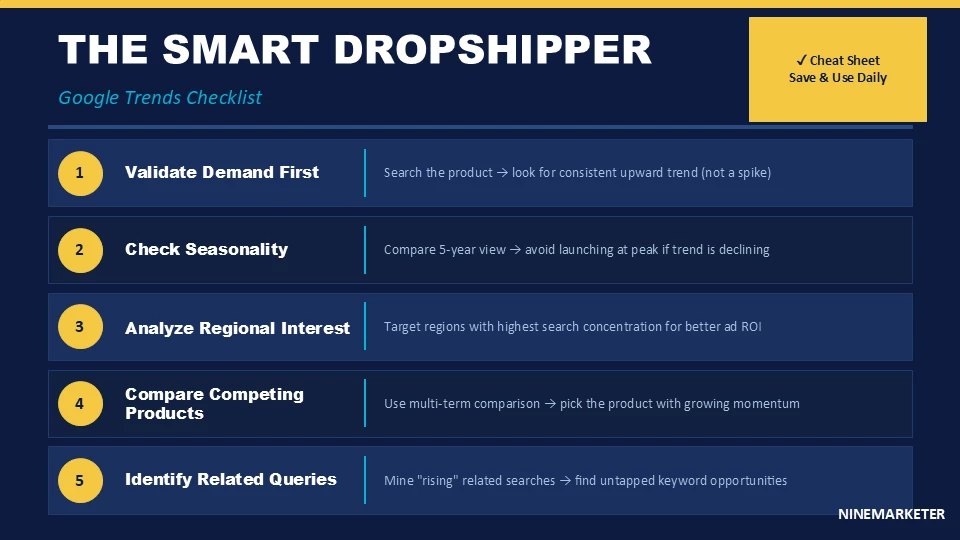
Change your location from “Worldwide” to your target market, United States, United Kingdom, wherever you’re selling.
Research shows 84% of ecommerce retailers say finding good products is their biggest obstacle, and half the battle is knowing where demand actually exists.
Time range matters too.
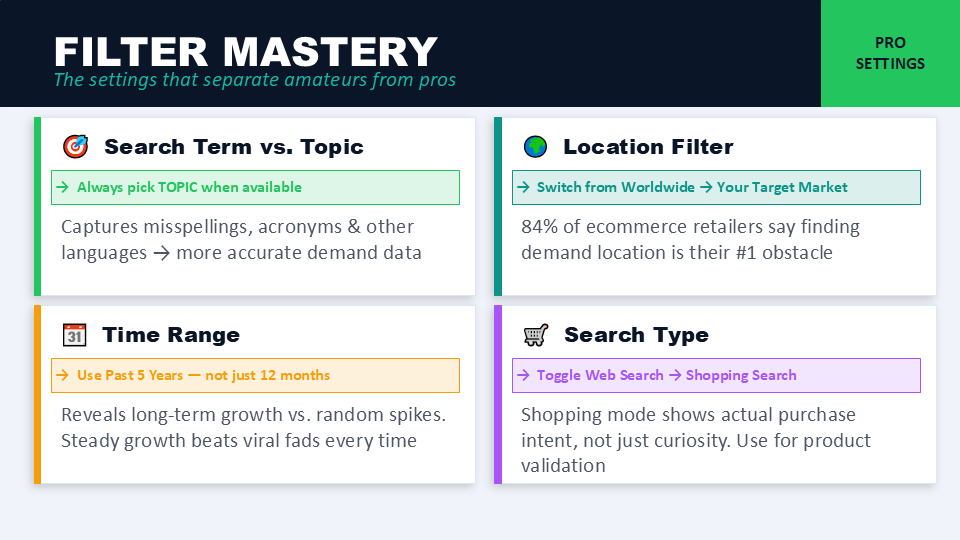
Don’t just stick with the default 12 months. Check “Past 5 years” to spot long-term trends versus temporary fads.
A product with steady growth beats one with a random spike any day.
The comparison feature is killer for validating products.
Click that “+ Compare” button and add up to five products side-by-side.
You can instantly see which one has stronger demand.
For example, compare “resistance bands” versus “yoga mats” versus “foam rollers” to figure out which fitness product deserves your attention first.
Don’t sleep on the Category and Search Type filters either.
If you’re researching “jaguar,” you better specify whether you mean the car or the animal.
The Web Search option works for most dropshipping research, but toggle to Shopping if you wanna see actual purchase intent.
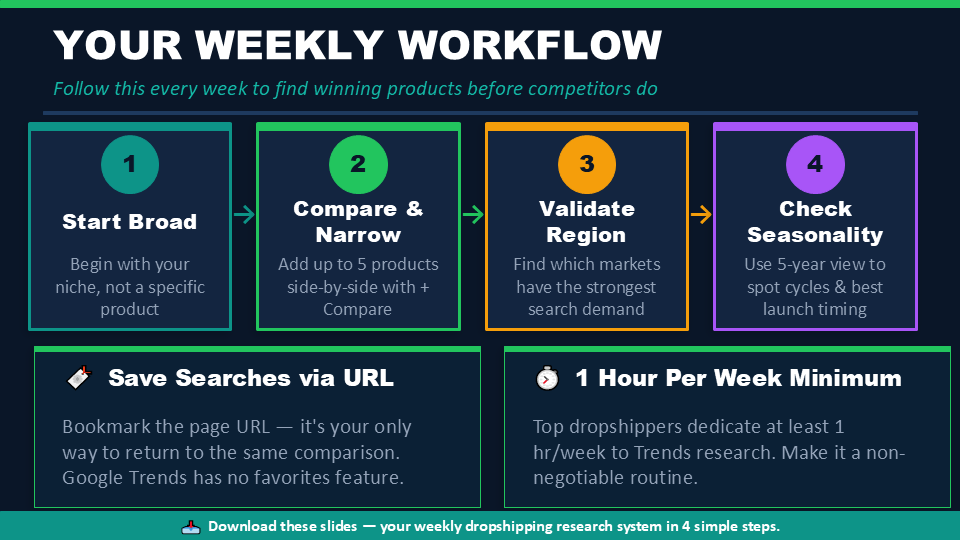
Here’s your workflow:
Start broad with a niche, narrow down to specific products using comparisons, validate with regional data, then check different time periods for seasonality.
Save your searches by bookmarking the URL, Google Trends doesn’t have a “favorites” feature, so that URL is your only way back to the exact same comparison.
Most successful dropshippers spend at least an hour weekly just exploring trends in their niche. Make it routine.
How to Interpret Google Trends Data Like a Pro
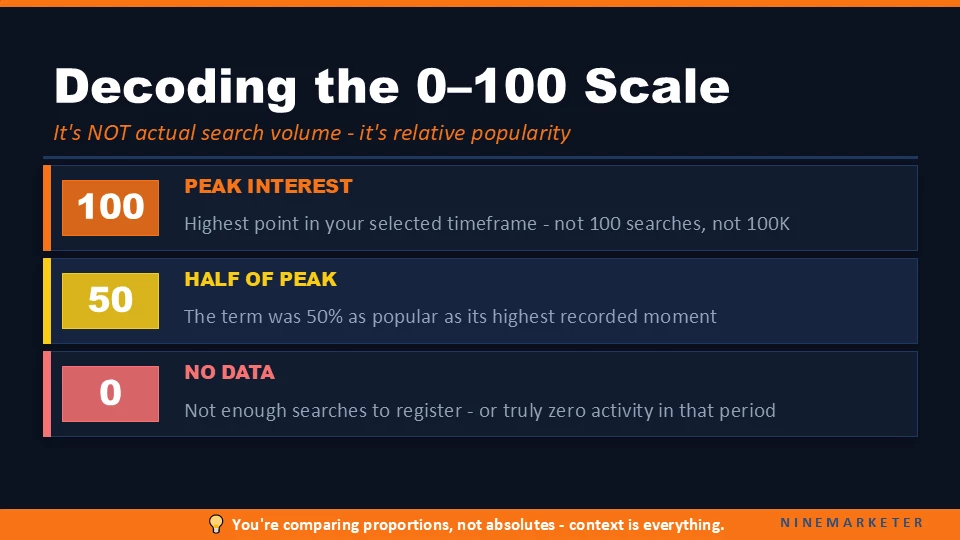
Here’s what trips up most beginners: that 0-100 scale isn’t showing you actual search numbers. It’s relative popularity.
When you see “100” on the graph, that’s the peak interest for your selected timeframe, not 100 searches, not 100 thousand searches.
A score of 50? That means the search term was half as popular compared to its peak moment.
Zero means there wasn’t enough data or barely any searches happened.
This matters because you’re comparing proportions, not absolutes.
If “wireless earbuds” hits 100 in December and drops to 38 in February, that February number represents 38% of December’s peak interest.
The actual search volume could still be massive, just smaller relative to the holiday surge.
Seasonal patterns are where the money’s at. Peak ecommerce months can see up to 46 percentage points difference between high and low periods.
November crushes it with 29% more orders than average, while February tanks at 17% below average.
That’s not subtle, your best month could literally do double what your worst month does.
Look for products with steady year-over-year growth instead of random spikes.
Christmas decorations will spike every December, that’s predictable seasonality you can plan around.
But if “fidget spinners” exploded from zero to 100 in three months then crashed back down? Classic fad territory.
The difference between fads and trends comes down to staying power.
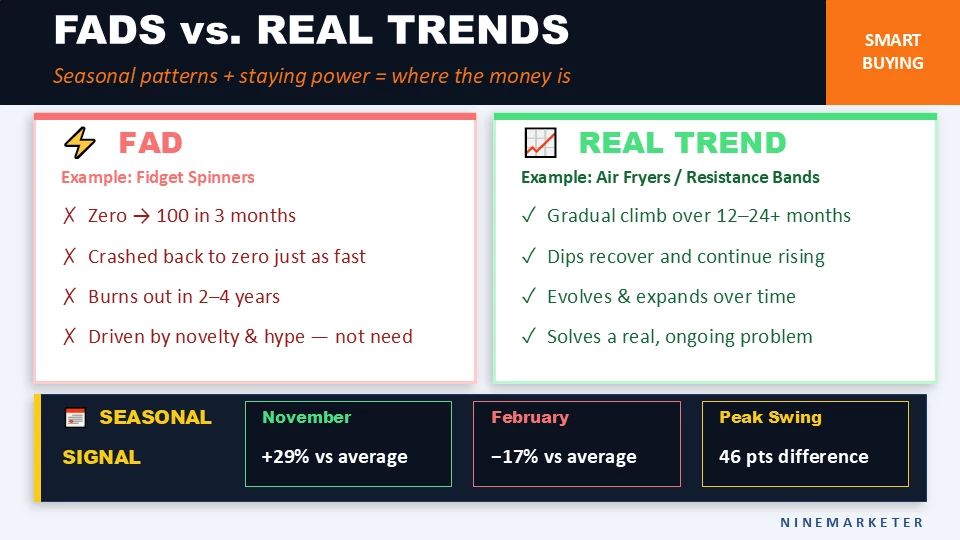
Fads typically burn out within two to four years, while trends evolve gradually over longer periods.
Check the Past 5 Years view in Google Trends.
Does interest keep climbing with occasional dips, or did it spike once and die?
Trends solve real problems. Fads rely on novelty and hype.
Here’s your golden window: catch emerging trends when they’re at 20-40 on the scale and climbing steadily month after month.
That’s early enough to get in before saturation, but validated enough that you’re not gambling on pure speculation.
If you spot something at 5 starting to tick upward consistently, you might be looking at the ground floor of the next big thing.
Regional interest data is criminally underused. Scroll down past that main graph and check “Interest by region.”
You might discover that “air fryers” are maxing out in the Northeast but barely registering in the Southwest.
That’s your untapped market right there.
Some dropshippers make their entire strategy around finding products with strong demand in one region but zero presence in others.
Don’t ignore the Related Queries section at the bottom. Toggle between “Top” and “Rising” searches.
Rising queries with “Breakout” tags? Those jumped over 5,000% in search growth, people are suddenly obsessed.
You’ll find product variations, related accessories, and complementary items you hadn’t even considered.
Someone searching “resistance bands” might also be looking for “door anchor resistance bands” or “fabric resistance bands vs latex.”
Now you’ve got three product ideas instead of one.
The key is connecting the dots.
High search volume + steady growth + low competition in certain regions + rising related queries = that’s your signal to move.
One piece of data means nothing. All four together? That’s when smart dropshippers place their bets.

Finding Trending Products Using Google Trends Search Strategies
The biggest mistake new dropshippers make?
Diving straight into specific products without understanding the broader niche first.
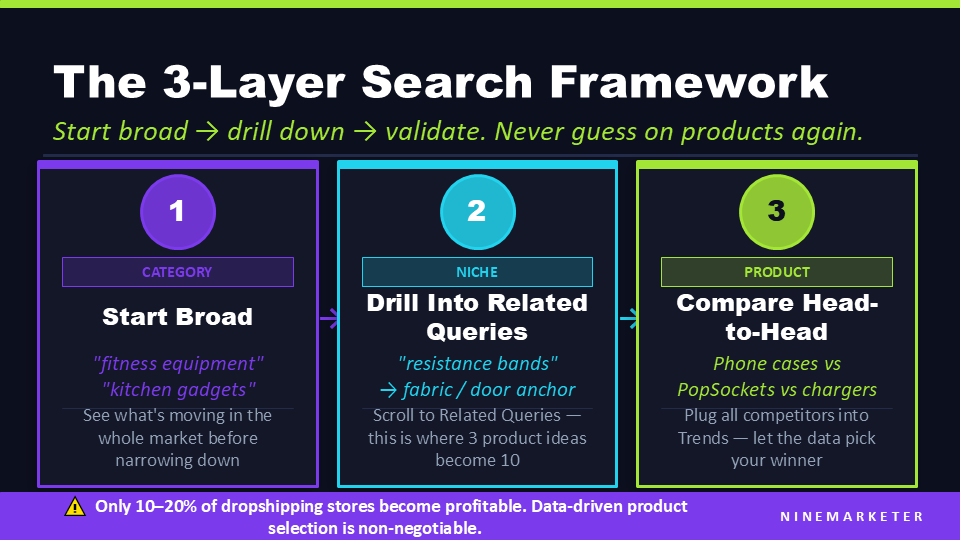
With only 10-20% of dropshipping stores becoming profitable, you can’t afford to guess.
Start with category-level searches like “fitness equipment” or “kitchen gadgets” to see what’s actually moving in the market.
Once you’ve got your broad category, scroll down to those Related Queries and Topics sections.
This is where the real gold’s hiding.
Most dropshippers completely ignore this feature and miss out on product variations they never would’ve thought of.
Someone searching “resistance bands” might lead you to discover “fabric resistance bands” or “resistance band door anchor”
Boom, three different product opportunities from one search.
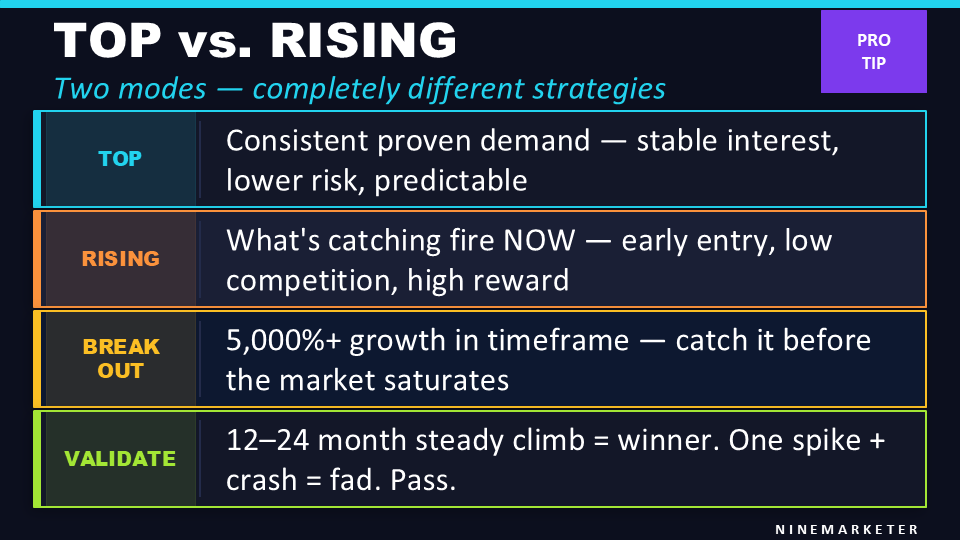
Here’s where it gets interesting: toggle between “Top” and “Rising” queries.
Top shows consistent demand, but Rising reveals what’s catching fire right now.
When you see “Breakout” next to a search term, that means it grew over 5000% in the selected timeframe.
That’s explosive growth, and if you catch it early, you’re getting in before the market gets saturated.
But don’t just chase shiny objects.
Compare your product ideas head-to-head using that comparison feature.
If you’re torn between selling phone cases, PopSockets, or wireless chargers, plug all three into Google Trends and let the data decide.
The one with steady upward movement over 12-24 months?
That’s your winner. Random spikes with quick crashes? Pass.
Validation is everything.
Look for products showing consistent month-over-month growth, not just one viral moment.
Check the Past 5 Years view to separate actual trends from temporary fads.
A genuine trend will show gradual increases with minor seasonal dips.
A fad hits 100 and drops to 15 within six months.
Now combine your Google Trends research with other tools to build a complete picture.
Cross-reference with Amazon Best Sellers to see if search interest matches actual sales.
Check AliExpress for supplier availability and pricing.
Use Google Keyword Planner to verify search volumes and CPC rates.
Peek at Facebook Ad Library to scope out competition and see who’s already advertising similar products heavily.
The smartest dropshippers don’t rely on one tool alone.
They triangulate data: high Google Trends interest + rising Amazon sales rank + reasonable supplier pricing + manageable ad costs = viable product.
Miss any piece of that equation and you’re gambling instead of building a business.
Set aside a few hours each week specifically for product research.
Make it routine.
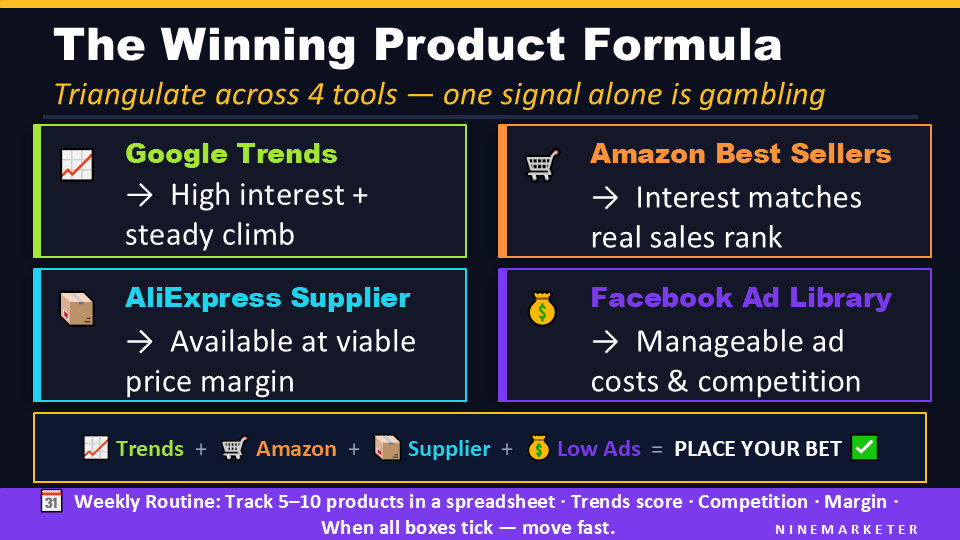
Track 5-10 potential products in a spreadsheet with their Trends scores, competition levels, and profit margins.
When one ticks all your boxes and shows that steady climb, move fast before everyone else catches on.
Identifying Winning Dropshipping Products: Key Indicators to Look For
The pattern you’re looking for?
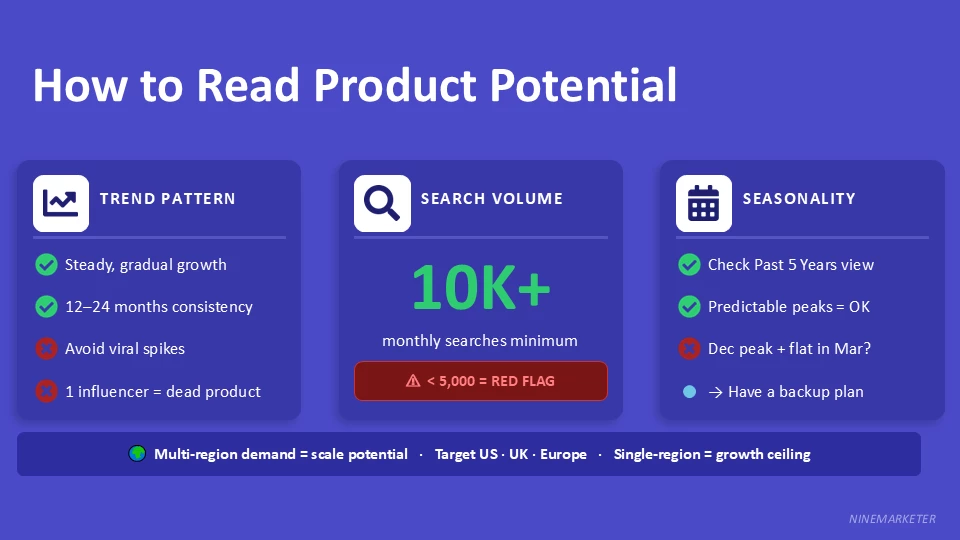
Steady, gradual growth, not those crazy vertical spikes that look exciting but crash just as fast.
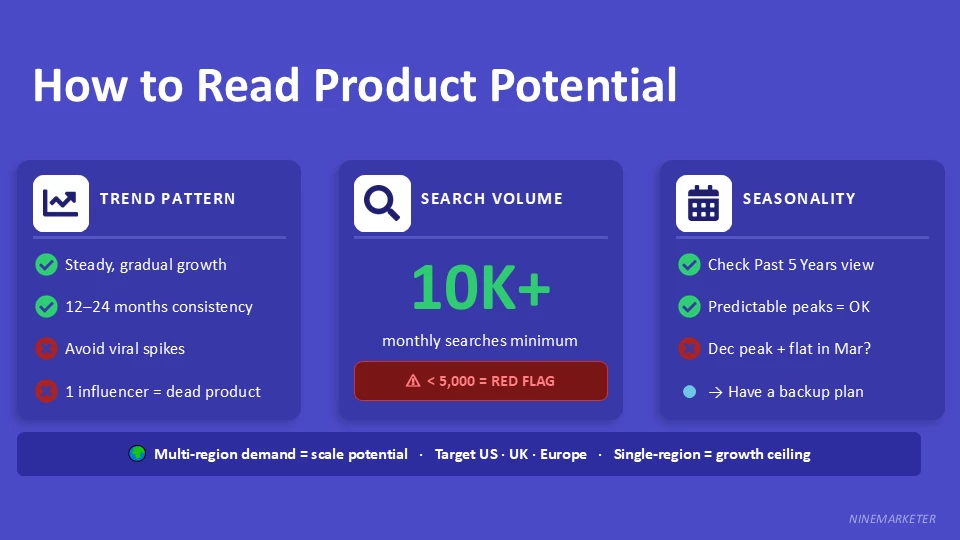
A product showing consistent month-over-month increases over 12-24 months beats a viral moment every single time.
Those sudden jumps usually mean one influencer mentioned it, and once the hype dies, you’re stuck with a dead product.
Search volume matters more than most beginners realize.
You need at least 10,000 monthly searches for your main keyword to have enough demand.
Anything below 5,000?
That’s red flag territory where the market’s just too small to build a sustainable business.
Think about it, if only a few hundred people per month are searching for your product, even a killer conversion rate won’t save you.
Now let’s talk seasonality because this trips up so many dropshippers.
Check that Past 5 Years view and look for products with demand spikes in specific months.
Christmas decorations, Halloween costumes, beach gear, these follow predictable patterns.
The problem isn’t seasonal products themselves. The problem is treating them like year-round cash cows.
If your product peaks in December and flatlines by March, you better have a plan for those lean months or a completely different product line ready.
Here’s where it gets tricky: most dropshippers operate with profit margins between 15-20%, and you need at least 10% minimum just to stay afloat.
High-performing stores can push 30%, but beginners need to be realistic.
If you’re sourcing a product for $15 and can only sell it for $20 after checking competitor pricing, those thin margins get eaten alive by ads, platform fees, and shipping issues.
Always aim for products where you can maintain at least 20% margins while staying competitive.
Red flags are everywhere if you know what to look for.
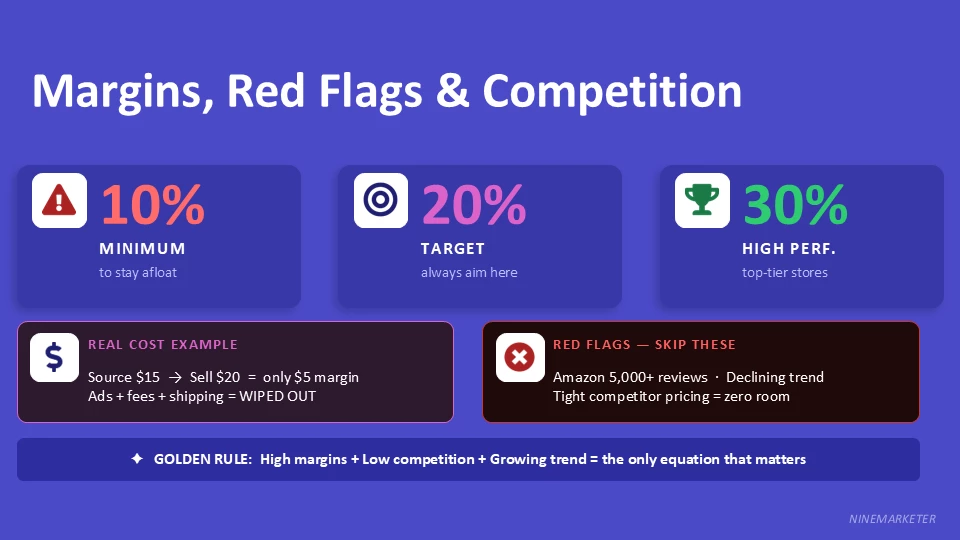
A product with massive search interest but Amazon listings showing 5,000+ reviews and tight pricing? Pass.
That market’s saturated, and you’ll be competing against established brands with deep pockets.
Also watch for products with declining trends over multiple years, that’s not a seasonal dip, that’s a dying market.
Geographic concentration can work both ways.
Products with strong demand in one specific region might signal an opportunity to expand into untapped markets.
But products that only work in tiny pockets?
That limits your growth potential.
You want products showing interest across multiple regions, or at minimum, concentrated demand in large markets like the US, UK, or Europe where you’ve got millions of potential customers.
The real winners cross-reference everything.
High Google Trends interest means nothing if profit margins are garbage.
Strong margins don’t matter if competition’s crushing you on price.
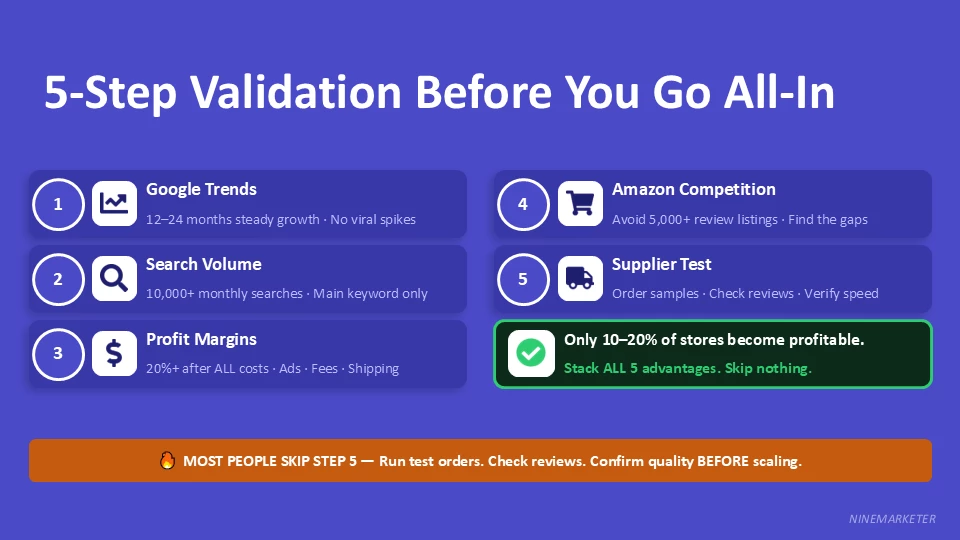
With only 10-20% of dropshipping stores becoming profitable, you’ve gotta stack every advantage in your favor.
Check trends, validate search volume, calculate real profit margins after all costs, scope out Amazon competition, and verify your supplier can actually deliver consistent quality.
Most people skip that last step and regret it later.
A product trending up with decent margins still fails if your supplier ships broken items or takes three weeks to fulfill orders.
Run test orders yourself. Check reviews. Make sure the whole equation works before going all-in.
Avoiding Dropshipping Product Mistakes with Google Trends
Nobody wants to invest money and time into a product that’s already dying.
Google Trends shows you exactly when to walk away from a product before it drains your wallet.
Pull up that Past 5 Years view and watch for downward slopes that keep trending lower month after month.
If a product peaked two years ago and has been steadily declining ever since, that’s not a temporary dip, that’s a death spiral.
You’ll be fighting an uphill battle trying to sell something people are actively losing interest in.
Market saturation is brutal.
With over 28 million ecommerce sites globally competing for attention, you need to spot when a market’s already too crowded.
High search volume sounds great until you realize 10,000 other dropshippers are selling the exact same product from the exact same supplier.
Check how many Amazon results pop up when you search your product.
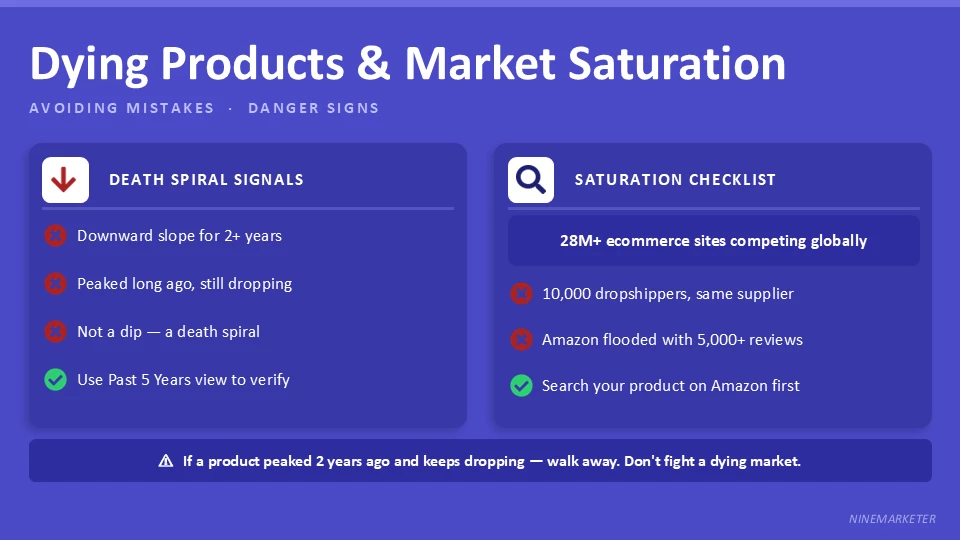
Thousands of listings with established reviews?
That market’s saturated, and you’re not breaking through without serious advertising budgets.
Here’s where beginners get wrecked: one-hit wonders.
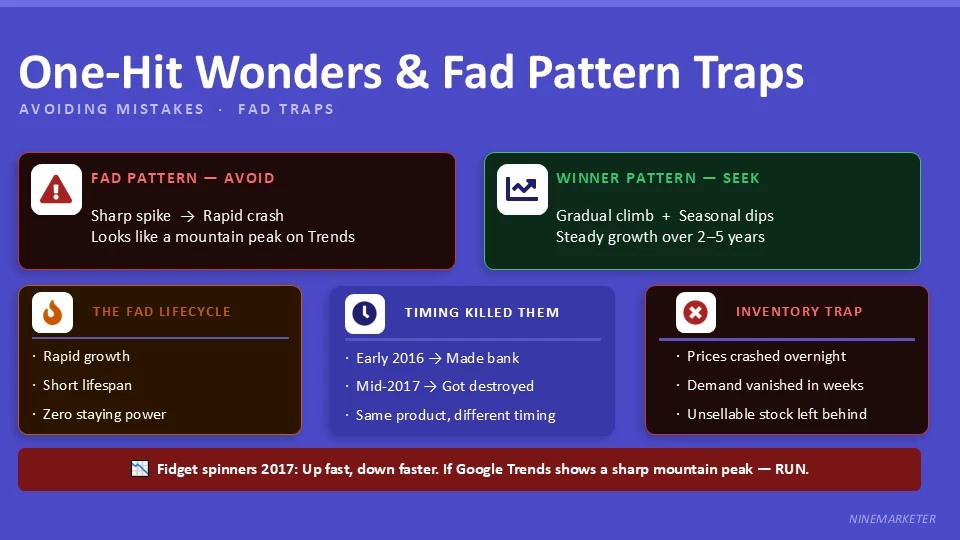
Remember fidget spinners in 2017?
They exploded from nowhere, hit peak popularity within months, then crashed spectacularly.
Google Trends showed that bell curve perfectly, a rapid spike followed by a nosedive.
Most people got stuck with unsellable inventory as prices crashed and demand vanished almost overnight.
That’s classic fad behavior: rapid growth, short lifespan, zero staying power.
The pattern you wanna avoid looks like a sharp mountain peak on Google Trends. Up fast, down faster.
Products with staying power show gradual climbs with seasonal variations, not vertical rockets followed by cliffs.
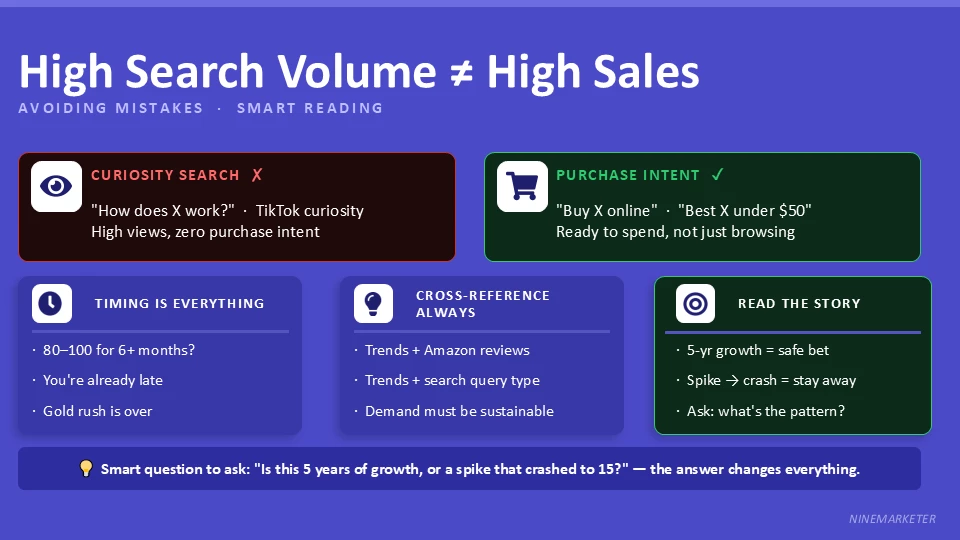
Now here’s the kicker that confuses everyone: high search volume doesn’t automatically mean high sales.
Sometimes massive search interest comes from people just being curious about a viral TikTok video, not actual buyers ready to purchase.
You need to cross-reference Google Trends with other signals.
Check if there’s actual commercial intent behind those searches.
Are people searching “how does X work” or “buy X online”? One’s curiosity, the other’s purchase intent.
Timing is everything.
Following trends too late is like showing up to a party after everyone’s already left.
By the time you’ve set up your store, sourced your suppliers, and launched your ads, the trend’s already peaked and everyone’s moving on to the next thing.
If Google Trends shows a product’s been at 80-100 for six months straight, you’re late.
The gold rush already happened, and you’re just picking through leftovers in an oversaturated market.
The fidget spinner disaster taught dropshippers a harsh lesson.
People who jumped on it early in 2016 made bank.
Those who waited until mid-2017 when it was everywhere got destroyed.
Dozens of stores launched overnight, competition drove prices into the ground, and within months the entire market collapsed.
Google Trends would’ve shown you that danger, the spike was too sharp, the decline too brutal.
Another famous failure was the “as seen on TV” gadgets that went viral on social media.
Google Trends showed massive spikes, but the data also revealed something critical: searches dropped off a cliff after 4-6 weeks.
Dropshippers who went all-in on these products watched their sales vanish once the viral moment ended.
The search volume was high but temporary, with no underlying sustainable demand to support a real business.
Smart dropshippers look at Google Trends data and ask: “What’s the story here?”
A product showing five years of gradual growth tells one story.
A product spiking to 100 then crashing to 15 in three months tells a completely different, much scarier story.
Learn to read those patterns before committing your money.
Advanced Google Trends Techniques for Competitive Advantage
Most dropshippers stick with basic web search and miss out on some seriously powerful filters that separate professionals from amateurs.
Once you’ve mastered the basics, it’s time to dive into advanced techniques that give you a real competitive edge.
YouTube search trends reveal products before they blow up everywhere else.
Over 2.1 billion people worldwide use YouTube to watch product reviews, unboxings, and tutorials.
When you toggle from “Web Search” to “YouTube Search” in Google Trends, you’re tapping into what people are actively researching and getting excited about.
Someone searching “best budget wireless earbuds” on YouTube isn’t just curious, they’re in that pre-purchase research phase, watching reviews and comparison videos.
That’s your signal to jump in before the product saturates web search.
YouTube often indicates educational interest while web search shows broader awareness, so you can catch trends in their early stages.
Now here’s where it gets interesting: Google Shopping trends show actual buyer intent, not just browsing.
Over 60% of Shopping and Apparel searches show broad intent where people explore different products and styles.
Switch that filter to “Shopping” and you’re cutting out casual curiosity searches, focusing only on queries with purchase intent.
If something’s trending on Google Shopping, those people have their wallets out.
They’re past the research phase and actively comparing prices and options.
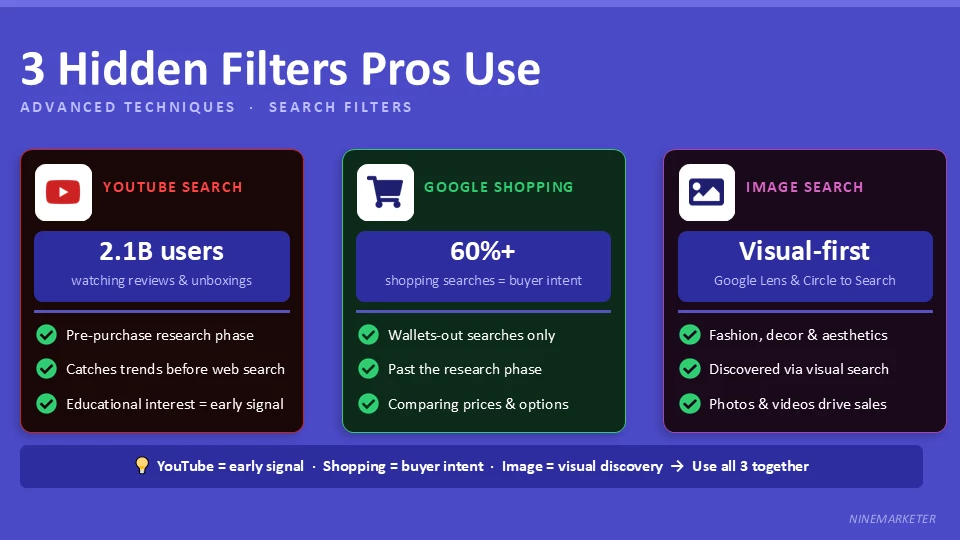
Image search data matters for visually-driven products like fashion, home decor, and anything aesthetic.
People search with their cameras now using Google Lens and Circle to Search features.
If your product category relies heavily on visual appeal, think wall art, clothing patterns, furniture styles.
Checking image search trends helps you understand what aesthetics are capturing attention.
Products that look good in photos and videos get discovered through visual search more than traditional keyword searches.
Comparing your niche against related niches reveals market dynamics you’d otherwise miss.
Maybe “resistance bands” are trending up while “dumbbells” are trending down.
That tells you people are shifting toward home workouts that don’t require bulky equipment.
Or you discover “standing desks” are climbing while “office chairs” stay flat,
Boom, you’ve identified a market shift toward ergonomic home office setups.
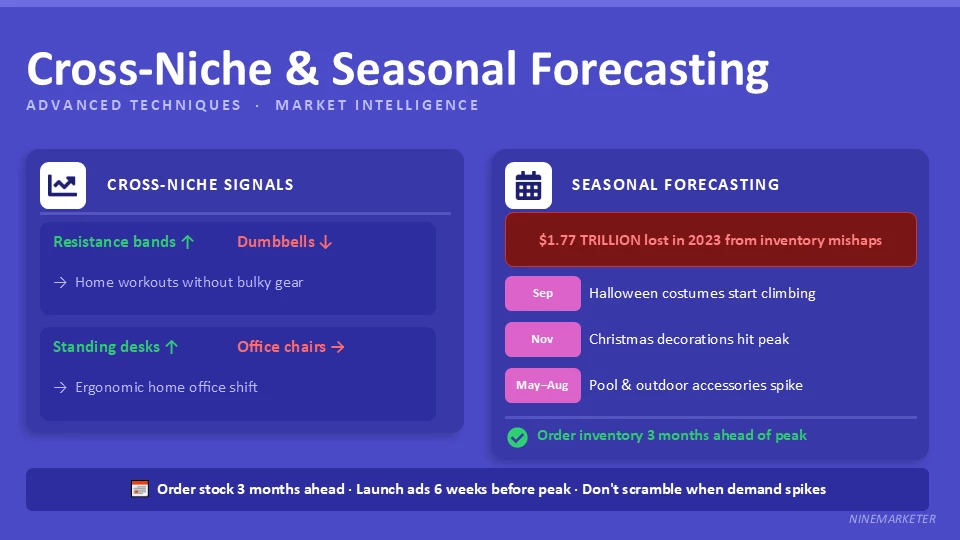
These cross-niche comparisons help you understand broader consumer behavior patterns instead of just staring at one product in isolation.
Seasonal forecasting is make-or-break for inventory planning.
Retailers lost $1.77 trillion in 2023 due to inventory mishaps, that’s not a typo.
Look at the Past 5 Years view in Google Trends and identify when your products peak.
Swimming pool accessories spike every May through August.
Christmas decorations hit peak interest in November. Halloween costumes start climbing in September.
Peak ecommerce months can see up to 46 percentage points difference between high and low periods.
You can spot patterns like a manufacturer might see a consistent 30% spike each October through January for winter products.
Map out these patterns and plan your supplier orders three months ahead of the peak.
Start marketing campaigns six weeks before seasonal spikes hit.
Most dropshippers wait until they see demand spiking in real-time, then scramble to find stock, by which point suppliers are sold out or shipping times have doubled.
Smart seasonal planning means placing your inventory orders when everyone else is still asleep, so you’re fully stocked when the buying frenzy starts.
The competitive advantage comes from stacking these techniques together.
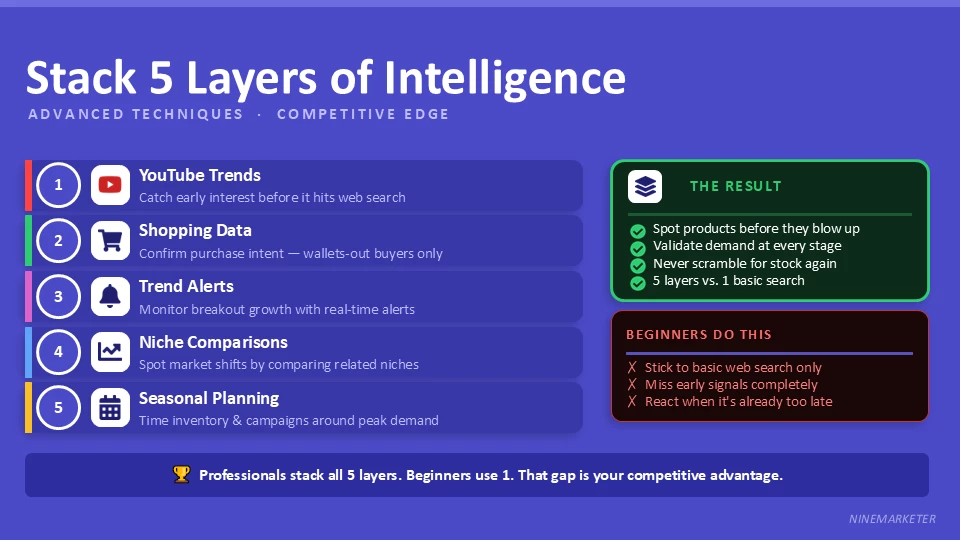
Track YouTube trends to catch early interest, validate with Shopping data to confirm purchase intent, set up alerts to monitor breakout growth, compare against related niches for context, and use seasonal forecasting to time your inventory perfectly.
That’s five layers of intelligence working together instead of relying on one basic search.
Conclusion
Mastering Google Trends isn’t just about finding products
It’s about developing a data-driven mindset that separates successful dropshippers from those who struggle.
I’ve shown you the exact strategies I use to identify winning products, from interpreting trend patterns to avoiding costly mistakes.
The beauty of Google Trends is that it’s completely free and accessible to everyone, which means you have the same tools as the big players!
Here’s the truth: the products you choose will make or break your dropshipping business.
By leveraging Google Trends consistently, you’re no longer gambling on inventory
You’re making informed decisions backed by real search data from millions of potential customers.
Ready to find your next winning product?
Start by opening Google Trends right now and searching for products in a niche you’re passionate about.
Look for those steady upward trends, check the related queries, and validate your ideas before committing.
Your future best-seller is waiting to be discovered in the data!
Don’t forget to bookmark this guide and revisit these strategies regularly
Product research should be an ongoing part of your dropshipping routine.
Now go out there and find those winning products!
Your successful dropshipping store starts with the right product selection, and you now have the blueprint to make it happen.